In a sprawling e-commerce warehouse near Berlin, robots powered by artificial intelligence are packing, picking, and sorting items at speeds that surpass human capabilities. Designed to handle over 600 units per hour, these machines autonomously identify each item’s nature, size, shape, and weight, then optimise their handling. The technology, developed by the Polish startup Nomagic, is part of a broader European push to recast logistics for the continent’s volatile e-commerce market.
“The robots work 24/7. So if you’re comparing robots with humans, they don’t need to take breaks. They can keep going, and they’re basically consistent,” explains Nitin Annam, Head of Operations at CEVA Logistics, which runs the facility in Großbeeren, just south of Berlin. “It’s not necessarily about replacing people with automation. It’s more about how we produce more volume at a cheaper cost and be more efficient.”
Why European Retailers Are Turning to Robotics
Online fashion retailer ASOS uses this distribution centre as its main hub in continental Europe. Klaus Lichtenfeld, Head of Logistics for the European Union at ASOS, says the volatility of e-commerce makes traditional staffing difficult. “Our e-commerce business is very volatile. This makes it very difficult to plan the staff properly,” Lichtenfeld notes. “The advantage of robots is that they’re always there and can easily help us cope with volume spikes.” Without such AI-driven solutions, he argues, many e-commerce business models would no longer be viable.
The robotic system has been engineered and tested by Nomagic, a company with 140 employees based in Warsaw, Poland. Engineers there have developed cloud-based AI that allows robots to learn from every pick. “When the robot is working, we collect all the metrics we can, all the readings from all the sensors, all the images of every single bin that the robot would see,” says Ewa Maciaś, Director of Software Engineering & User Experience at Nomagic. “And we use this data to train the machine learning model and adjust it further. The robots can adapt to new items that it sees for the first time, and to different shapes, sizes and kinds of items.”
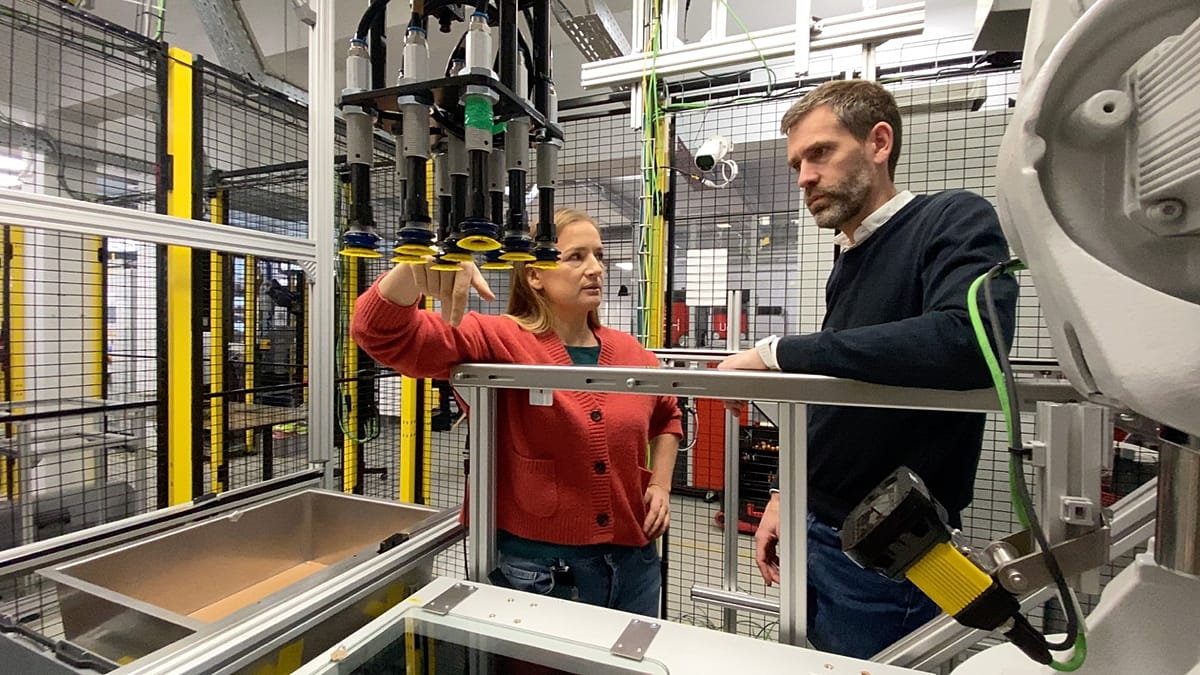
One of the toughest challenges is designing the “robotic hands” — the pickers that must handle a wide variety of items, from plastic wrapping to shoeboxes. “You have the lid of the shoe box, the bottom of the shoe box and the item inside,” explains mechatronics design engineer Mateusz Karolak. “Picking only the lid, for example, doesn’t count as success. You need to pick the whole item and make sure that it will stay together without separating.”
Nomagic has reported tripling its business volume and client base — including major retailers — in recent years. In 2025, the company announced it had secured approximately €50M in investment to drive AI innovation in robotics. Both developers and end users say they are mindful of the social impact of this rapid automation. “The robot still requires some maintenance. We’re working together with our clients on educating their staff,” says Kacper Nowicki, Nomagic’s CEO. “And we’ve seen cases where the employees take pride in working in a more advanced, higher tech environment rather than performing a lot of very manual tasks.”
Lichtenfeld is emphatic that a fully automated warehouse is not on the horizon. “A humanless warehouse is impossible. That will never work. So there will always be human employees, people working in a warehouse.” Annam echoes that sentiment: “We’re not necessarily replacing man with machine. It’s more about creating harmony and moving forward.”
This European approach to AI-driven logistics contrasts with some narratives from outside the continent, where automation is often framed as a direct threat to jobs. Here, the emphasis is on augmentation and resilience — a strategy that may prove crucial as Europe faces demographic shifts and energy market disruptions. For more on how the EU is adapting its economic policies, see EU Relaxes State Aid Rules to Shield Businesses from Middle East-Driven Energy Crisis. Meanwhile, the integration of AI into manufacturing is also advancing, as demonstrated by Siemens and Nvidia’s test of a humanoid robot in a German factory. The broader trend of AI-driven profit surges is visible across sectors, as seen in Intel’s recent earnings beat.