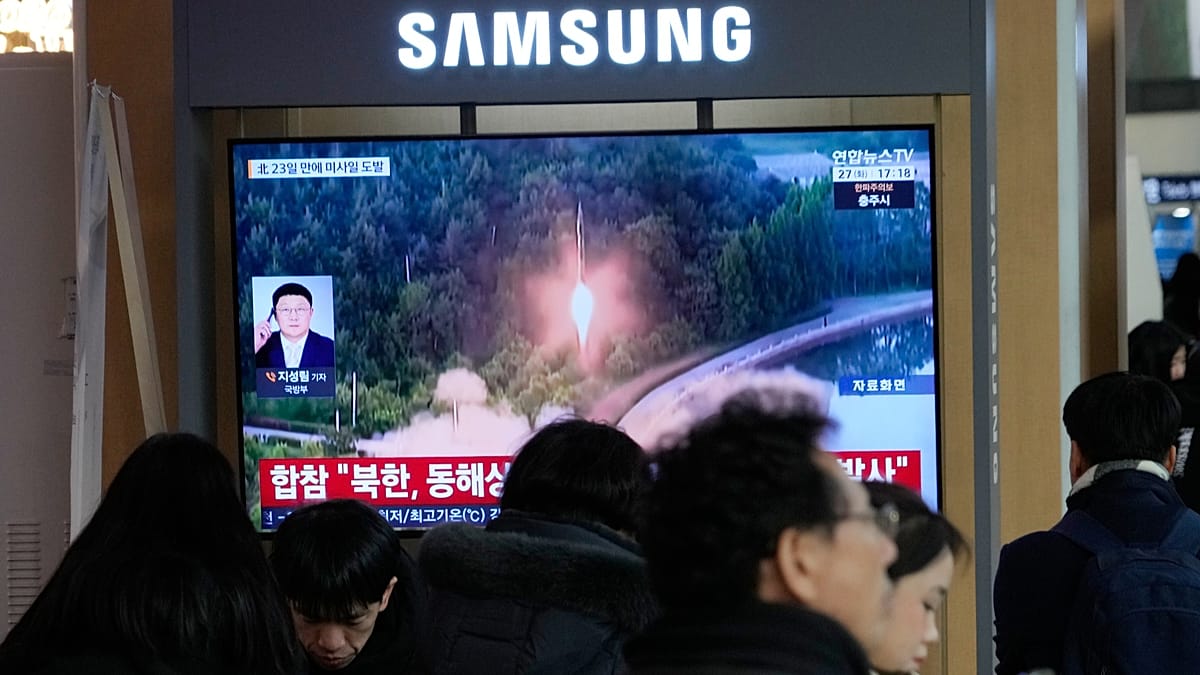
North Korean leader Kim Jong-un has personally overseen the test of a new weapon system, state media reported on Tuesday, describing it as a demonstration of the country's rapidly advancing military capabilities. The announcement came just two days after South Korea and Japan reported that Pyongyang had launched two short-range ballistic missiles into the waters off its eastern coast, a move both governments condemned as a threat to regional stability.
The official Korean Central News Agency (KCNA) said the country's missile bureau "successfully tested a new type of weapon" on Sunday, with Kim in attendance. While Pyongyang did not specify the nature of the system, Kim was quoted as praising the launch as "undoubtedly a striking demonstration of ultra-modern defence technology." He warned that the advances would give adversaries "an incurable headache and a very cruel and unavoidable blow."
Escalating provocations
Sunday's test followed a similar launch eight days earlier, when North Korea fired multiple short-range ballistic missiles toward the East Sea, also known as the Sea of Japan. That exercise, which Pyongyang later described as a joint firepower drill, involved long-range artillery and missiles that state media claimed "hit the targets with 100 percent accuracy."
The latest activity has heightened concerns in Seoul and Tokyo. South Korea's government condemned the launches as a violation of United Nations Security Council resolutions and urged Pyongyang to cease its ballistic missile activities. Japan lodged a "stern protest," calling the launches a threat to regional peace and security.
Kim linked Sunday's test to the country's broader military preparedness, saying that acquiring such technology "is of weighty significance in the state's readiness for war and the future development of the armed forces."
Nuclear status enshrined in law
The tests come amid a broader consolidation of North Korea's nuclear posture. The country has legally enshrined its status as a nuclear-armed state, with its leadership repeatedly declaring the atomic arsenal permanent and irreversible. Last week, Pyongyang rejected a resolution adopted at the International Atomic Energy Agency demanding it halt its nuclear activities, with a foreign ministry spokesperson saying the resolution "has no effect on the DPRK's position as a nuclear weapons state."
Kim Yo-jong, the leader's powerful sister, recently described the country's nuclear-armed status as "absolute" and dismissed those hoping for denuclearisation as "idiots."
The developments are being closely watched in Europe, where concerns about nuclear proliferation and regional security remain high. The European Union has repeatedly called on North Korea to engage in dialogue and to abandon its weapons programmes, but Pyongyang has shown little interest in resuming talks. The latest tests also come as South Korea's president has urged the United States to keep channels of communication open with the North, underscoring the diplomatic fragility in the region.
Analysts note that the timing of the tests, so soon after the previous launch, suggests a deliberate strategy to assert military dominance and to pressure regional neighbours. The lack of a specific description of the new weapon has also fuelled speculation about its nature, with some experts suggesting it could be a hypersonic glide vehicle or a new type of cruise missile.
For now, the international community remains on edge, with the UN Security Council yet to respond to the latest provocations. The United States, which has troops stationed in South Korea and Japan, has not issued an official statement on the Sunday test, but previous launches have drawn warnings of further sanctions.
As North Korea continues to advance its weapons programmes, the risk of miscalculation grows. The region's stability, already fragile, depends on a careful balance of deterrence and diplomacy. For Europe, the situation serves as a reminder of the global nature of nuclear threats, and the need for a coordinated international response.