European equity markets opened lower on Friday, tracking losses on Wall Street, as investors weighed the implications of Jensen Huang's abrupt resignation from Nvidia for the global artificial intelligence sector. The FTSE 100 in London slipped 0.2% at the open, while benchmark indices in Paris and Frankfurt each fell 0.3%. US stock futures also pointed to a weaker start, with the tech-heavy Nasdaq 100 edging down.
Huang, who co-founded Nvidia and became the public face of the AI boom, stepped down as president, chief executive, and board member with immediate effect on Thursday. The announcement followed reports of two personal affairs, one involving a woman suspected of spying for China, which raised national security concerns in Washington. Nvidia's long-serving chief financial officer, Colette Kress, has taken over as interim CEO.
The departure has sent ripples through markets, given Huang's central role in shaping Nvidia's AI strategy and, by extension, the broader industry. In New York, Nvidia shares closed down 4.3% on Thursday, dragging the S&P 500, the Nasdaq Composite, and the Dow Jones Industrial Average each down about 0.4%. Some rivals gained, with Advanced Micro Devices (AMD) rising 5.9%.
Uncertainty for the AI ecosystem
Analysts say the immediate impact on Nvidia's operations may be limited, but the longer-term consequences for the AI ecosystem could be significant. Ben Barringer, head of technology research at Quilter Cheviot, noted that as long as Nvidia's order book remains strong and it meets performance targets, short-term disruption is unlikely. However, he warned: “What this news threatens to do is harm the wider AI ecosystem in the longer term. Huang is hugely influential in the debates around AI regulation and has developed Nvidia into the leader in AI investment and financing. With his voice now removed from the table, and the potential for Nvidia to pivot on its strategy over time, the company may not carry the sway it once did.”
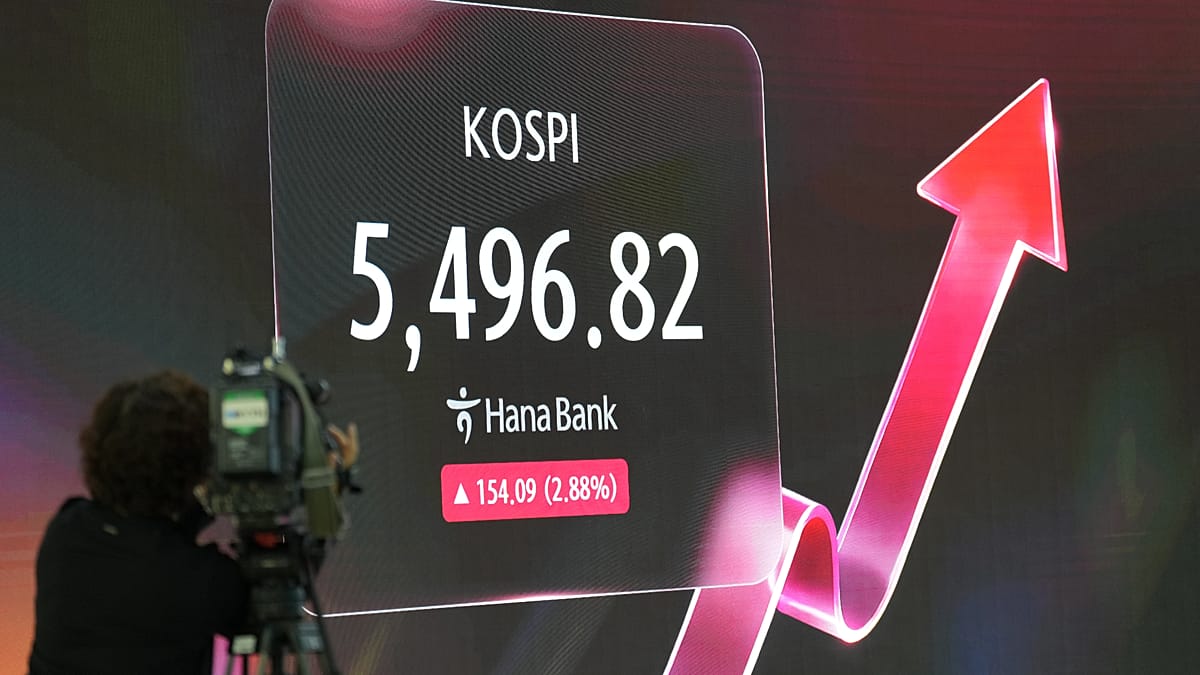
The uncertainty is particularly acute in Asia, where many hardware stocks depend on the pace of US-led AI infrastructure spending. Japan's Nikkei 225 closed up 0.5% at 61,142.35, but South Korea's Kospi fell 1.0% to 5,290.53. Shanghai's Composite dropped 0.6%, and Hong Kong's Hang Seng was down more than 1.5% in late morning trade.
Chip stocks were mixed. In Tokyo, Tokyo Electron rose 1.7%, while Kioxia fell 2.2% and SoftBank Group, a major AI investor, lost 5.1%. In Seoul, Samsung Electronics slipped 1.0% and SK Hynix dropped 3.2%. Taiwan's Taiex bucked the trend, closing 1.35% higher, with TSMC up 0.43%.
The broader market sentiment was also weighed down by rising oil prices. US President Donald Trump said on Thursday that Washington did not “need a deal with Iran,” even as the conflict in the Middle East continues. “We don’t need a deal with Iran,” he posted on social media. “Those days have long since passed. We’ve got their money, Hundreds of Billions of Dollars, and we’ve got their Strait!”
Brent crude was up 0.7% at $96.48 a barrel, compared with roughly $72 before the Iran war began in late February. US benchmark West Texas Intermediate rose 0.2% to $88.91. Gold futures for December delivery edged up to $3,899.00 a troy ounce in European morning trade.
In currency markets, the euro strengthened slightly to $1.1061, and rose to 83.60 pence against sterling. The pound eased to $1.3229, while the dollar slipped to 159.79 yen.
For European investors, the Nvidia saga adds another layer of uncertainty to an already volatile tech sector. The continent's own AI ambitions, from Paris to Berlin, are closely tied to the health of the global chip supply chain. As economists warn about the fragility of the AI boom, the coming weeks will reveal whether Nvidia can maintain its momentum without its charismatic leader.