Eurostat confirmed on Friday that eurozone annual inflation eased to 2.8% in June, down from 3.2% in May — the first decline since prices began accelerating in January. The data arrives less than a week before the European Central Bank's Governing Council meets on Thursday to decide whether to follow June's rate hike with another increase or pause.
The details of the release tilt toward a hold. Core inflation, which excludes energy, food, alcohol and tobacco, slowed from 2.6% to 2.4%. Energy inflation cooled from 10.8% to 8.5%, and services eased from 3.5% to 3.2%. Headline inflation fell in 22 of the EU's 27 member states.
Among the eurozone's four largest economies, Germany registered 2.4%, France 2%, Italy 3% and Spain 3.6%. The broad-based deceleration gives ECB policymakers room to argue that June's rate increase — the first in nearly three years — is working as intended.
Geopolitical Headwinds Return
The complication is that the shock behind that June hike has resurfaced. Oil prices neared $120 a barrel in March before sliding to around $72 following an interim peace agreement at the end of June. But the truce has frayed badly this month. The United States and Iran have exchanged fresh strikes, Tehran has attacked commercial shipping and threatened regional energy exports, while Washington has reimposed sanctions and tightened its naval blockade, pushing Brent crude back up to $87 a barrel on Friday.
The renewed escalation has revived the possibility of a surprise rate hike on Thursday, according to ING, although the bank still expects the ECB to hold rates steady, viewing a second increase as more likely in September. July is also not a forecasting meeting, giving policymakers cover to wait for updated economic projections before taking further action.
This geopolitical uncertainty underscores the fragility of the inflation outlook. As central banks face a credibility test over the timing of rate cuts, any renewed energy price spike could force the ECB to act sooner than anticipated.
Lagarde's Cautious Stance
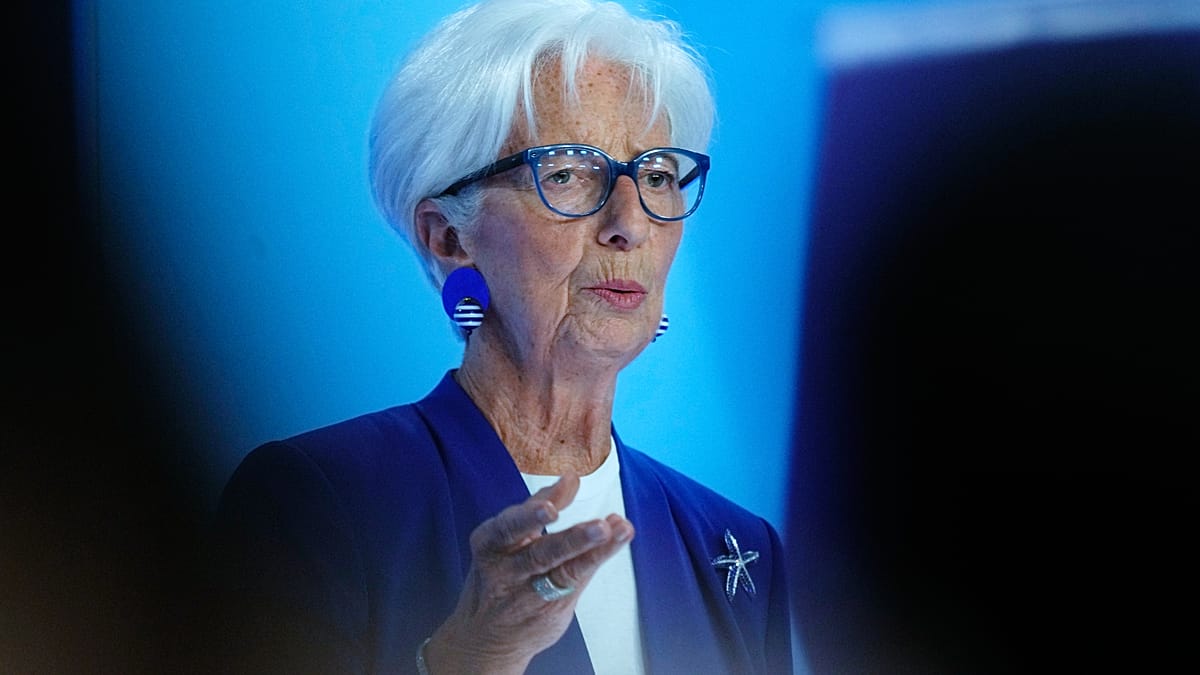
Speaking at the ECB's Sintra forum a few weeks ago, President Christine Lagarde insisted June's rate hike was not an "insurance hike" but a response to a genuine inflation problem. She noted that the ECB's projections showed inflation returning to its 2% target only in late 2027, and only if monetary policy was tightened further. Lagarde also refused to pre-commit to a policy path, saying "forward guidance is not in the cards" and that decisions would continue to be made on a meeting-by-meeting basis, guided by incoming economic data.
The ECB remains the only major Western central bank to have actually pulled the trigger. The US Federal Reserve left its benchmark interest rate unchanged at 3.50%-3.75% in June, at Kevin Warsh's first meeting as chair, although his hawkish tone unsettled markets. This transatlantic divergence highlights the ECB's unique challenge: it must balance a slowing economy with persistent price pressures, all while navigating a volatile energy landscape.
For now, the inflation data provides a plausible rationale for a pause. But as Spain's inflation steadied at 3.2% in June, and with energy costs still unpredictable, the ECB's path forward remains uncertain. The decision on Thursday will be closely watched for signals on whether the central bank views June's hike as the start of a tightening cycle or a one-off response to a temporary shock.