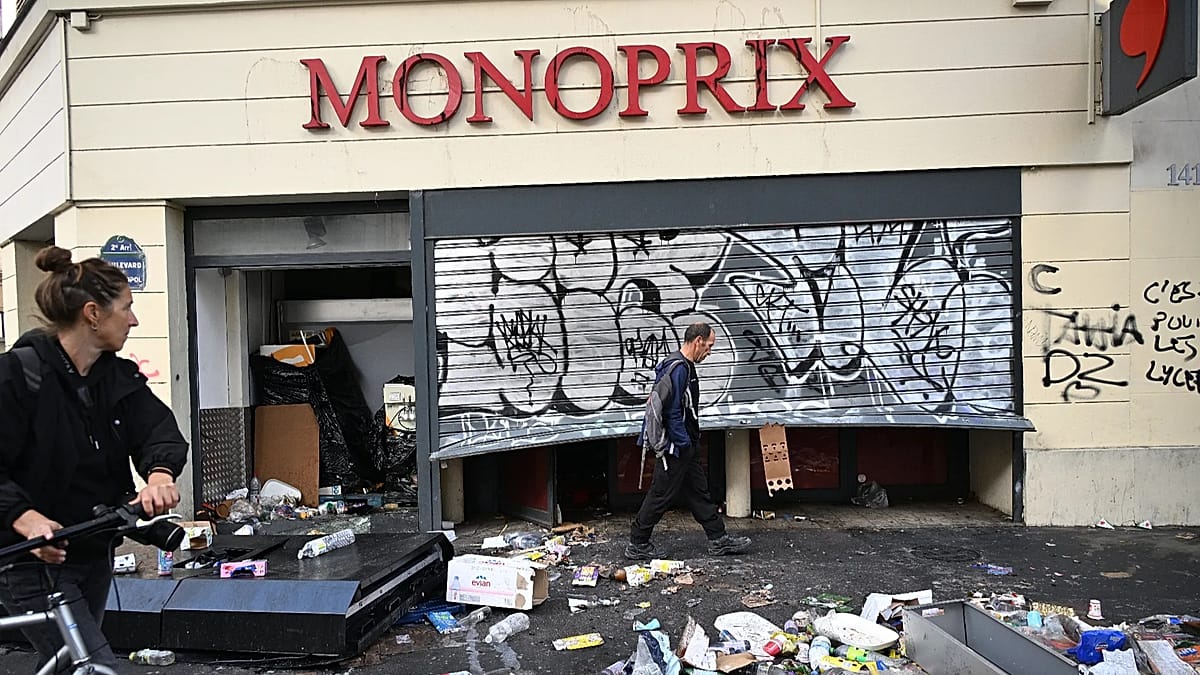
Sunday morning brought a sobering sight to streets across France: shattered glass, scattered debris and the remnants of a night of unrest. What began as demonstrations over the rising cost of living spiralled into widespread looting on Saturday, leaving shopkeepers and major retail chains to count the cost.
From Paris to Lyon, Marseille, Bordeaux, Rennes, Strasbourg, Grenoble, Nice and Limoges, masked individuals forced their way into stores, pulling down metal shutters and grabbing whatever they could. Supermarket chains such as Carrefour, Franprix and Monoprix were hit, along with luxury boutiques, bars and vape shops.
Alexandre Bompard, chairman and CEO of Carrefour Group, said on Sunday that 50 of the company's stores had been targeted, including 19 Carrefour convenience stores and supermarkets. Affected locations spanned Paris, Rennes, Lille and Bordeaux. Bompard expressed solidarity with the broader retail community, noting that around 1,500 shops across all chains had suffered similar violence. He warned of "considerable human and economic consequences," with dozens of employees at franchise partners facing short-time working and repair costs expected to exceed €10 million.
Small businesses bear the brunt
While the big chains can absorb some of the shock, independent shopkeepers are far more vulnerable. One store owner near the Place de la République in Paris, whose shop was wrecked, told the Brut outlet that he had invested all his savings into the business and felt he had lost everything. "I don't know how I'll get by or how I'll live with my family," he said. A neighbour has since launched a fundraiser to help him recover.
Paris Mayor Emmanuel Grégoire has promised full support for affected businesses and announced the creation of an emergency task force to assist shopkeepers who were victims of vandalism. "Its role will be to assess the damage, support affected shopkeepers, and assist them with administrative and insurance procedures," he said. "You bring Paris to life every day. Today, it's Paris' turn to stand by your side."
The violence also targeted journalists. A Euronews crew was assaulted near the Place de la République while reporting on the looting. Correspondent Estelle Nilsson-Julien described how masked individuals, including teenagers, surrounded them, hit her cameraman and tried to snatch his equipment. "They pushed him against the wall and started hitting and punching him," she said. The cameraman was protected by his goggles and mask. Meanwhile, a separate march along Boulevard de Clichy remained peaceful, according to another Euronews journalist on the ground.
The unrest is part of a broader wave of cost-of-living protests across Europe. In recent weeks, similar demonstrations have erupted in Brussels and Liège, and Portugal has seen housing protests as part of the same continental trend. The French government now faces the dual challenge of addressing public anger over inflation while helping businesses rebuild.
As the clean-up begins, the human toll is evident. For many shopkeepers, the damage is not just financial but deeply personal. The coming weeks will test the resilience of local communities and the effectiveness of official support mechanisms. The question remains whether the authorities can restore confidence among business owners who feel increasingly exposed to the fallout of social unrest.