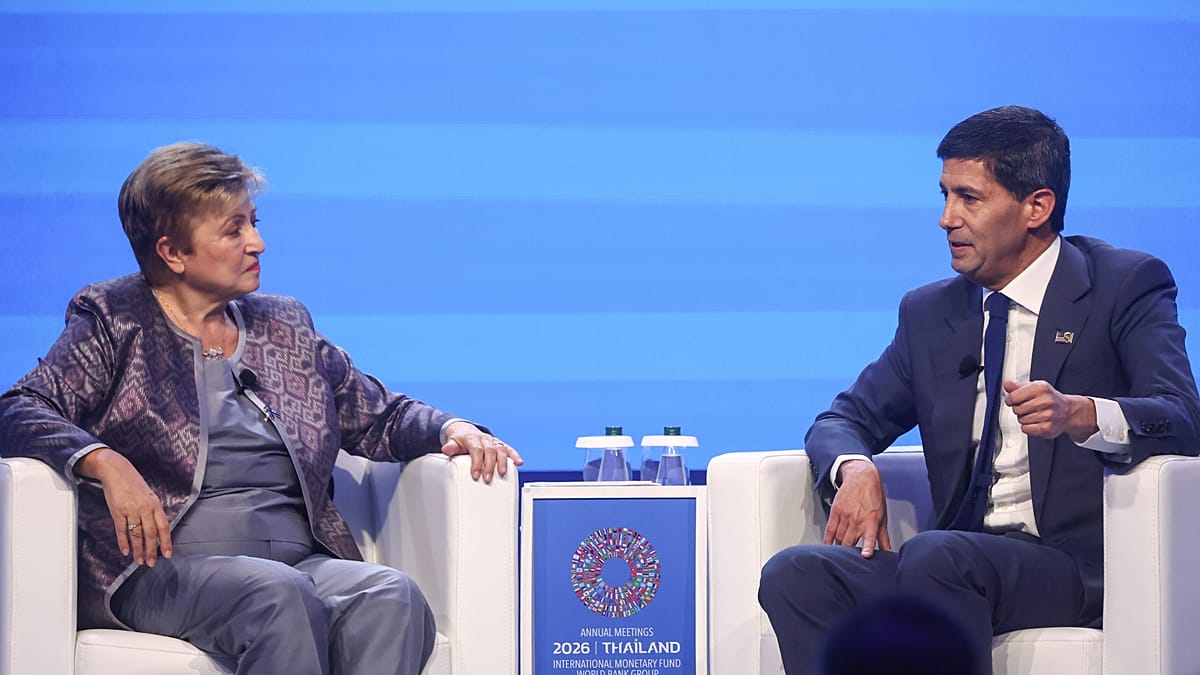
Speaking at the annual meetings of the IMF and the World Bank in Bangkok on Friday, US Federal Reserve Chair Kevin Warsh offered a cautiously optimistic view of the global economy, calling artificial intelligence the most consequential change of his lifetime. Yet he carefully avoided any hint about the central bank's next interest-rate move, scheduled for 28 October.
Warsh, who took the helm at the Fed in May, said the global economy had shown a resilience that he would not have predicted half a year ago. "Almost everywhere, the economy is showing a resilience I'm not sure I would have predicted five or six months ago," he told an audience that included IMF Managing Director Kristalina Georgieva.
The Fed chair was particularly upbeat about the United States, noting that a broadening investment surge—"not just AI"—had given the economy "plenty of tailwinds," momentum that is "certainly not found everywhere in the world." His remarks come as energy prices have spiked since the US and Israel went to war with Iran in late February, adding to inflationary pressures across many economies.
Inflation and rate hikes
Inflation has run above the Fed's 2% target for over five years, prompting the central bank to raise rates by a quarter point to 3.75–4% in September—its first hike since July 2023. Warsh defended the Fed's approach: "At the Federal Reserve, we made very clear that we would deliver price stability." He said he had heard the same resolve from other central bankers in Bangkok, describing the wave of rate hikes, including two by the European Central Bank, as a "synchronous tightening" that leaves "no free riders."
The IMF on Tuesday nudged up its 2026 global growth forecast to 3.1%, but warned that risks were tilted to the downside. Rich countries are also facing soaring borrowing costs, with the 10-year US Treasury yield above 5% and the French bond yield trading around 4.8% at the time of writing. These developments have heightened concerns about stagflation risks in the eurozone, as growth stalls and inflation persists.
AI: a bumpy road ahead
Much of Friday's discussion centred on AI, which Warsh described as "probably the most consequential change" for the US and global economies in his lifetime. Before taking office, he had argued that an AI-driven productivity boom could curb inflation and make room for lower interest rates. On Friday, he acknowledged that, for now, the investment frenzy is pushing prices up by fuelling demand.
Minutes from the Fed's September meeting noted that data-centre construction had driven up the cost of chips, computer equipment, and electrical components. However, Warsh expects AI to eventually boost the economy's productive capacity, bringing a "huge benefit" at home and abroad. He also predicted it would transform central banking, saying, "we torture data with old-fashioned models. Not so long from now, it won't be torture."
Despite his optimism, Warsh warned that the road ahead was "likely to be a very bumpy one," both in understanding the technology and because "we really don't know what the market structure is going to be."
No clues on the next move
Warsh, who has promised fewer hints about policy direction, kept to that pledge. "I don't prejudge meetings," he said, though he noted the world had "broadly conformed" to the Fed's expectations since September.
US consumer price inflation rose to 3.7% in September from 3.4% as petrol prices surged, though core inflation—excluding food and energy—was 2.6%. Wholesale prices rose 6.3% year on year, the most since 2022, while the economy added just 29,000 jobs last month.
Market expectations for an October hike have swung wildly this week, jumping from about 22% to around 50% after Wednesday's inflation figures before falling back to about 30%, according to CME FedWatch. Markets currently price in a roughly 90% chance of a December hike, and the September minutes showed most Fed officials expect another increase this year.
New York Fed President John Williams, vice chair of the Fed's committee, told Bloomberg on Tuesday that "it may be appropriate to have one more rate hike," but saw no need for more in 2027. In contrast, Fed Governor Michelle Bowman said at the Bangkok meetings on Wednesday that she felt no urgency to act.
The decision comes days before the 3 November US midterm elections. September's hike defied US President Donald Trump's demands for lower rates, though he still backs Warsh, his pick for the job.
Friday's remarks were among Warsh's last before the Fed's quiet period, which starts on Saturday and bars officials from discussing policy until after the meeting. Investors will next hear from him at his press conference following the decision.