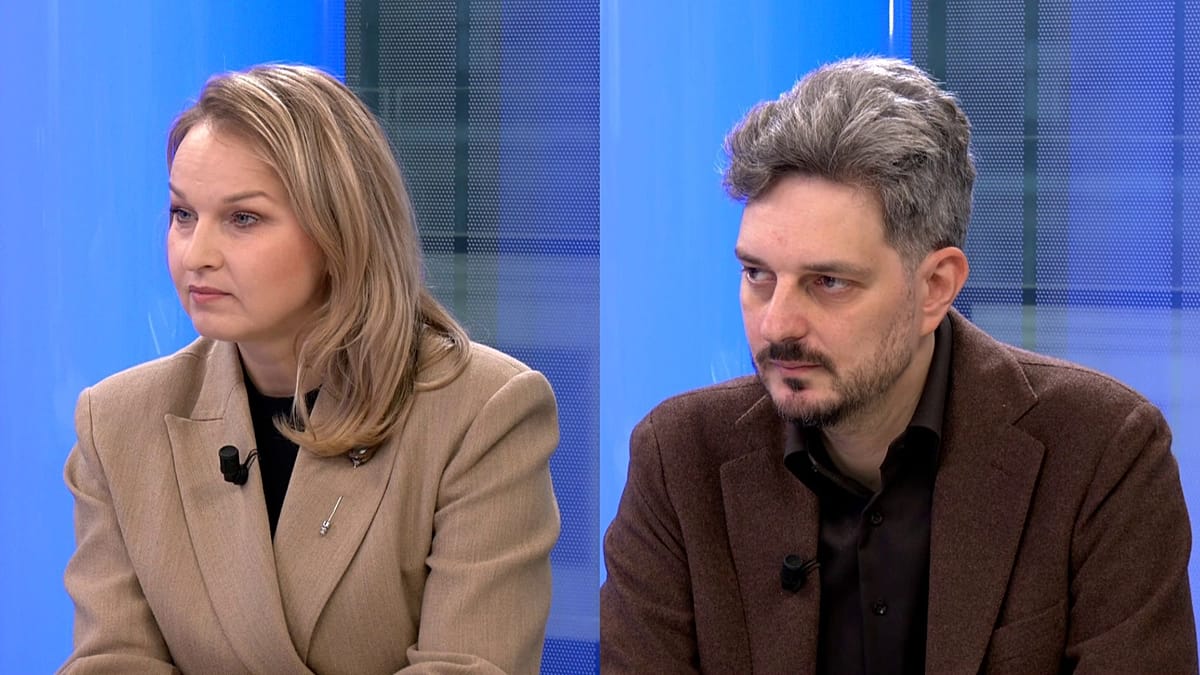
For Alina Koushyk, editor-in-chief of the Polish-based Belarusian channel Belsat, the label 'terrorist' is absurd. 'I'm not a terrorist, I'm just a journalist,' she told European Pulse in Brussels. 'For many years, I've been working just to say the truth, an alternative point of view. And this is not a crime.'
Minsk has designated Koushyk an 'extremist' and Moscow has put her on its wanted list. A dozen Belsat journalists have been imprisoned in Belarus, though most were released last year. In March, Minsk freed 250 political prisoners, including Belsat's Katsyaryna Andreeva, in a US-brokered deal that also brought sanctions relief. But former Belsat employee Ihar Ilyash and other prominent journalists like Denis Ivashin remain behind bars.
Maxim Katz, a Russian opposition YouTuber, left Russia three days before the full-scale invasion of Ukraine, by chance, to film a documentary series in London. When the war began, he knew he could not return. Moscow soon introduced censorship laws banning the word 'war' in favour of 'special military operation', with penalties of up to 15 years in prison. Katz was designated a 'foreign agent' and sentenced in absentia to eight years. He now lives in Israel with his family.
Staying safe, staying connected
Koushyk feels safe in Europe but remains vigilant. 'Belarusian and Russian secret services are working here. There are agents, there are spies, and this is not a cinema. This is our reality,' she said. She stresses cybersecurity and media literacy as essential tools for exiled journalists.
Reporting from afar requires creativity. Koushyk scans official sources, authorities' websites, and social media platforms like Telegram and TikTok. 'Ordinary people inform [us] a lot about what is going on in the country,' she said. But she cannot interview Belarusians on the street or even by phone, because they would immediately be jailed.
Satellite broadcasting is crucial. 'Satellite is important, especially for Belarus, because if you watch satellite, you don't have digital threats. They cannot trace you,' Koushyk explained. Reporters Without Borders launched the Svoboda satellite in 2024 to beam independent Russian-language news to censored regions. Belsat also uses Instagram and YouTube, which remain accessible in Belarus without a VPN, unlike in Russia.
Katz relies on YouTube and Telegram to reach Russian audiences. Although Russian authorities have blocked YouTube since February, it remains accessible via VPN. His channel reaches about one million people daily, comparable to some Russian TV channels.
Deconstructing propaganda
Koushyk believes the best way to counter Minsk's propaganda is to present facts and alternative viewpoints. 'I don't believe that you have to say that they are wrong and we are right,' she said.
Katz advises adapting language to resonate with ordinary Russians. 'Obviously, I'm anti-war and anti-Putin. But the question is, how do you tell it?' He suggests talking about problems people 'see from their window' and issues from their daily life, as if speaking in a kitchen in St. Petersburg, not at a protest rally.
Both journalists continue their work despite the risks, driven by a commitment to truth. Their experiences highlight the growing challenges for independent media in authoritarian states, and the resilience of those who refuse to be silenced. As Russia's judicial crackdown intensifies, their voices remain vital for audiences seeking reliable information.