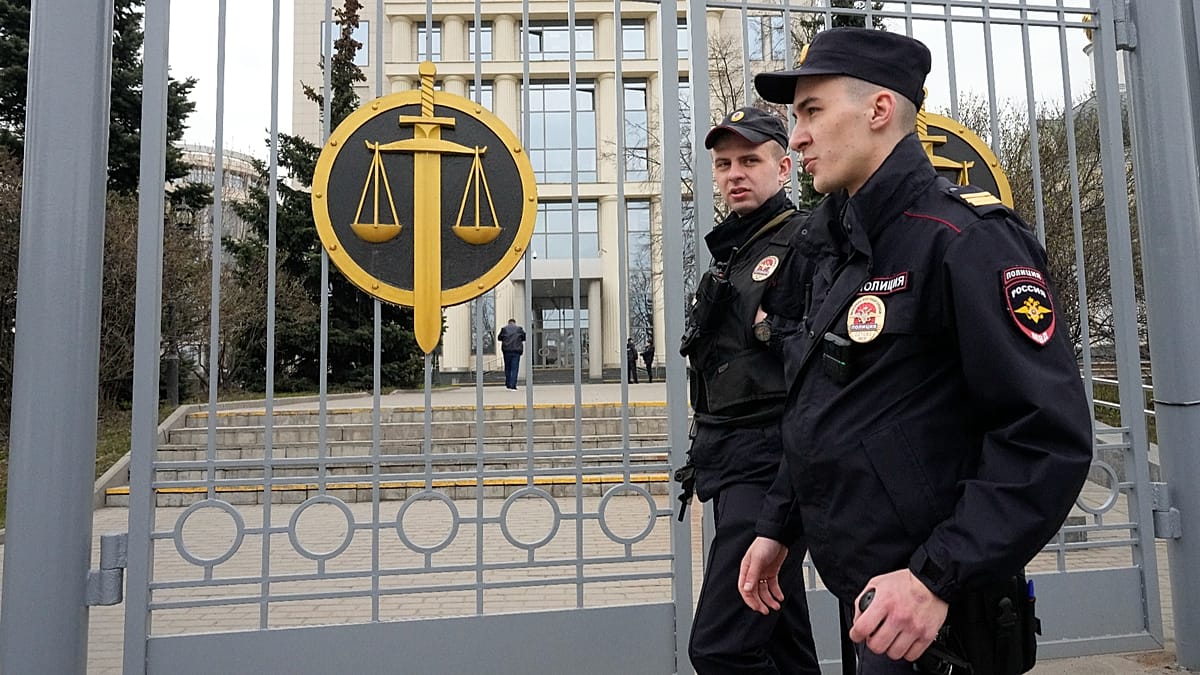
Russia's Supreme Court is preparing legislation that would allow presiding judges to enter the deliberation room while a jury discusses its verdict and would reduce jury panels from six or eight members to four. Critics say the changes would consolidate decision-making power in the hands of state-appointed officials and further erode the independence of a system that already acquits at a rate sharply above the national average.
Deputy Chair of the Supreme Court Nikolai Timoshin and Supreme Court judge Sergei Zelenin have outlined the main provisions of the planned reform, although the draft law has not yet been published. Under the proposals, the presiding judge would not be permitted to vote on a defendant's guilt but would be entitled to "clarify" questions arising during deliberations.
Additional provisions would change the procedure for selecting jurors, allow citizens over 65 to serve, restrict the grounds for dissolving an already formed panel, and give defendants the right to refuse a jury trial even after a hearing has been scheduled.
Why jury trials matter in Russia
Jury trials are rare in Russia but produce acquittals at a rate sharply above the national average. Of more than 640,000 criminal cases heard in Russia in 2025, only 643 were decided by a jury—around 0.1%. In the first half of 2025, 144 of 444 defendants in jury cases were acquitted, close to one in three, according to Professor Sergei Nasonov of Moscow State University of Law, cited by Current Time. Across the Russian criminal justice system as a whole, the acquittal rate is below 0.5%.
Zelenin has argued that Russia's current jury model draws heavily from the Anglo-American legal tradition and fits poorly with the continental legal system, and that closer interaction between judge and jury would make proceedings more stable. The proposed model is closer to the European lay judge system, in which a professional judge and non-specialist members sit together as a single panel.
Supporters of the reform also cite the high rate at which jury acquittals are overturned on appeal—between 65% and more than 80% in different years, according to figures cited by the Supreme Court. Critics argue that grounds for overturning verdicts are typically described as procedural breaches, which can be interpreted broadly: from paperwork errors to remarks by trial participants that courts treat as improper influence on the jury.
Lawyers' objections centre mainly on admitting the judge to deliberations, which they say undermines the jury's independence. Reducing the panel to four also raises questions about how much weight public participation carries in verdicts.
One source cited by Current Time said the reform amounts to legalising practices already in use informally: "Judges on the ground do not want this, none of the law enforcers need these courts. They fight them as best they can. Now they are simply legalising what they are already doing anyway." The same source said jurors had frequently exposed weaknesses in prosecution cases, showing that some were "stitched together with white thread," a Russian expression for crude fabrication.
Jury trials have existed in Russia since the judicial reforms of Tsar Alexander II in 1864. They were abolished in the Soviet period, restored in the early 1990s, and have been revised several times since.
The proposed changes come as Russia's legal system faces increased scrutiny from European observers. The NATO chief's dismissal of Russian nuclear threats and the EU's expanded Mediterranean naval mission highlight the broader context of tensions. Meanwhile, Bulgaria's PM urging EU dialogue with Russia shows the continent's divided approach. As Tsikhanouskaya warns Russia is probing EU resolve, the reform's implications for rule of law resonate beyond Russia's borders.