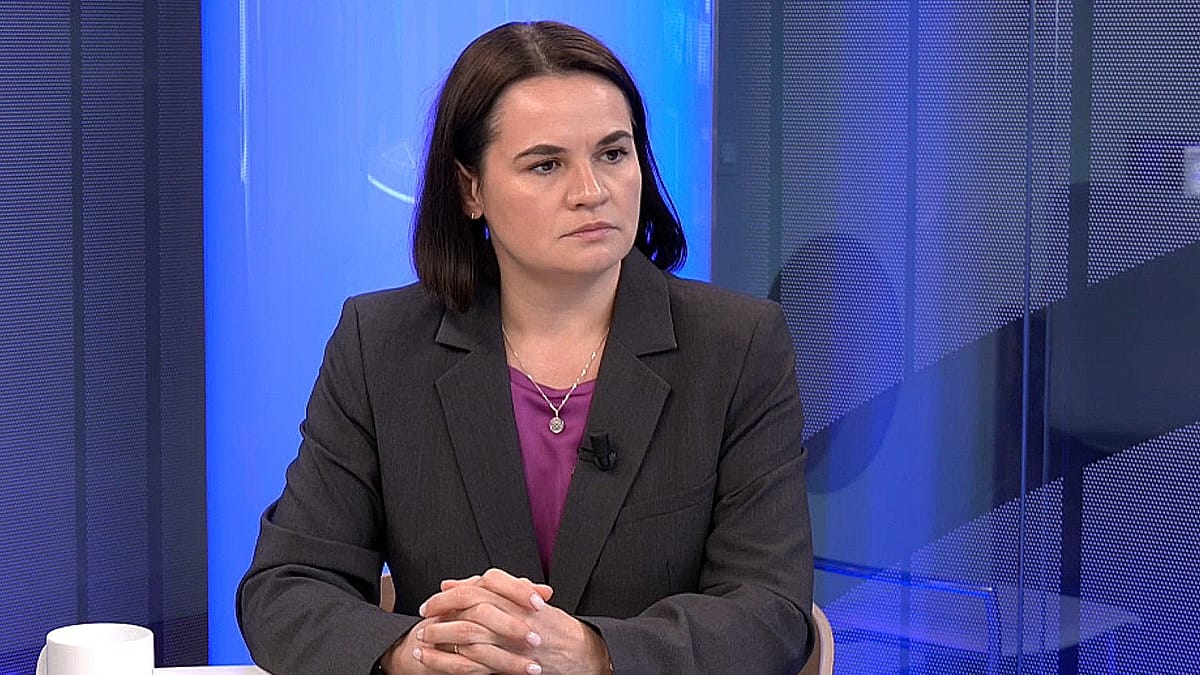
Belarusian opposition leader Sviatlana Tsikhanouskaya has warned that Russia is deliberately probing the European Union's limits, testing how far it can go before the bloc reacts. In an interview with European Pulse, she said that President Vladimir Putin is "testing the borders" of the EU and closely "watching the reaction" from Western capitals.
Tsikhanouskaya, who has lived in exile since the disputed 2020 Belarusian presidential election, urged European leaders not to panic but to prepare. "I am not encouraging Europe to attack," she said. "But Europe must be ready to respond to a possible attack. The question is not if, but when and where."
A more consolidated opposition
Tsikhanouskaya argued that her country's opposition movement is more unified than its Russian counterpart, which could make Belarus a catalyst for change across the region. "Change in Russia could begin with change in Belarus," she said, pointing to the resilience of Belarusian civil society despite years of repression.
Her comments come as the Kremlin continues to escalate pressure on its neighbours. Recent incidents, such as Estonia blaming Russian special services for arson at a defence firm, and Putin's latest decree expanding the Russian army, underscore the growing security challenges facing Europe.
Tsikhanouskaya stressed that the EU must not be caught off guard. "We have seen what happens when we are not prepared," she said, referring to the full-scale invasion of Ukraine. "Europe has the resources and the unity to deter further aggression, but only if it acts now."
Economic and security dimensions
The Belarusian leader also highlighted the economic front, noting that the EU's financial support for Ukraine is crucial. Kyiv has urged the EU to seize Russian assets to cover a projected €68 billion funding gap by 2027, a move that Tsikhanouskaya supports. "Freezing is not enough. Seizing those assets would send a clear signal that aggression does not pay," she said.
She also pointed to Russia's internal vulnerabilities, such as plans for seven new superprisons despite an inmate exodus to the war, as signs that the Kremlin's priorities are skewed. "The Russian people are paying the price for Putin's ambitions," she said.
Tsikhanouskaya's call for preparedness resonates across the Baltics and Central Europe, where governments have long warned about Russian hybrid tactics. From cyberattacks to disinformation, the EU faces a multifaceted threat that requires a coordinated response.
"We are not asking for confrontation," she concluded. "We are asking for clarity and strength. The EU must show that it knows where its red lines are and that it will defend them."