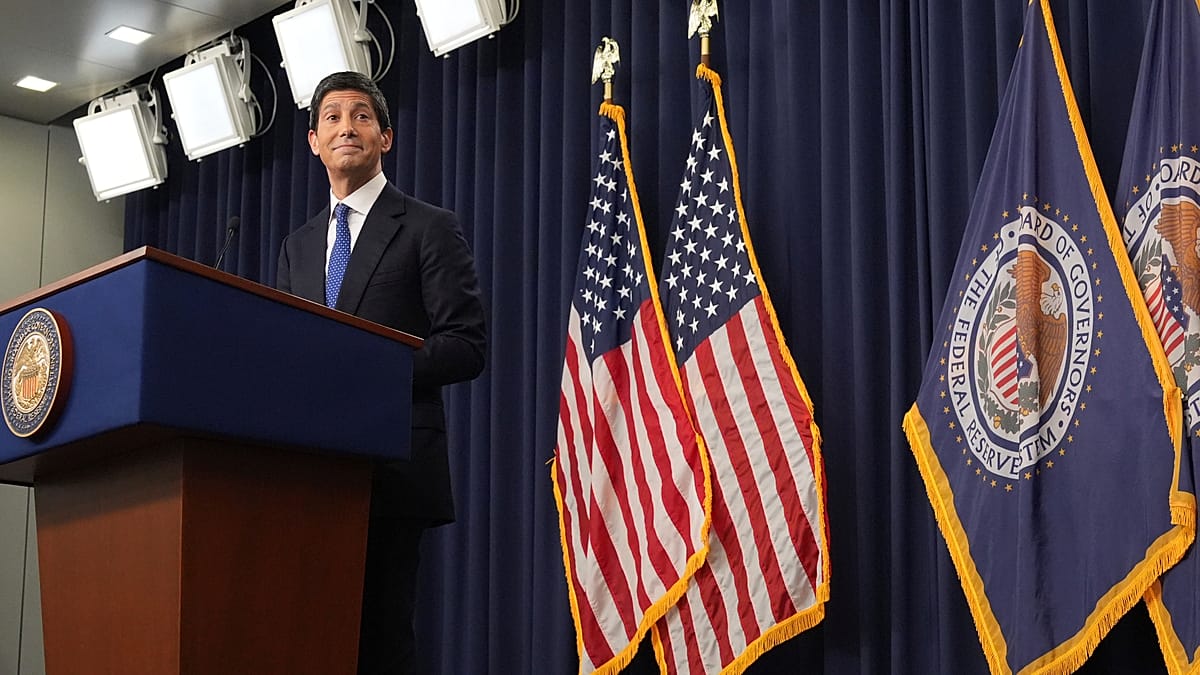
When the Federal Reserve announces its latest policy decision on Wednesday evening, it is almost certain to leave its benchmark interest rate unchanged at 3.75% to 4%. The move comes less than a week before Americans head to the polls for the midterm elections, and the central bank is keen to avoid any appearance of political interference.
Yet the calm on the surface masks a more complicated picture. Inflation remains stubbornly high at 3.7%, energy prices are still elevated, and futures markets are pricing in a 73% chance of a quarter-point hike at the Fed's December meeting, according to CME Group's FedWatch tool. That would follow September's increase, the first in three years.
Several senior officials have tried to cool expectations of further tightening. Vice Chair Philip Jefferson pointed to the recent jump in longer-term borrowing costs, saying that "my colleagues and I will need to come to our own judgment, which may take more time." New York Fed President John Williams echoed that sentiment, insisting "there is no need for urgency."
Politics is never far from the surface. "The Fed doesn’t want to poke the White House in the eye six days before an election," said Joseph LaVorgna, chief economist at SMBC's US arm and a former Trump administration official. But not everyone may go along. Cleveland Fed President Beth Hammack and Dallas Fed President Lorie Logan have both argued that rates are not yet high enough to cool inflation, and as many as three officials could dissent.
Inflation remains hot, but growth holds up
The case for tighter policy is still strong. US consumer prices rose 3.7% in September from a year earlier, up from 3.4% in August, while core inflation, which excludes food and energy, climbed to 2.6%. Wholesale prices jumped 6.3%. Chicago Fed President Austan Goolsbee called the reading "discouraging," adding that underlying inflation at today's level is "not acceptable."
Petrol, which has topped $4 a gallon for the past three months, accounted for more than half of September's price increase, according to the US Labor Department. Diesel hit a record $6.53 a gallon in late September, raising the cost of shipping almost everything. Brent crude, the global benchmark, fell over 6% on Monday from about $117.4 a barrel, its highest close since March, as diplomacy over the Iran war appeared to gain momentum. It was trading at roughly $110.8 a barrel on Tuesday, still far above the $72 it fetched before the conflict began.
Borrowing costs are biting too. The average 30-year US mortgage rate hit 7.4% in early October, a three-year peak, before easing to 7.32% last week. That is up from just under 6.2% a year ago. Research firm Oxford Economics estimates that this year's rise has priced 5 million more American households out of buying a home. Expectations of further hikes have also kept the US dollar close to an 18-month high against major currencies.
The economy, meanwhile, is bending rather than breaking. Employers added just 29,000 jobs in September and unemployment rose to 4.2%, yet the US economy grew at an annualised 2.2% in the second quarter, and the Atlanta Fed's GDPNow tracker points to 3.5% for the third. The next test comes on Thursday, when the US publishes its first estimate of third-quarter growth and September data for the Fed's preferred inflation gauge, the personal consumption expenditures (PCE) price index.
"Fed officials still appear broadly intent on tightening policy at a measured pace," Thomas Ryan, senior North America economist at Capital Economics, wrote in a note.
All eyes on Warsh
Chair Kevin Warsh, who will speak to reporters after the decision, has offered few hints. Speaking in Bangkok at the International Monetary Fund and World Bank annual meetings this month, he said the world had "broadly conformed to our expectations" since September. "I don’t prejudge meetings," Warsh said, while stressing that "at the Federal Reserve, we made very clear that we would deliver price stability." He has long opposed forward guidance, the practice of signalling future moves to the markets, and has avoided it.
Aditya Bhave, head of US economics research at Bank of America, said a surprise hike could "end forward guidance by showing markets that they can't listen to the guidance anymore," though most economists doubt it. The Fed Chair's independence is also under scrutiny. Warsh defied President Donald Trump's calls for lower rates in September, but Trump later said he had told Warsh he "might as well" vote for a hike, and has since stepped up his push to remove Fed Governor Lisa Cook. Trump created a three-person committee to recommend whether he has cause to fire Cook over mortgage fraud allegations she denies. Cook is expected to appear before the committee next week.
For European readers, the Fed's path matters beyond US borders. A stronger dollar and higher US rates can put pressure on European currencies and complicate the European Central Bank's own fight against inflation, which has seen eurozone inflation climb to 3.8%. The Fed's decisions also ripple through global financial markets, affecting borrowing costs for governments and businesses across the continent.
As for Warsh, if his speech focuses on the need to return inflation to the Fed's 2% target faster, investors will likely read it as confirmation of a December hike. That would be a clear signal that the Fed is not done tightening, even as the political calendar heats up.