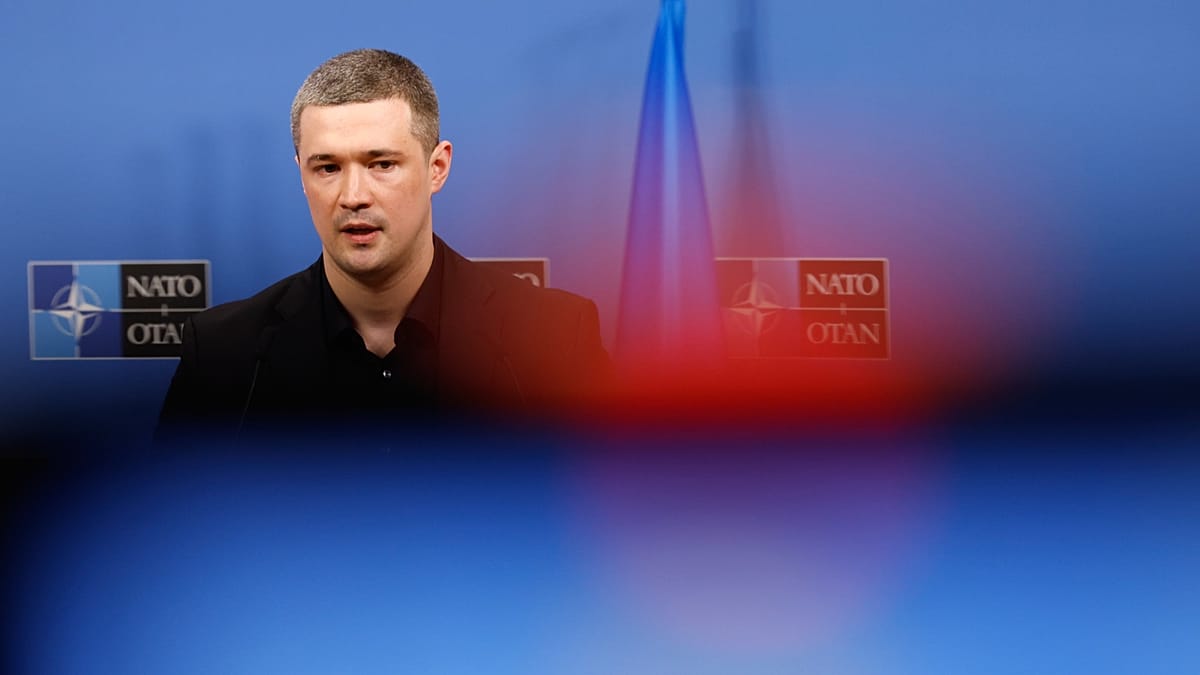
Just hours after President Volodymyr Zelenskyy formally nominated Yevhen Khmara as Ukraine's next defence minister, the man he replaced broke his silence. Mykhailo Fedorov, dismissed a month ago amid nationwide protests, used a video address to urge Ukrainians to find a way to hold elections even as the war with Russia grinds on.
“We must not let Putin decide when Ukrainians can choose their government,” Fedorov said in the message, titled “Address of Mykhailo Fedorov to the People of Ukraine.” He added: “Democracy is not a peacetime luxury. Democracy is part of what we are fighting for today.”
The intervention came after Zelenskyy put forward Khmara, the acting defence minister and former head of the Security Service (SBU), as the permanent choice. That move effectively ended any chance of Fedorov returning to the ministry he led for only six months.
A political pivot
Fedorov had been offered other senior roles after his dismissal, including deputy prime minister positions, but he refused, insisting he would only return as defence minister. Khmara's nomination closed that door. Now, Fedorov's remarks have shifted the debate from a personal dispute to broader questions about political accountability and the exercise of power during wartime.
His decision to speak directly to Ukrainians on social media, focusing on issues far beyond his former portfolio, has already sparked speculation about his political ambitions. Fedorov is one of Ukraine's most popular former ministers, and he had not previously called for elections during the war. He did so only after it became clear he would not get his old job back.
Ukraine has not held national elections since Russia launched its full-scale invasion in February 2022. The constitution prohibits elections under martial law, and organising a nationwide vote during an active war would present enormous security and logistical hurdles—including how to enable soldiers, millions of refugees abroad, and residents of frontline cities to cast ballots.
Fedorov did not demand an immediate vote or set out a timeline. Instead, he argued that Ukraine should develop a mechanism to hold elections during wartime, giving citizens the chance to assess the performance of those in power and decide whether they still enjoy public trust. “Democracy could not simply be postponed until the war is over,” he said.
The former minister also linked political accountability to the conduct of the war itself. He criticised corruption and bureaucratic inefficiency, warning that mismanagement of public funds could cost lives if resources meant for defence were diverted. “Power must mean responsibility,” Fedorov said, arguing that officials entrusted with authority, public money, or government positions should be required to account for what they have achieved.
He called for greater transparency from the authorities, saying the extraordinary trust placed in the government since the invasion did not give officials the right to operate without explaining their decisions. “People do not demand that the state never make mistakes,” Fedorov said. “But they have a right to the truth.”
Fedorov's intervention brings the politically sensitive issue of elections back into focus as Zelenskyy tries to move past a month of turmoil at the defence ministry. Khmara, whose appointment requires parliamentary approval, is a veteran of Ukraine's security services who previously commanded the SBU's Alpha special operations centre. He was involved in the 2022 operation to retake Snake Island and later oversaw Ukraine's campaign of long-range drone strikes against Russia. He became acting head of the SBU in January 2026 after Vasyl Maliuk stepped down.
Fedorov has not publicly criticised Khmara and appears to have sought a smooth handover. In an interview on 6 August, he said he had personally briefed Khmara on a detailed “war plan.” “This was the first thing I did, I showed it to him personally,” Fedorov said. He explained that he had outlined how the plan translated into procurement and development, breaking the overall strategy into hundreds of individual projects spanning weapons production and financing.
But Fedorov's decision to address Ukrainians directly on elections, public trust, and government accountability suggests his departure from office may mark the beginning of a different political role rather than a retreat from public life. That prospect contrasts with how Fedorov described his future only weeks ago, when he said he would focus on volunteer work and supporting the military.
The timing is delicate. Ukraine's parliament is already grappling with leadership gaps in key ministries, as recent reports have noted. Meanwhile, Russian strikes continue to hit civilian infrastructure, as seen in the latest attack on Kramatorsk. Fedorov's call for elections may resonate with a war-weary public, but it also risks opening a new front in Ukrainian politics at a critical moment in the conflict.