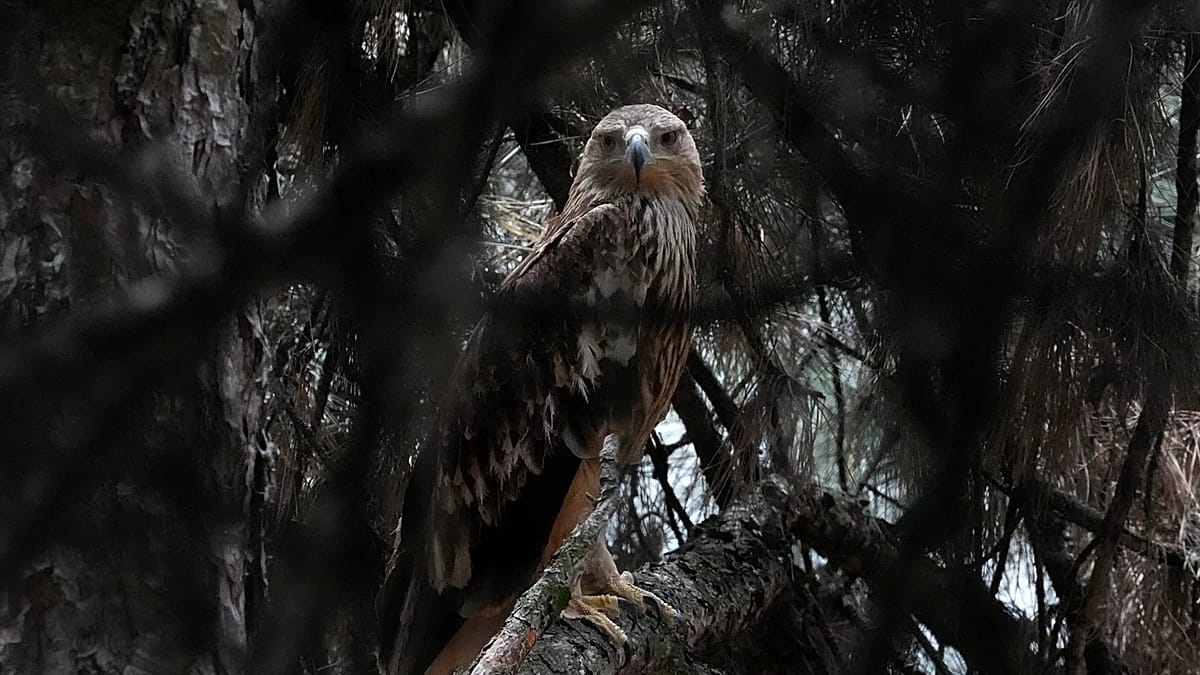
Feliks, a year-old eastern imperial eagle from Serbia, has returned home after a months-long ordeal that reads like a thriller: kidnapped by poachers, sold on the black market, and smuggled across borders in a potato sack. The bird, fitted with a tracking device before his first migration, was recovered thanks to a coalition of conservationists, refugees, and the Serbian military.
The saga began in August, when Feliks—ringed and equipped with a small transmitter by the Bird Protection and Study Society of Serbia (BPSSS)—set off on his maiden journey southeast. His route took him over North Macedonia, Greece, and Turkey before his signal vanished in late October in Syria. “We hoped it was just a transmitter problem,” said Uroš Stojiljković of BPSSS. But weeks later, news arrived from Michel Sawan, head of the Lebanese Association for Migratory Birds: Feliks had been captured by poachers using water traps in the desert, nets, and even motorcycles to catch migratory birds.
Feliks was put up for sale on WhatsApp groups dedicated to illegal wildlife trading. Sawan, refusing to pay ransoms, mobilized contacts in Syria to track the bird. “When Felix was caught, it was posted on many WhatsApp groups for selling wild birds illegally trapped in Syria,” Sawan said. The eagle was sold to a buyer in Lebanon, then resold back into Syria before Sawan’s network retrieved him. Getting Feliks across the border into Lebanon proved perilous due to regional fighting and bad weather. Eventually, a group of refugees carried the eagle in a potato sack across the Nahr al-Kabir river on the Syria-Lebanon border. “It was crazy,” Sawan recalled.
From Beirut to Belgrade: A Military Rescue
Once safely at Sawan’s bird sanctuary in Beirut, the challenge became returning Feliks to Serbia. The outbreak of the Iran war in February made commercial transport impossible. After three failed attempts, the Serbian army stepped in, using its troops in the UN peacekeeping mission in Lebanon. On 22 June, Feliks arrived in Serbia aboard a military transport plane.
Feliks is now in quarantine for 21 days at a zoo in northern Serbia. BPSSS experts plan to fit him with a new transmitter before releasing him back into the wild. The eastern imperial eagle, a protected species with a wingspan of up to two metres, was down to a single breeding pair in Serbia in 2017. Conservation efforts, including tree planting and nesting platforms across the Vojvodina plain, have boosted the population to 29 breeding pairs, supported by an EU-backed project.
Stojiljković noted that dangers persist at home, from accidental poisoning to power lines. “Feliks went full circle and came back to where he had set off,” he said. “Let’s hope he won’t be bored here.”
The case highlights the broader crisis of illegal wildlife trafficking, which Sawan says is “getting worse year after year, season after season, day after day.” Feliks’s story also underscores the fragility of migratory routes across the Middle East, a region increasingly disrupted by conflict. For Serbia, the eagle’s return is a rare piece of good news amid political turbulence, as the country heads to snap elections following President Vučić’s resignation. Serbia Heads to Snap Elections as EU-China Trade Talks Intensify.