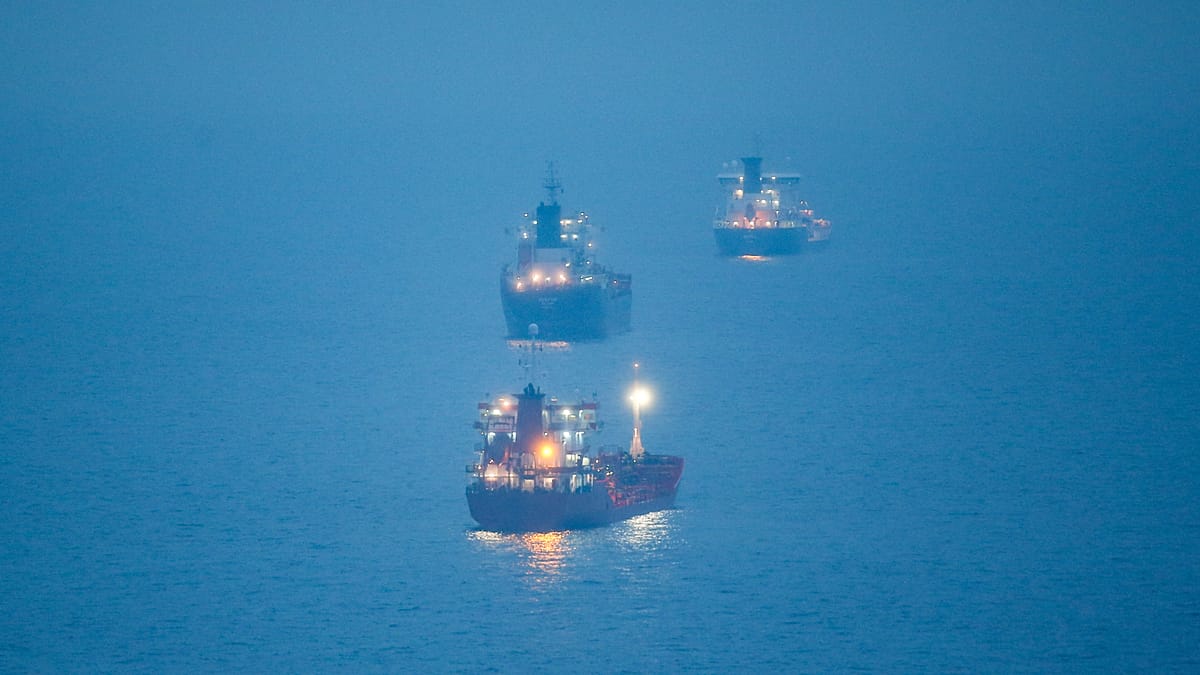
Five Azerbaijani sailors were killed overnight on Friday when two cargo vessels were struck by drones in the Sea of Azov near the Russian port of Taganrog, Azerbaijan's foreign ministry confirmed on Friday. The vessels, identified as the dry cargo ships Natra and Zirkon, were travelling from Turkey to Rostov-on-Don to load grain when the attack occurred, according to media reports.
Natra, sailing under the flag of Belize, was hit multiple times, resulting in two fatalities. A fire on board was later brought under control, but the vessel lost propulsion and remained afloat. Zirkon, registered under the flag of Palau, also sustained several strikes, killing three crew members. A fire forced the remaining crew to abandon ship before emergency responders arrived.
Preliminary information indicated that 12 Azerbaijani nationals were serving aboard Natra and 14 aboard Zirkon under private civilian employment contracts. The sailors were not linked to any official Azerbaijani state activity. Several surviving crew members were evacuated to nearby ports for medical checks and emergency assistance, though details about their condition remain limited.
Azerbaijan has consistently urged its citizens to avoid travel to or employment in conflict zones, stressing that the safety of civilians cannot be fully guaranteed.
Shadow Fleet Operations
Shipping databases show that Zirkon previously operated under the Russian flag before being re-registered in Palau in 2022. Natra has also flown other flags in the past, including those of the Cook Islands and Vanuatu. The flag histories of both vessels are consistent with Russia's shadow fleet — a network of ageing, often uninsured ships sailing under flags of convenience that Moscow uses to bypass Western sanctions on its maritime trade.
Belize and Palau are among the most commonly used registries in the Russian shadow fleet. The EU and US have sanctioned numerous vessels in this network for carrying Russian oil, although neither Natra nor Zirkon appeared on published sanctions lists at the time of the incident.
The commander of Ukraine's unmanned systems forces, Robert Brovdi, stated that Ukrainian drones had "struck five illegally loitering vessels during the night of 5 June in the ports of Mariupol and Berdiansk, and in the coastal waters of the temporarily occupied territories." He said they were being used to ship grain from occupied Ukraine and did not refer specifically to Baku's statement that five Azerbaijani citizens were killed.
The ships were heading to Rostov-on-Don, one of Russia's major grain export ports on the Sea of Azov. Both Rostov-on-Don and the nearby port of Taganrog have been repeatedly identified by Western governments and Ukraine as transit points for grain looted from Russian-occupied Ukrainian territories. Since its full-scale invasion of Ukraine in February 2022, Russia has systematically stripped grain from occupied regions of Zaporizhzhia, Kherson, Donetsk and Luhansk. Satellite tracking of vessels has corroborated Ukrainian and Western claims that significant quantities of grain have left Russian Black Sea and Azov ports.
This incident underscores the ongoing risks to civilian shipping in the region, as well as the broader implications for European security and maritime trade. The use of drones to target vessels linked to Russia's shadow fleet highlights the evolving nature of the conflict in Ukraine, where both sides are increasingly employing unmanned systems to disrupt supply chains and military logistics.
For more on the impact of drone strikes in the region, see our coverage of a Geran-2 drone that struck a Romanian apartment block. Additionally, the broader context of Russian strikes on civilian infrastructure is explored in our report on a Russian strike on the Odesa region that cut power for thousands and hit civilian ships.