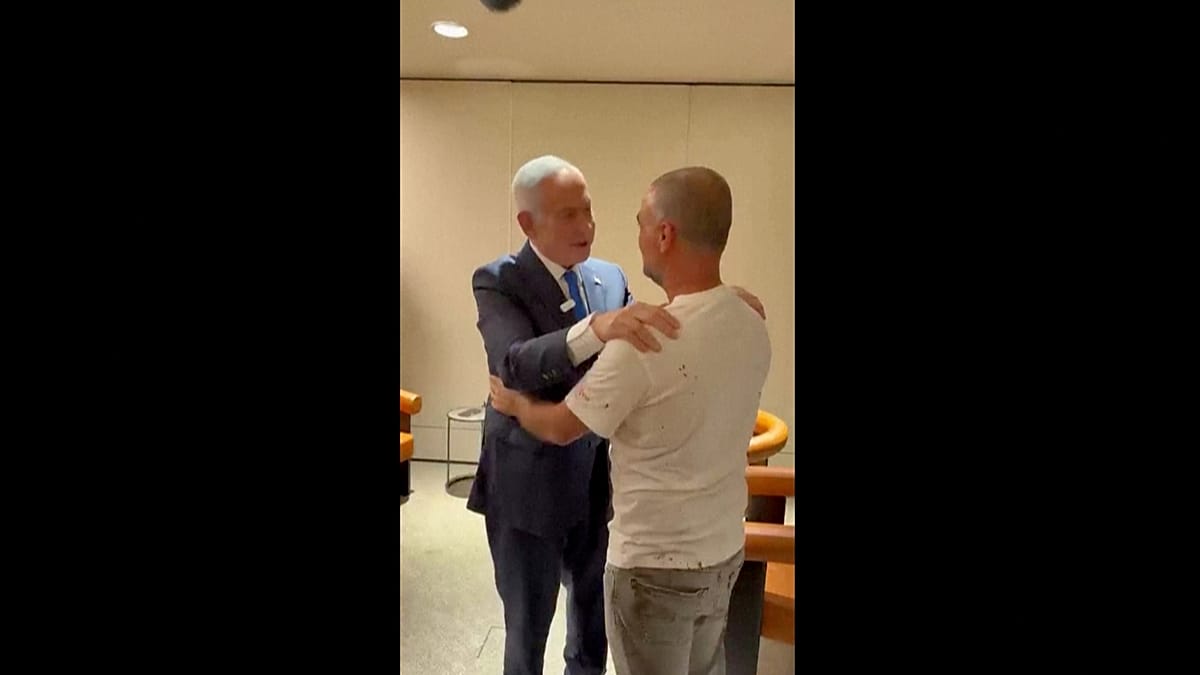
Israeli Prime Minister Benjamin Netanyahu met Yaniv Hayun at Ben Gurion Airport on Wednesday, days after the passenger helped restrain a co-pilot during a mid-flight attack on a Flydubai aircraft. The encounter came after the Boeing 737 was forced to divert to Saudi Arabia, where Hayun and other passengers were briefly held before being flown back to Israel.
Hayun, an Israeli national, was among a group of passengers who rushed to the cockpit after the captain was stabbed by an assailant. According to eyewitness accounts, Hayun grabbed the controls to keep the plane stable while other passengers subdued the attacker. The co-pilot, who was also injured, managed to land the aircraft safely in Jeddah.
A hero's welcome
Netanyahu hugged Hayun at the airport and praised him as a hero, saying his quick thinking and bravery had saved the lives of everyone on board. "You represent the best of our people," Netanyahu told Hayun, according to a statement from his office. "In a moment of chaos, you acted with clarity and courage."
Hayun, who appeared visibly moved, said he had acted on instinct. "I heard the screams and saw the captain on the floor," he told reporters. "I didn't think, I just grabbed the controls. Anyone would have done the same."
The incident has raised questions about aviation security, particularly on routes between the Gulf and Israel. Flydubai, a low-cost carrier based in Dubai, said it was cooperating with authorities and had launched an internal review. The airline did not confirm the identity of the attacker, but Israeli media reported that he was a passenger who had boarded in Dubai.
The diversion to Saudi Arabia added a diplomatic layer to the episode. Saudi Arabia and Israel do not have formal diplomatic relations, though ties have warmed in recent years. Passengers were held for several hours while Saudi authorities questioned them, before being allowed to continue their journey on a separate flight arranged by the Israeli government.
Security experts say the incident underscores the vulnerability of commercial aviation to lone-wolf attacks. "Cockpit doors are designed to be tamper-proof, but the human element remains the weakest link," said Dr. Miriam Kessler, an aviation security analyst at the European University Institute in Florence. "This case shows how a determined individual can still breach the last line of defense."
The attack also echoes a broader pattern of in-flight disruptions that have become more frequent in recent years. In Europe, authorities have been on alert for such incidents, particularly after a spate of fake AI-generated protest videos and disinformation campaigns that have sought to exploit public fears about security and migration.
For Hayun, the ordeal is not over. He said he has been in contact with the captain, who is recovering in a hospital in Dubai. "I hope to meet him soon," he said. "We went through something together that most people will never understand."
The incident has also reignited debate about the role of passengers in aviation security. While some have praised Hayun and his fellow passengers as heroes, others have warned that untrained civilians should not be encouraged to intervene in cockpit emergencies. "It's a fine line," said Kessler. "In this case, it worked, but it could easily have ended in disaster."
As the investigation continues, the focus will be on how the attacker managed to bypass security checks at Dubai International Airport. Flydubai has said it is reviewing its procedures, and Israeli authorities have offered to assist in the inquiry. For now, Hayun is back home in Israel, trying to process what happened. "I'm not a hero," he said. "I'm just a guy who was in the right place at the right time."