French Foreign Minister Jean-Noël Barrot clarified on Friday that the newly announced US-led coalition to reopen the Strait of Hormuz is designed to complement, not compete with, the parallel maritime security initiative spearheaded by France and the United Kingdom. Speaking in Abu Dhabi, Barrot said he had briefed Gulf allies on the UK-France mission, which he described as now at an “advanced” stage.
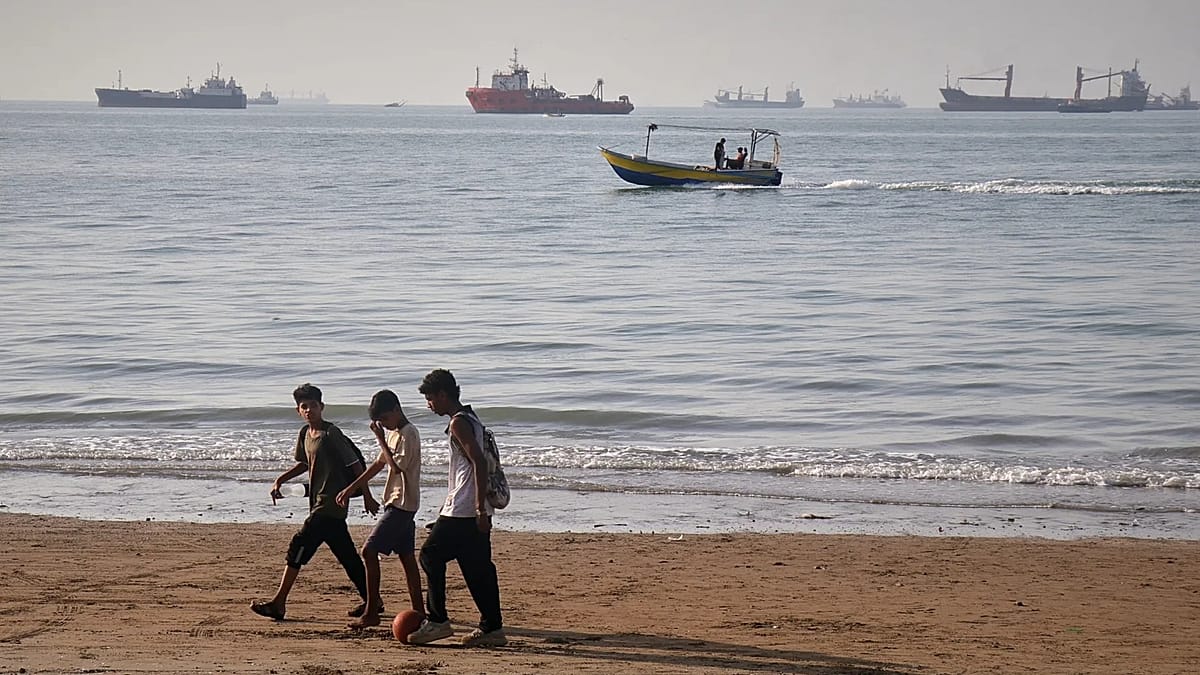
The US State Department unveiled the “Maritime Freedom Construct” (MFC) on Thursday, describing it as a framework to “take steps to ensure safe passage, including providing real-time information, safety guidance, and coordination to ensure vessels can transit these waters securely.” The announcement came as the Strait of Hormuz—through which roughly one-fifth of the world’s oil and liquefied natural gas normally flows—remains effectively blockaded by Iran since the start of the war, sending energy prices soaring and choking global trade networks. Washington’s own blockade of Iranian ports and vessels has further curtailed traffic through the strait.
Barrot emphasised that the US mission is “not of the same nature as the one we established … it comes as a sort of complement.” He added, “It is not in competition with the initiative we have launched and on which we are focused.” The UK and France have led separate talks on a maritime effort, recently convening a meeting with representatives from more than 50 countries.
The Wall Street Journal reported that a diplomatic cable called on US embassies to press foreign governments to join the US-led effort. When asked whether France would participate in Washington’s initiative, Barrot declined to comment at this stage. “The planning has been finalised,” he said of the UK-France mission. “I have come to present the concept of this mission to a number of our closest partners in the region.”
European Energy Security at Stake
The closure of the Strait of Hormuz has had severe repercussions for European economies heavily reliant on energy imports. France, along with other EU member states, has been scrambling to secure alternative supply routes and accelerate investments in renewables and nuclear power. The EU Accelerates Renewables and Nuclear Push After Strait of Hormuz Closure reflects the bloc’s urgency to reduce dependence on volatile Middle Eastern energy corridors.
US President Donald Trump has criticised allies for their reluctance to engage directly in the US-Israeli war on Iran and has urged oil-reliant nations to take responsibility for reopening the Strait of Hormuz. Iran has vowed not to reopen the waterway as long as the US maintains its blockade of Iranian ports.
Meanwhile, Iran’s judiciary chief, Gholamhossein Mohseni Ejei, stated on Friday that Tehran remains open to talks with the US but will not accept what he termed a policy “imposition.” “The Islamic Republic has never shied away from negotiations … but we certainly do not accept imposition,” Ejei said in a video carried by the judiciary-run Mizan Online website. He insisted that Tehran was “absolutely not willing to abandon our principles and values in the face of this malicious enemy in order to avoid war or prevent its continuation.”
Iran and the US held a single round of talks in Pakistan in mid-April, but those discussions ended without a breakthrough and have since stalled.
Nuclear and Missile Tensions
Iran’s new Ayatollah, Mojtaba Khamenei, has defiantly vowed to protect the country’s nuclear and missile capabilities, which Trump has sought to curtail through air strikes. In a statement read out on state television, Khamenei allegedly said the only place Americans belong in the Persian Gulf is “at the bottom of its waters” and that a “new chapter” was being written in the region’s history. The younger Khamenei has not been seen in public since taking over as ayatollah following the killing of his father and predecessor, Ali Khamenei, in the war’s opening salvos on 28 February, prompting questions about his condition.
Iran’s already shaky economy is reeling as its currency, the rial, hits new lows, while its oil industry is squeezed by the US blockade on its ports. The standoff has also stranded thousands of seafarers and disrupted global energy flows, as detailed in Strait of Hormuz Standoff Strands 20,000 Seafarers, Disrupts Global Energy Flows.
For European policymakers, the competing maritime initiatives underscore the challenge of coordinating a unified response to a crisis that directly threatens the continent’s energy security. France’s insistence that the US and European efforts are complementary, rather than rival, may help ease transatlantic tensions, but the underlying question of who will bear the cost and risk of securing the strait remains unresolved.