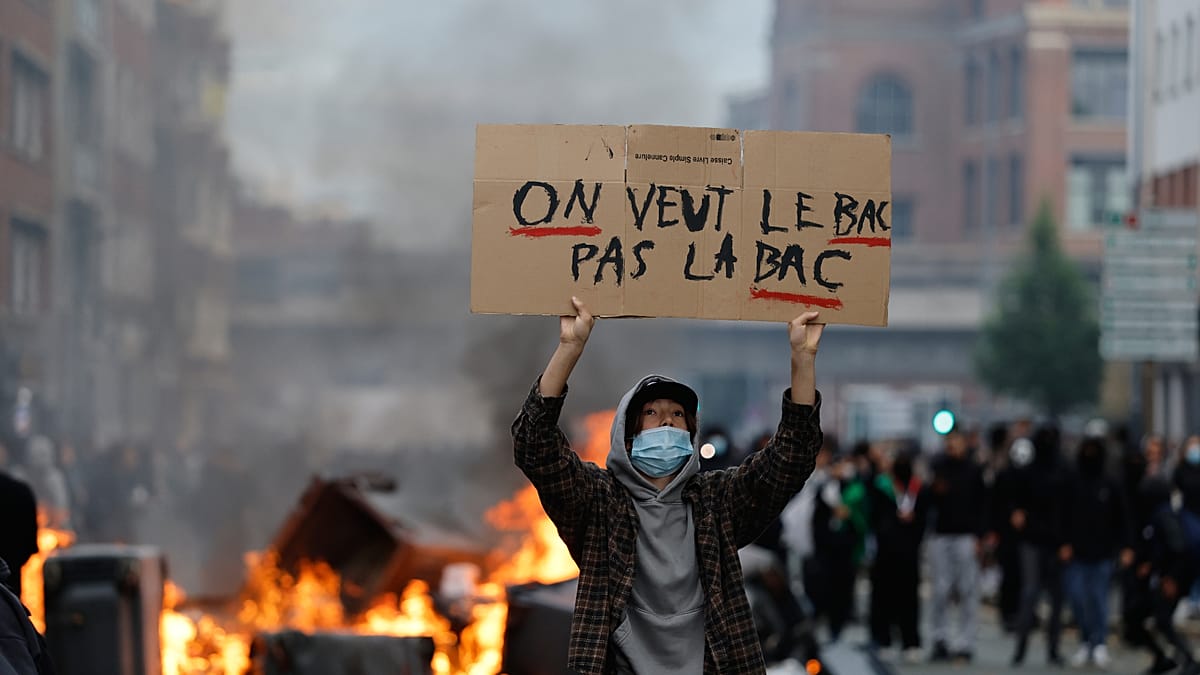
French students took to the streets in several cities on Tuesday, with clashes erupting between pupils and police in Paris, Toulouse, and Lille. The demonstrations, which began over concerns about school funding and working conditions, have escalated into a nationwide movement, prompting warnings from student leaders that protests will continue unless their demands are met.
Protests spread beyond the capital
Footage from the scenes shows groups of students facing off with riot officers, with some throwing projectiles and police responding with tear gas. In Paris, the protests centered around the Lycée Louis-le-Grand and other prestigious institutions, while in Toulouse and Lille, students blocked roads and occupied school courtyards. The unrest has not been confined to the capital; reports indicate that hundreds of lycées across the country have been shut down or disrupted, with hundreds of schools affected.
The trigger for the protests appears to be a combination of budget cuts, overcrowded classrooms, and a perceived lack of support for students from the government. Many demonstrators are also expressing solidarity with teachers, who have been striking over pay and working conditions. "We are fighting for our future," said Camille, a 17-year-old student in Paris. "The government is not listening to us, so we have to make our voices heard."
Police response and detentions
Authorities have moved to contain the unrest, with police making dozens of arrests. According to the interior ministry, at least 625 people have been detained nationwide, a figure that underscores the scale of the demonstrations. In some cases, officers used batons and shields to disperse crowds, leading to accusations of excessive force from student unions and human rights groups.
The clashes have also drawn attention to the broader context of social tensions in France. The country has seen a series of protests in recent years, from the gilets jaunes movement to pension reform demonstrations, and the current student unrest is being watched closely by political analysts. Some see it as a sign of growing frustration among young people, who face high unemployment and a housing crisis, as highlighted by similar housing protests in Spain.
Government response and next steps
So far, the government of Prime Minister Élisabeth Borne has urged calm, with Education Minister Pap Ndiaye calling for dialogue. However, student leaders have rejected the overture, insisting that concrete action is needed. "We are not interested in empty promises," said Lucas, a representative of the UNL student union. "We want a commitment to increase funding for education and to address the teacher shortage."
The protests have also coincided with a period of economic uncertainty, as France's budget outlook has been questioned by watchdogs. A recent growth forecast for 2027 was met with skepticism, and the government's fiscal room to maneuver is limited. This has led some commentators to suggest that the protests could put additional pressure on public finances, though others argue that investing in education is essential for long-term growth.
As the movement shows no signs of abating, universities are also beginning to join the blockades, with students in Lyon, Rennes, and Montpellier holding assemblies and voting to support the action. The involvement of university students could broaden the scope of the protests, potentially leading to a more sustained campaign.
For now, the situation remains fluid, with more demonstrations planned for the coming days. The question is whether the government will offer concessions or dig in, risking a prolonged standoff that could disrupt the end of the school year. For many students, the stakes are clear: they are fighting for the resources they believe are necessary for a quality education, and they are determined to be heard.