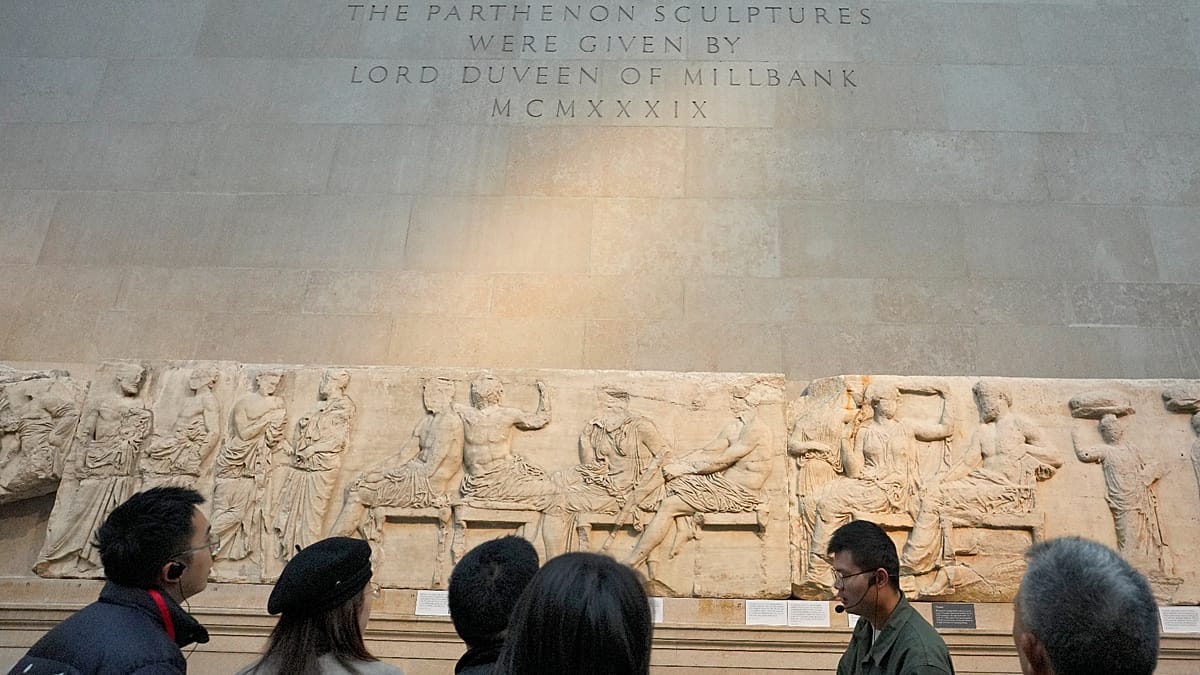
Talks between Greece and Britain over the fate of the Parthenon Marbles have reportedly stalled, prompting Athens to renew its diplomatic push for a return to the negotiating table. Greek Prime Minister Kyriakos Mitsotakis has written a forceful opinion piece in The Guardian, arguing that the sculptures' permanent reunification in Athens must be the goal, and rejecting any framework that would treat them as a loan.
According to reports in The Telegraph, negotiations have effectively broken down, with Athens expressing deep disappointment over the lack of progress. No talks are currently under way, and there appears to be no clear plan for their resumption. Greece had revived discussions with the British Museum in 2021, hoping to secure the return of the 5th-century BC sculptures that were removed from the Parthenon in the early 19th century by Lord Elgin.
A tale of two treasures
Mitsotakis's intervention comes after the British Museum suggested that the recent loan of the Bayeux Tapestry to Britain could serve as a model for the Parthenon Marbles. The Greek leader dismisses that comparison outright. The Bayeux Tapestry, he notes, is a single, continuous work of art that France lent to Britain and which will be returned. The Parthenon Sculptures, by contrast, are fragments of a single monument, now split between London and Athens.
“We cannot borrow parts of our own monument,” Mitsotakis writes. He argues that the issue is not merely about ownership or custody, but about restoring the “physical, aesthetic and conceptual integrity” of the Parthenon. The surviving sculptures should be displayed together, he insists, and in visual dialogue with the temple itself—something the Acropolis Museum was explicitly designed to achieve.
The Greek position is clear: Athens will not accept any agreement that requires Greece to recognise the British Museum's ownership of the sculptures or to treat them as objects it is “borrowing.” The British Museum, for its part, maintains that under current law it can lend the pieces but cannot permanently transfer them, and that any loan would require recognition of its title.
Why the Bayeux comparison fails
Mitsotakis argues that the Bayeux Tapestry—a nearly 70-metre-long embroidered narrative of the Norman conquest—is a unified artwork whose meaning depends on being seen as a whole. Cutting it up and displaying parts in different countries would be unthinkable, he says. The Parthenon Sculptures, he contends, were created as integral parts of a single architectural and artistic ensemble, and should be treated with the same respect.
“It is not about emptying museums,” Mitsotakis stresses, seeking to distinguish Greece's claim from broader calls for mass repatriation. The Parthenon case is unique, he argues, because what is at stake is not simply a change in custody but the restoration of a monument of global significance.
He also points to public opinion: a poll published last year found that a majority of Britons support the return of the sculptures, with 72% agreeing that they are better understood as part of a single entity with the Parthenon.
UNESCO and the legal dispute
Greece has repeatedly raised the issue at UNESCO, where the Intergovernmental Committee has called on the UK to engage in dialogue. The British government and the British Museum argue that Lord Elgin obtained a lawful permit from the Ottoman authorities, who then ruled Greece. Athens disputes this, and in 2024 Turkey—whose Ottoman archives are relevant—expressed support for the Greek position, saying no evidence of such a permit has been found.
Mitsotakis concludes by suggesting that reunification could become a model for cultural cooperation between Greece and Britain, opening new avenues for exhibitions, research, and conservation. He calls for the “political will” to break the impasse, and notes that his government has held “detailed discussions” with the British Museum's leadership in recent years.
The debate over the Parthenon Marbles remains one of Europe's most enduring cultural disputes, touching on questions of heritage, legality, and national identity. As Greek diplomats warn of broader global challenges, the marbles issue continues to test the relationship between Athens and London.