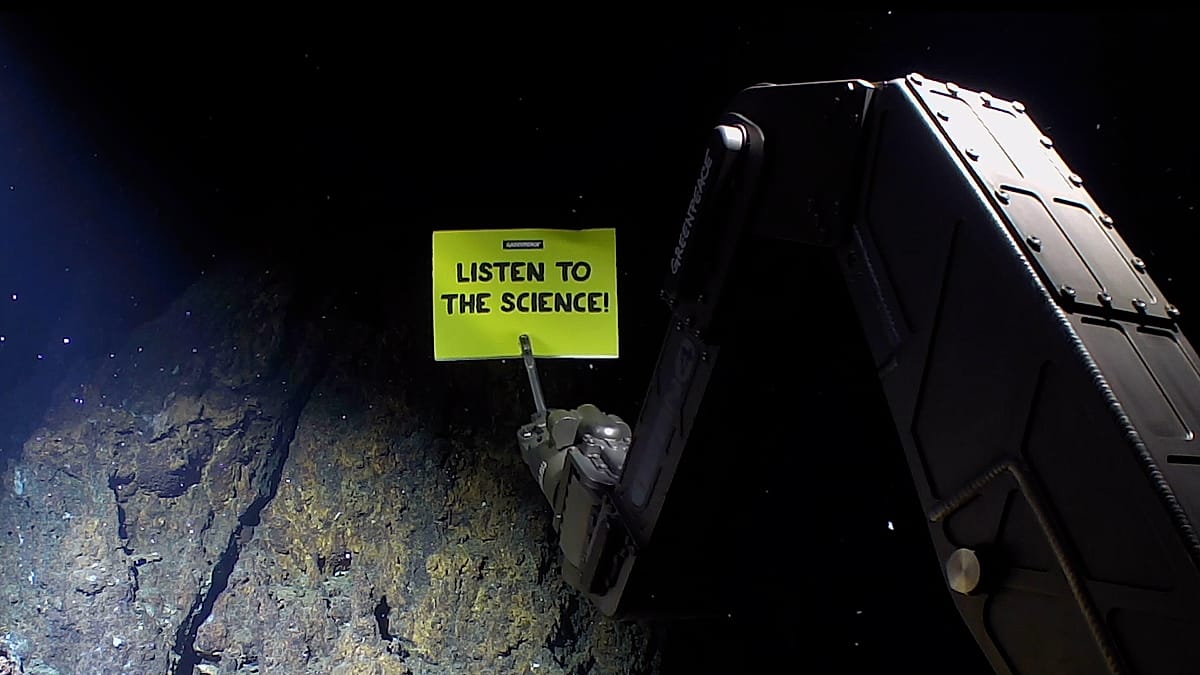
Environmental group Greenpeace has staged what it calls the deepest protest in history, deploying a robot more than 2,300 metres below the ocean surface to unfurl a banner reading “Listen to the Science” in opposition to deep-sea mining. The action, carried out in international waters, aims to draw attention to the potential ecological devastation of mining the seabed for minerals used in batteries and electronics.
Record-Breaking Protest in the Deep Ocean
The remotely operated vehicle descended to a depth of 2,300 metres—far deeper than any previous protest—to display the message. Greenpeace activists coordinated the operation from a surface vessel, highlighting the growing technological capacity of civil society to monitor and challenge industrial activities in remote environments.
“We are sending a clear message to governments and corporations: the deep sea is not a mining pit,” said a Greenpeace spokesperson. “The science is unequivocal—seabed mining would cause irreversible harm to marine ecosystems that we are only beginning to understand.”
The protest comes as the International Seabed Authority (ISA) continues to develop regulations for deep-sea mining, with several countries and companies pushing to begin commercial extraction as early as 2025. The ISA, based in Kingston, Jamaica, has faced mounting pressure from environmental groups and some European governments to impose a moratorium.
European Stakes in the Seabed Mining Debate
European nations are deeply divided on the issue. France, Germany, and several other EU member states have called for a precautionary pause, while Norway has moved forward with plans to open its continental shelf to exploration. The European Commission has funded research into deep-sea ecosystems but has not taken a definitive stance on mining.
“The EU must lead by example,” said a spokesperson for the European Environmental Bureau, a coalition of green groups. “Instead of rushing to exploit the deep sea, we should invest in recycling and sustainable alternatives to reduce demand for new minerals.”
The debate is intertwined with Europe’s push for a green transition. Minerals such as cobalt, nickel, and manganese are essential for electric vehicle batteries and renewable energy storage. However, environmentalists argue that seabed mining could destroy habitats that take millennia to form and disrupt carbon storage processes crucial for climate regulation.
In a related development, the Nordic Coalition has warned the EU against expanding Arctic drilling, underscoring the tension between resource extraction and environmental protection in sensitive regions.
Scientific Concerns and Regulatory Gaps
More than 700 marine scientists from over 40 countries have signed a petition calling for a moratorium on deep-sea mining until comprehensive environmental impact assessments are completed. Studies have shown that mining operations could generate sediment plumes that smother marine life, release toxic metals, and disrupt the migration patterns of species like tuna and whales.
“We know less about the deep ocean than we do about the surface of Mars,” said Dr. Lisa Levin, a marine biologist at the Scripps Institution of Oceanography. “Proceeding with mining before we understand the consequences is reckless.”
The ISA is expected to finalize its mining code by July 2025, but critics say the process has been opaque and dominated by industry interests. Several Pacific island nations, including Nauru and Tonga, have sponsored companies to apply for exploration licenses, hoping to benefit from mineral wealth. In contrast, the European Parliament has passed resolutions urging the EU to support a moratorium.
The protest also echoes broader European activism against environmental degradation. Earlier this year, Pussy Riot and FEMEN protested Russia's return to the Venice Biennale, linking cultural events to geopolitical and ecological issues.
What Comes Next
Greenpeace has vowed to continue its campaign, targeting companies and governments that back seabed mining. The group plans to release further evidence of the potential impacts and to pressure retailers and manufacturers to commit to sourcing minerals only from land-based mines with higher environmental standards.
Meanwhile, the European Commission is expected to publish a strategy on ocean governance later this year, which may include recommendations on deep-sea mining. Environmental groups hope the protest will shift public opinion and political will toward a precautionary approach.
“The deep sea is the last frontier on Earth,” the Greenpeace spokesperson added. “We must protect it, not plunder it.”