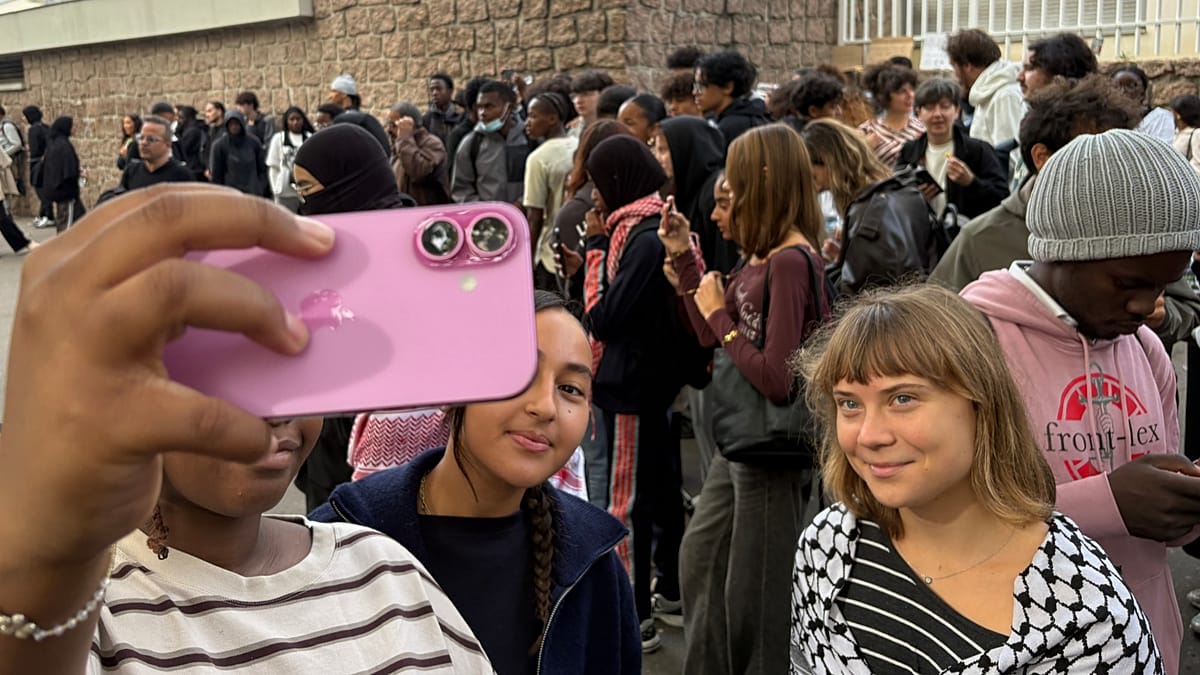
Swedish climate activist Greta Thunberg stood alongside French high school students in Saint-Denis on Tuesday, lending her voice to a movement demanding better conditions in the country's schools. The 23-year-old, who rose to prominence through youth climate strikes, joined pupils outside the Paul Éluard high school, where lawyers formed a human chain to protect teenagers amid allegations of police brutality.
"Young people are not being included in the conversation. Our future is being robbed away from us," Thunberg told AFP, echoing the frustrations of students who say their grievances have been ignored.
The protests, which began in late September, have seen tens of thousands of students take to the streets across France. They are demanding action on chronic teacher shortages, dilapidated buildings, overcrowded schedules, and other systemic problems. The movement has drawn support from trade unions and the far-left opposition party La France Insoumise, with a midday march planned through Paris and similar rallies in other cities.
Blockades and clashes
On Tuesday morning, students blockaded entrances to several schools in the Paris region, while in Marseille they slowly pushed dumpsters in front of their high school. The education ministry reported that around 200 schools were closed, fewer than last week, as authorities sought to avoid damage near protest routes.
Most demonstrations have been peaceful, but clashes with police have occasionally broken out. The ministry said eight teaching staff were injured on Monday, mostly in the Paris region, Bordeaux, and Lyon. In Reims, fireworks fired through a tube injured two school workers, and similar incidents were reported in a Paris suburb and Marseille.
More than 6,800 people, largely minors, have been taken into police custody since the protests began, according to the justice ministry. Police have opened internal investigations into 24 allegations of brutality against demonstrators.
"Students aren't being heard enough... not their proposals to authorities and elected officials," said Léo, a 19-year-old graphic design student in Paris. He added that protesters, many of whom are minors, were "disturbed by the level of repression never before seen for a student movement."
President Emmanuel Macron, speaking at the Paris Motor Show on Monday, urged restraint. "These are issues that deserve time, consultations, discussion and respect," he said, just months before elections to replace him.
The government has promised to deploy around 3,000 substitute teachers to the 114 worst-affected high schools. Education Minister Édouard Geffray said on Tuesday that 35% had already been assigned.
Tuesday's demonstrations were to be followed on Saturday by wider public rallies against the rising cost of living. Naila, a 17-year-old student in Rennes, hoped the two movements would "converge."
The protests have drawn attention beyond France, with the United Nations warning over violence as the movement entered its fifth day. They also come amid broader European concerns about education funding and social inequality, as seen in Portugal's housing protests and Madrid's housing demonstrations.
For many observers, the French student movement is a test of whether the government can address deep-seated frustrations before they escalate further. As analysts have noted, it may be a precursor to a broader crisis of confidence in public institutions.