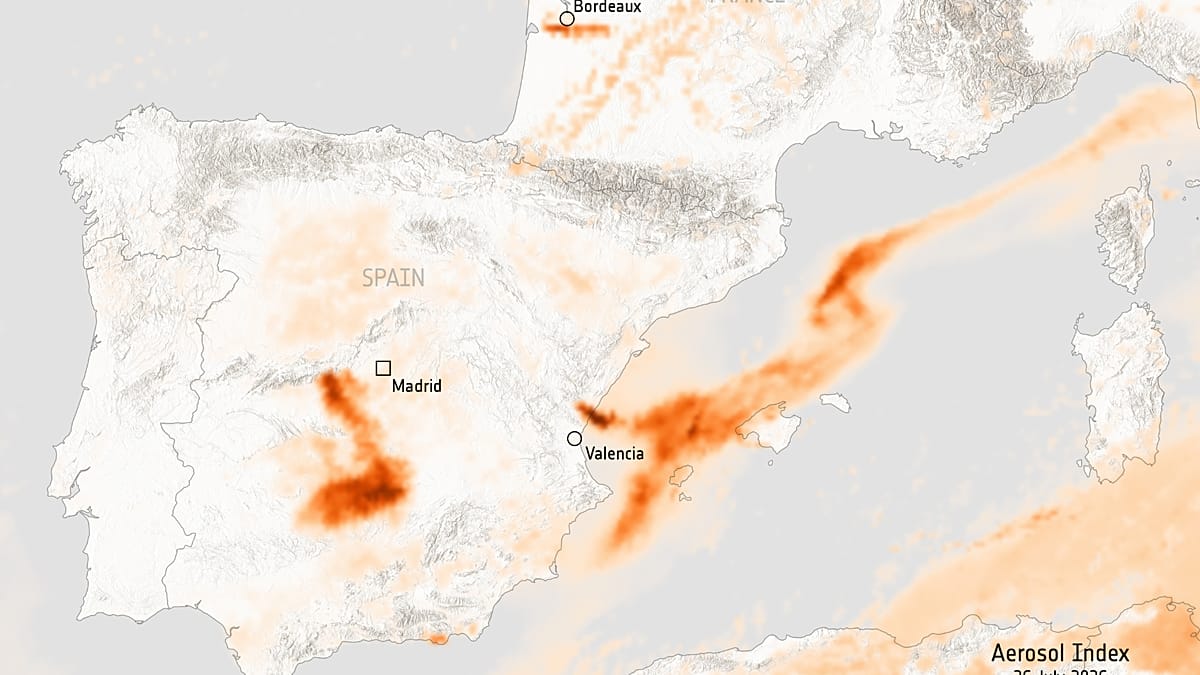
During the heatwaves and wildfires that swept the continent between June and August, roughly half of Europe's population was exposed to ground-level ozone at concentrations the EU classes as poor, very poor or extremely poor. The figures come from the Copernicus Atmosphere Monitoring Service (CAMS), the European Commission's atmospheric watchdog, in its first annual Atmosphere Watch report.
Ozone is not the pollutant most Europeans think of when they picture dirty air. Unlike the protective ozone layer high in the stratosphere, ground-level ozone is a secondary pollutant: it forms when sunlight and high temperatures drive thousands of chemical reactions involving nitrogen oxides and volatile organic compounds, most of them produced by burning fossil fuels. The result is a gas that can penetrate deep into the respiratory system and enter the bloodstream, reaching organs throughout the body. Asthmatics, children and the elderly are most at risk.
Why heatwaves make the problem worse
Because ozone formation depends on temperature, the record-breaking heat that gripped southern and central Europe this summer translated directly into dangerous air. "Ozone pollution is a stark reminder of how interconnected our atmosphere, climate, health, and livelihoods really are," said Laurence Rouil, director of CAMS. The report describes ground-level ozone as illustrating the tight coupling between air pollution and climate change, since the same fossil-fuel combustion that warms the planet also supplies the precursors of ozone.
As a greenhouse gas in its own right, ozone is responsible for roughly 0.23°C of present-day warming, according to the UK charity Clean Air Fund, which calls it a "super pollutant". Wildfire smoke compounds the problem: hotter, drier conditions produce more extreme fires, which release additional precursors and can carry pollution thousands of kilometres. When Belgium suffered its worst wildfire in a century in August, the smoke plumes travelled through Germany as far as Poland. "Air pollution knows no border," said Florian Pappenberger, director-general of the European Centre for Medium-Range Weather Forecasts.
Milan among the world's worst
The geography of exposure is stark. Peak-season surface ozone is highest across southern Europe, where heatwaves were hottest and most prolonged. Under the EU Ambient Air Quality Directive, the maximum eight-hour daily average should not exceed 120 μg/m³ on more than 18 days a year, with a long-term objective of 100 μg/m³ in line with World Health Organization guidance. Large parts of the continent breached those thresholds this year.
Milan stands out even by global standards, recording some of the worst ozone levels measured anywhere. The Po Valley's combination of intense summer heat, industrial activity and heavy road traffic makes northern Italy a persistent hotspot. Worldwide, almost 40 per cent of the global population was exposed to extremely high ozone levels in 2026, including 60 per cent of Asians; Oceania was least affected.
Progress on other pollutants, stagnation on ozone
There is a paradox at the heart of the report. Europe has made substantial progress against the pollutants it regulates most aggressively. Sulphur oxide and nitrogen oxide emissions have fallen by roughly three to five per cent a year across the EU over the past decade. Since 2015, industrial sulphur oxide emissions have dropped 59 per cent and industrial nitrogen oxides 39 per cent, while road transport has cut nitrogen oxides by 40 per cent and fine particulate matter (PM2.5) by 34 per cent.
Yet ozone "shows no clear downward trend and remains an issue", the report warns. The reasons are complex: ozone is transported across borders, its chemistry is non-linear, and continued warming can offset gains from cleaner industry and transport. The European Air Quality Directive, revised in 2024 and widely considered among the world's most ambitious air-quality laws, obliges member states to monitor pollutants and act when limits are exceeded.
Public health officials point to a familiar set of remedies: better public transport, low- and zero-emission zones in cities, a faster shift away from fossil fuels, and reduced meat consumption. Air pollution is linked to more than four million premature deaths globally each year, according to the WHO, and in 2025 was associated with 56 deaths per 100,000 people across Europe and Central Asia. For Milan and other southern European cities, the coming summers will test whether those remedies can outpace the heat.