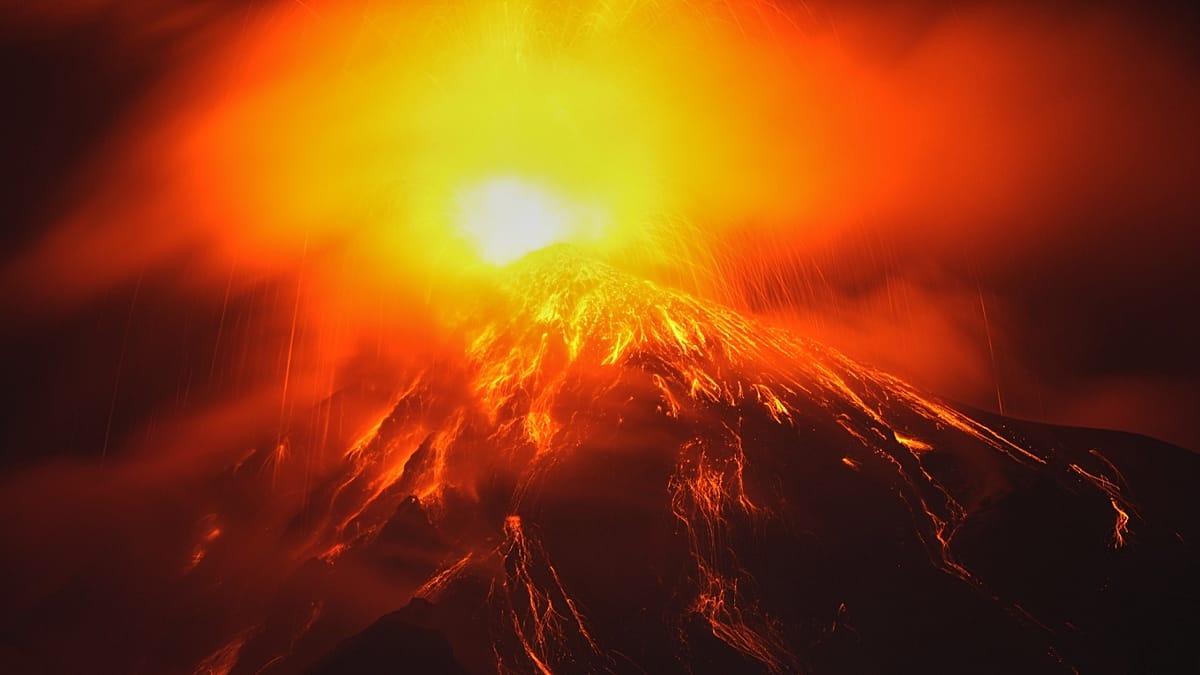
Hundreds of families living on the slopes of Guatemala's Fuego volcano have spent the past two days evacuating as the country's most active volcano continues to erupt with renewed intensity. By Tuesday morning, the eruption had lasted more than 23 hours, sending rivers of lava down the mountain and a column of ash roughly six kilometres into the sky.
Emergency services issued a red alert — the highest warning level — after the volcano, which sits less than 100 kilometres from Guatemala City, erupted on Monday morning. Conditions worsened through the night, prompting authorities to urge residents in high-risk areas to leave voluntarily.
"Since early morning it was active. That night, the alarm was raised that we needed to evacuate," local resident Alejandro Garcia told the AFP news agency. He described terrifying scenes of lava oozing down the mountainside, with villagers leaving of their own accord out of fear.
Firefighters reported transporting at least 500 residents from the villages of El Porvenir and Las Lajitas to the municipality of San Juan Alotenango, east of the volcano. There, evacuees are being housed in a community hall where makeshift beds have been set up. The total number of people moved to other nearby towns remains unclear, but authorities say around 1,700 people are now in shelters.
Shelter life and lingering fear
At the San Juan Alotenango shelter, Lidia Ortiz told AFP that the constant threat of the volcano weighs heavily on evacuees. "If there were any chance of moving to a different house, it would be better, because you're always afraid since the volcano doesn't give any warning," she said.
In Escuintla, to the south, local authorities reported sheltering dozens more families, including children. The red alert applies to the departments of Sacatepéquez, Chimaltenango and Escuintla, an area home to roughly 1.6 million people.
Claudine Ogaldes, director of emergency services, called on at-risk families to come to shelters voluntarily. "In those spaces, you will find care, support and safe conditions while the volcanic activity continues," she wrote on X.
Guatemala's Institute of Volcanology warned of hot volcanic debris flows down Fuego's slopes, with communities on the western and southern flanks facing the greatest risk. Although the intensity of the eruption was easing slightly by Tuesday morning, the institute said the volcano had been erupting continuously for 23 hours.
"We've already gotten used to having the volcano constantly active, but this time it was really too much," said 50-year-old resident Sonia Vásquez.
So far, the capital's international airport has not been affected. The education ministry suspended face-to-face classes in communities within two municipalities near the volcano, and police temporarily closed a road leading to the colonial city of Antigua, a UNESCO World Heritage site and popular tourist destination, before reopening it.
Guatemala lies on the Pacific "Ring of Fire" and experiences frequent seismic and volcanic activity. Fuego has triggered several mass evacuations in recent years. Last year, more than 500 people were moved to shelters after the volcano emitted gas and ash. In 2023, around 1,200 people were evacuated. The deadliest recent event came in 2018, when pyroclastic flows destroyed a village, killing 215 people and leaving a similar number missing.
While this eruption has not yet caused casualties, the scale of the displacement and the ongoing volcanic activity underscore the region's vulnerability. For the evacuees, the immediate future remains uncertain as they wait for the volcano to calm and for authorities to assess when it might be safe to return home.