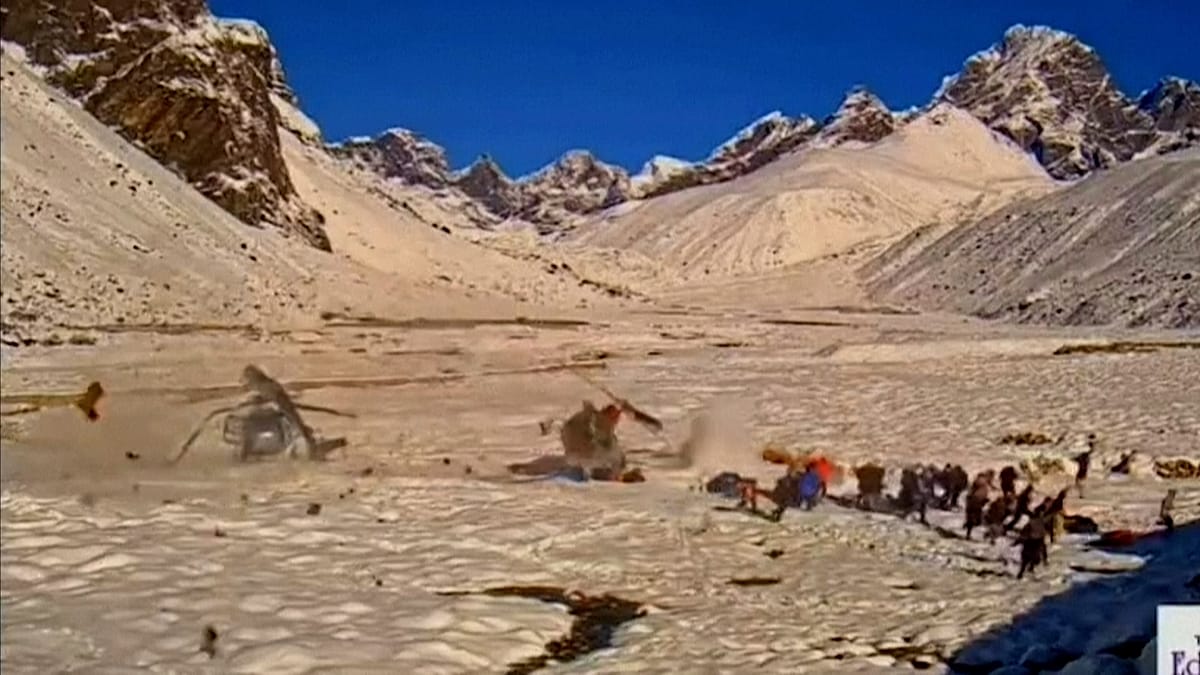
Two small helicopters collided while attempting to land on a snowy site in Nepal's Solukhumbu district, a region that serves as the gateway to Mount Everest. The crash killed an Indian tourist and left a New Zealander injured, according to local officials.
The accident occurred on [date], when the two aircraft, operated by local companies, were approaching a helipad near the village of [village name, if known]. Video footage circulating on social media shows the moment of impact, with one helicopter clipping the other as both descended. The cause of the collision is not yet clear, and Nepal's civil aviation authority has launched an investigation.
High-altitude risks
Solukhumbu district, home to the Sherpa people and the main trekking routes to Everest Base Camp, is one of the busiest helicopter corridors in the Himalayas. Helicopters are widely used to ferry tourists, supplies, and medical evacuations in an area where roads are scarce and weather can change within minutes.
The collision underscores the inherent dangers of flying in such terrain. Pilots must navigate narrow valleys, strong winds, and sudden cloud cover, often landing on unprepared or makeshift pads. Despite these challenges, the region has seen a steady increase in helicopter traffic, driven by a boom in adventure tourism and luxury trekking packages.
Nepal's aviation safety record has improved in recent years, but the country still faces scrutiny over oversight and maintenance standards. The European Union has previously banned Nepali airlines from its airspace due to safety concerns, though that ban was lifted in 2013 after reforms. However, helicopter operations remain largely domestic, and international standards are not always applied.
The injured New Zealander was airlifted to a hospital in Kathmandu, where their condition was reported as stable. The Indian tourist's body was recovered and is being repatriated. The identities of the pilots and other passengers have not been released.
Local authorities have cordoned off the crash site, and a team of investigators is expected to arrive in the coming days. The incident has reignited calls for stricter regulation of helicopter operations in the region, with some experts advocating for mandatory flight data recorders and enhanced pilot training.
For the thousands of European trekkers and climbers who visit the Everest region each year, the news serves as a reminder of the risks involved. Many European tour operators offer helicopter sightseeing flights as an add-on to trekking itineraries, and the demand for such services continues to grow.
As the investigation unfolds, the focus will be on determining whether pilot error, mechanical failure, or weather conditions played a role. The outcome could have implications for the future of helicopter tourism in Nepal, a sector that is vital to the local economy but increasingly under scrutiny.
This incident is not isolated. In recent years, there have been several helicopter crashes in the Himalayas, including a fatal accident in 2019 that killed a pilot and a passenger. The region's challenging environment demands the highest safety standards, and any lapse can have tragic consequences.
For now, the families of the victims mourn, and the aviation community in Nepal grapples with yet another reminder of the fragility of life in the world's highest mountains.