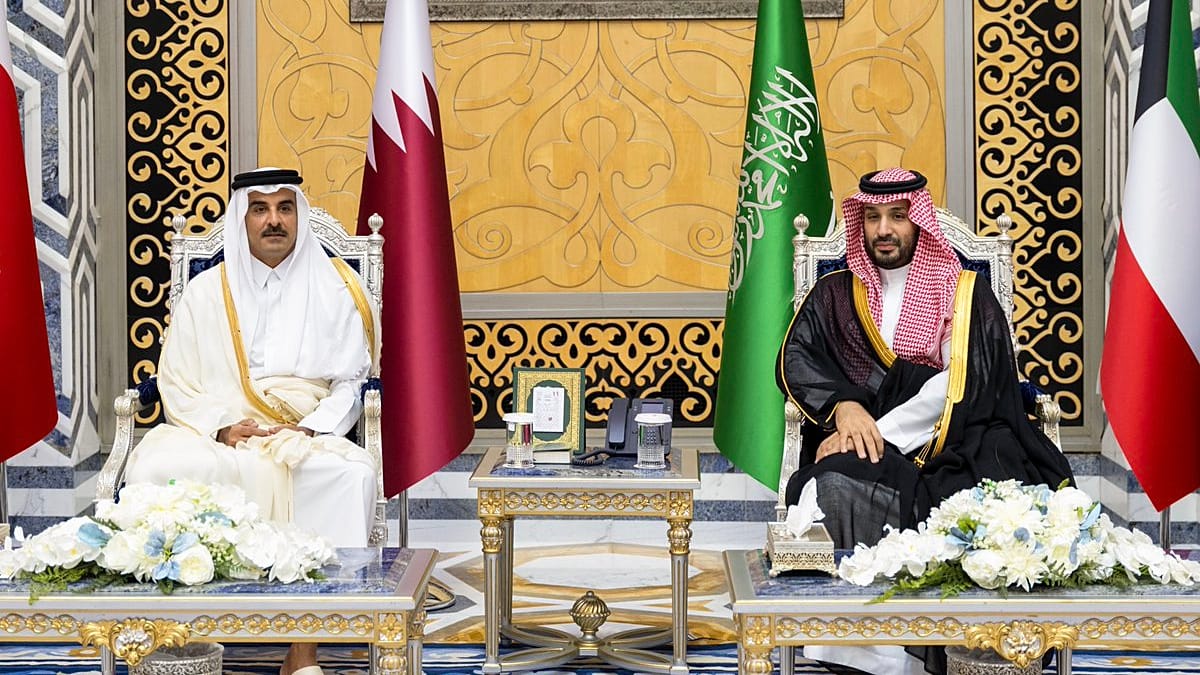
Gulf leaders convened in Jeddah on Tuesday for their first in-person summit since the outbreak of the Iran war, aiming to project a unified front even as the meeting yielded no concrete joint measures. Chaired by Saudi Crown Prince Mohammed bin Salman, the consultative Gulf Cooperation Council (GCC) session focused on coordination, diplomacy, and regional security after weeks of Iranian missile and drone strikes on energy and civilian infrastructure across the bloc.
The summit was as much about signalling unity as delivering outcomes. Saudi Crown Prince Mohammed bin Salman personally received Qatar's Emir Tamim bin Hamad Al Thani at the aircraft upon arrival in Jeddah—a gesture that went beyond routine protocol and underscored political warmth. Similar scenes with Bahrain and Kuwait reinforced the image of a bloc closing ranks under pressure, reflecting how far Saudi-Qatari ties have stabilised since the 2017–2021 rift.
Unity narrative, underlying fractures
Despite the strong visuals, the summit also exposed the limits of Gulf unity. The United Arab Emirates, represented by Foreign Minister Abdullah bin Zayed Al Nahyan rather than its president, has openly criticised the GCC's response to the Iran war. Just a day before the meeting, senior Emirati official Anwar Gargash described the bloc's political and military stance as the 'weakest in its history,' pointing to frustration over the lack of a coordinated response. Oman's absence, with no public confirmation of representation, further highlighted uneven engagement within the bloc at a critical moment.
Official statements pointed to broad areas of agreement rather than concrete policy steps, with leaders emphasising diplomacy, regional coordination, and the reopening of the Strait of Hormuz. GCC Secretary-General Jasem Mohamed Albudaiwi said discussions focused on finding a diplomatic path that addresses Gulf security concerns and supports long-term stability, while Qatar warned against the risk of a prolonged 'frozen conflict'.
The summit took place as Gulf states try to balance their security ties with the United States while avoiding further escalation with Iran, with uncertainty still surrounding talks between Washington and Tehran. At the same time, disruptions to energy flows and shifting regional dynamics continue to shape the Gulf's response.
For European observers, the Gulf's internal divisions carry significant implications. The Iran conflict has already pushed the eurozone into recession, as PMI data signals a sharp downturn. Meanwhile, a Pentagon leak revealed plans to suspend Spain from NATO over its refusal to participate in the Iran war, underscoring how the crisis is straining transatlantic alliances. The Gulf's inability to present a united front may further complicate European efforts to secure energy supplies and maintain diplomatic stability.
As the GCC struggles to coordinate, the broader geopolitical landscape remains uncertain. The summit in Jeddah may have projected unity, but the absences and critical signals from key members suggest that the bloc's cohesion is far from assured.