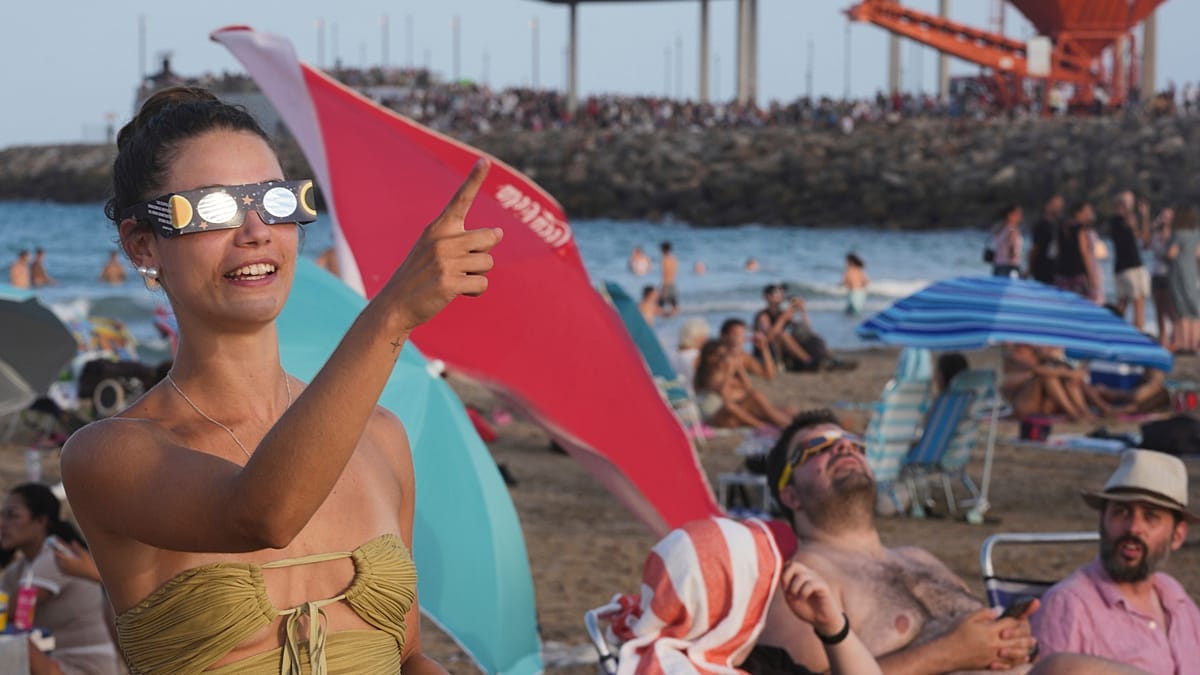
On Wednesday 12 August, a total solar eclipse swept across northern Spain, drawing more than half a million visitors to a narrow corridor stretching from the Atlantic coast to the Mediterranean. It was the first time in over a century that the region experienced a total eclipse, and the event turned towns and rural plains into open-air observatories.
The moon passed directly in front of the sun shortly after midday, plunging areas along the path of totality into darkness for up to four minutes. In Soria, on the high plains of Castilla y León, crowds gathered at the ancient hilltop fortress of Gormaz, a site that had been promoted for months as one of the best vantage points. Local authorities reported that the population of some villages more than doubled overnight as eclipse chasers arrived from across Europe and beyond.
A continental spectacle
The event was not just a Spanish affair. Visitors came from France, Germany, the United Kingdom, and as far away as Japan and the United States. Many had planned their trips years in advance, booking hotels and campsites along the path of totality. In Zaragoza, the regional capital of Aragón, city officials set up viewing areas in parks and squares, distributing certified eclipse glasses to thousands of attendees.
For many, the appeal lay in the unique conditions of the Iberian Peninsula: clear skies, accessible infrastructure, and a well-publicised path that crossed several major cities. Unlike previous eclipses in remote locations, this one offered a rare combination of natural wonder and urban convenience.
The eclipse also had a scientific dimension. Researchers from the European Space Agency and several universities used the event to study the sun's corona, the outer atmosphere that becomes visible only during totality. Balloons and drones equipped with cameras were launched from multiple sites to capture images from above the clouds.
Local economies and logistics
The influx of visitors provided a significant boost to local economies. Hotels reported full occupancy for weeks in advance, and restaurants and shops in small towns saw record sales. In Soria, the provincial government estimated that the eclipse generated over €20 million in revenue, a substantial sum for a region often overlooked by mass tourism.
However, the surge also tested infrastructure. Roads leading to prime viewing spots were congested for hours, and some rural areas experienced temporary shortages of water and fuel. Authorities had prepared for the crowds, setting up temporary parking areas and shuttle services, but the sheer number of people exceeded expectations.
One of the challenges after the event is the disposal of millions of eclipse glasses. Many municipalities have launched collection points to recycle the cardboard and plastic frames, aiming to keep them out of landfills. Recycling initiatives are being coordinated with local waste management companies.
Health officials also reminded the public to watch for symptoms of retinal damage, which can occur if proper eye protection is not used. Signs of damage include blurred vision or dark spots, and anyone experiencing these is advised to seek medical attention.
For those who missed the event, the next total solar eclipse visible in Europe will occur in 2026, but it will pass over Iceland and the Arctic. Spain will not see another total eclipse until 2028, when the path crosses the southern part of the country.
As the crowds dispersed, many expressed awe at the experience. "It was like nothing I've ever seen," said María González, a visitor from Madrid. "The darkness, the silence, the stars appearing in the middle of the day—it was almost spiritual."
The eclipse also served as a reminder of the power of natural phenomena to bring people together. In a continent often divided by borders and politics, for a few minutes, everyone looked up at the same sky.