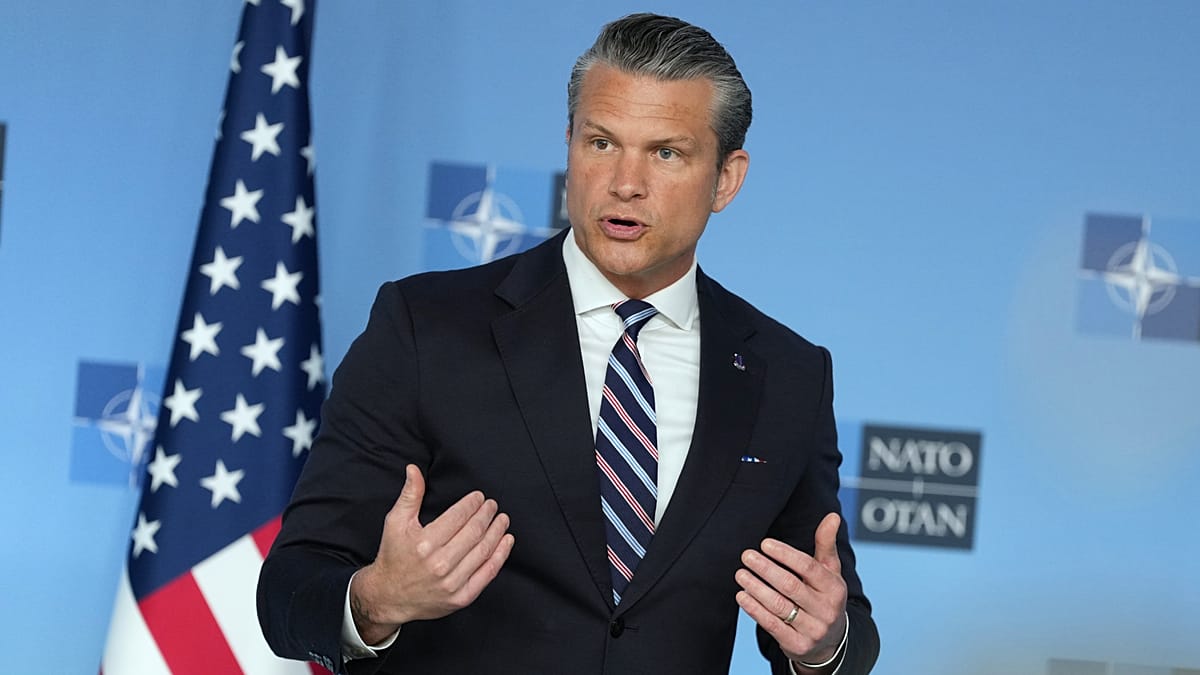
US Secretary of War Pete Hegseth told NATO counterparts in Brussels on Thursday that European allies must take the lead in building what he called a revamped 'NATO 3.0' — a 'real, hardline military alliance' capable of deterring aggression on the continent. The remarks, delivered ahead of a meeting of defence ministers, underscore a significant shift in Washington's posture toward European security under President Donald Trump.
'NATO 3.0 is post-Cold War recognition that needs to go back to a real, hardline military alliance that has real military capabilities capable of deterring right here on the continent and taking the lead for the conventional defence of Europe,' Hegseth said. His comments come as the Trump administration pushes European allies to increase defence spending and signals a gradual reduction of US military commitments in Europe, redirecting resources toward China and the Indo-Pacific region.
US Drawdown and European Burden-Sharing
Trump has repeatedly pressed NATO members to meet the alliance's defence spending targets. In May, Washington reportedly informed NATO allies that it would reduce the number of bombers, fighter jets, warships, and other military assets assigned to the alliance. Trump has also threatened to withdraw US troops from Germany amid tensions with Chancellor Friedrich Merz, and later from Poland, before reversing course and announcing the deployment of an additional 5,000 forces to Poland.
At the Hague Summit last year, NATO members committed to investing 5% of GDP annually on core defence and broader defence-and security-related areas by 2035. Hegseth acknowledged that many allies have followed through but warned that 'some still need to do more.' 'We will be candid about that both in private and in public,' he told reporters on Thursday, while also touting Trump's proposed $1.5 trillion defence budget as a 'message to the world.'
The push for a more self-reliant European defence architecture comes as the Trump administration pursues a more transactional approach to alliances. At the recent G7 summit in Évian, Trump's interactions with European leaders were marked by both tension and deal-making, including a patch-up with Italian Prime Minister Giorgia Meloni after weeks of friction, and a lighthearted moment with Merz over a personalized football jersey.
Implications for European Security
Hegseth's call for a 'NATO 3.0' reflects a broader debate within the alliance about its future role. For decades, the United States has been the dominant military power in NATO, providing the bulk of its conventional and nuclear deterrent. But as Washington pivots to the Indo-Pacific, European members — including the 27 EU states plus the UK, Switzerland, Norway, and the Balkans — are being asked to shoulder more of the burden for their own defence.
The shift has been met with mixed reactions across the continent. Some leaders, particularly in Eastern Europe and the Baltics, have long advocated for higher defence spending and a more robust NATO posture. Others, especially in Western Europe, have been more cautious, wary of provoking tensions with Russia and mindful of domestic budget constraints. The challenge is compounded by the need to coordinate defence investments across 30 allies with different strategic priorities and industrial capabilities.
Hegseth's remarks also come amid ongoing diplomatic efforts to resolve the war in Ukraine. At the Évian summit, G7 leaders urged Trump to break the Ukraine deadlock, while the US president separately urged Israeli Prime Minister Benjamin Netanyahu to restrain operations in Lebanon. The interplay between these crises underscores the complexity of European security in a multipolar world.
For now, the onus is on European capitals to translate Hegseth's rhetoric into concrete action. Whether they can overcome internal divisions and build a credible 'NATO 3.0' remains an open question — but the message from Washington is clear: the era of US-led defence of Europe is giving way to a new model of shared responsibility.