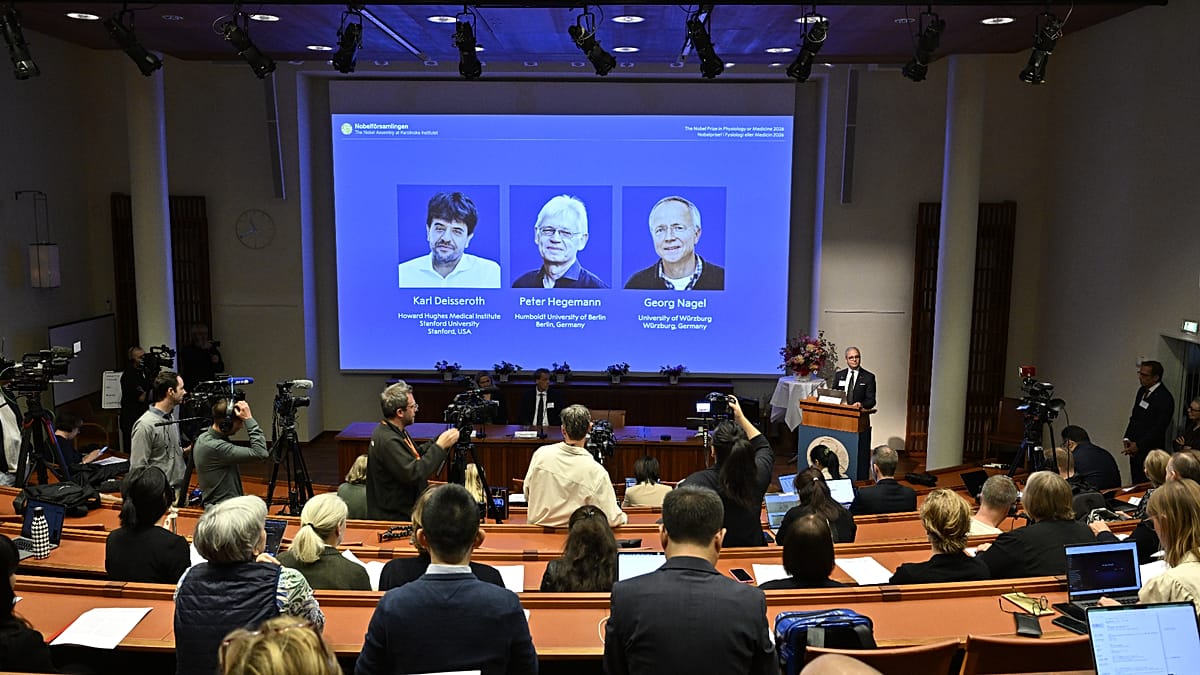
On Monday, the Nobel Assembly at Karolinska Institutet in Stockholm announced that the 2026 Nobel Prize in Physiology or Medicine would go to Karl Deisseroth, Peter Hegemann and Georg Nagel for their pioneering work on light-gated ion channels and optogenetics. The committee described their contributions as laying the foundation for “a new era in neuroscience.”
Optogenetics is a technique that allows researchers to control specific cells in living tissue using light as a remote control. By introducing light-sensitive proteins into neurons, scientists can switch them on or off with millisecond precision, then observe how that activity influences behaviour, perception or disease. It has become one of the most powerful tools in modern brain research.
The story begins more than two decades before the term “optogenetics” was coined in 2006. Peter Hegemann, then working in Germany, was studying the single-celled alga Chlamydomonas, which famously swims toward light. He wanted to understand the molecular machinery behind this phototaxis. His team focused on the alga’s eyespot, a tiny orange structure on the cell surface that detects light. Through careful experiments, they identified a family of light-sensitive proteins called channelrhodopsins.
Together with Georg Nagel, then at the Max Planck Institute for Biophysics in Frankfurt, Hegemann took the next crucial step. They inserted the algal genes into frog egg cells and human kidney cells, proving that channelrhodopsin functions as a light-controlled ion channel. When exposed to blue light, the channel opened within 0.2 milliseconds, allowing positively charged ions to flow into the cell and generate an electrical impulse. This was the first demonstration that a single protein could translate light into a neural signal.
The third laureate, Karl Deisseroth, working at Stanford University, saw the broader potential. He introduced the channelrhodopsin gene into rat neurons and showed that blue light could trigger action potentials—the basic electrical signals of the nervous system. He then moved to living mice, using light to control neurons in the brain. In one striking experiment, researchers could make a mouse’s whiskers twitch or wake a sleeping animal simply by switching on a light source.
Per Svenningsson, chair of the Nobel Committee for Physiology or Medicine, said in a press release that the discovery “provides opportunities for mapping the brain in a way that we could once only dream of.” That mapping is now happening across laboratories in Europe and beyond.
From basic research to clinical promise
Today, optogenetics is primarily a research tool. It allows scientists to establish direct cause-and-effect relationships between neural activity and behaviour. Researchers can turn on or off specific cell types in the brain to study circuits involved in fear, anxiety, reward, pain, thirst, attention or aggression. This precision is unmatched by earlier techniques such as electrical stimulation or drugs, which affect many cell types at once.
The method has become a staple in neuroscience labs, including many in Europe—from the Max Planck Institutes in Germany to the Sainsbury Wellcome Centre in London and the Champalimaud Foundation in Lisbon. It is widely used to model and investigate neurological and psychiatric conditions such as depression, schizophrenia, anxiety, Alzheimer’s disease, Parkinson’s disease and epilepsy. By pinpointing which circuits go awry in these disorders, researchers hope to identify new therapeutic targets.
Optogenetics has also entered clinical trials for retinitis pigmentosa, a genetic condition that causes blindness due to the loss of light-detecting cells in the retina. In these trials, patients receive a viral vector carrying a channelrhodopsin gene into remaining retinal cells, making them responsive to light. Early results have been encouraging, though the approach is still experimental.
The Nobel recognition underscores how a fundamental discovery about a humble alga can ripple through medicine. As the field matures, the combination of optogenetics with other techniques—such as advanced imaging and memory research—is likely to yield even deeper insights into how the brain works. For now, the prize celebrates a method that has already transformed neuroscience and given hope to patients with previously untreatable conditions.