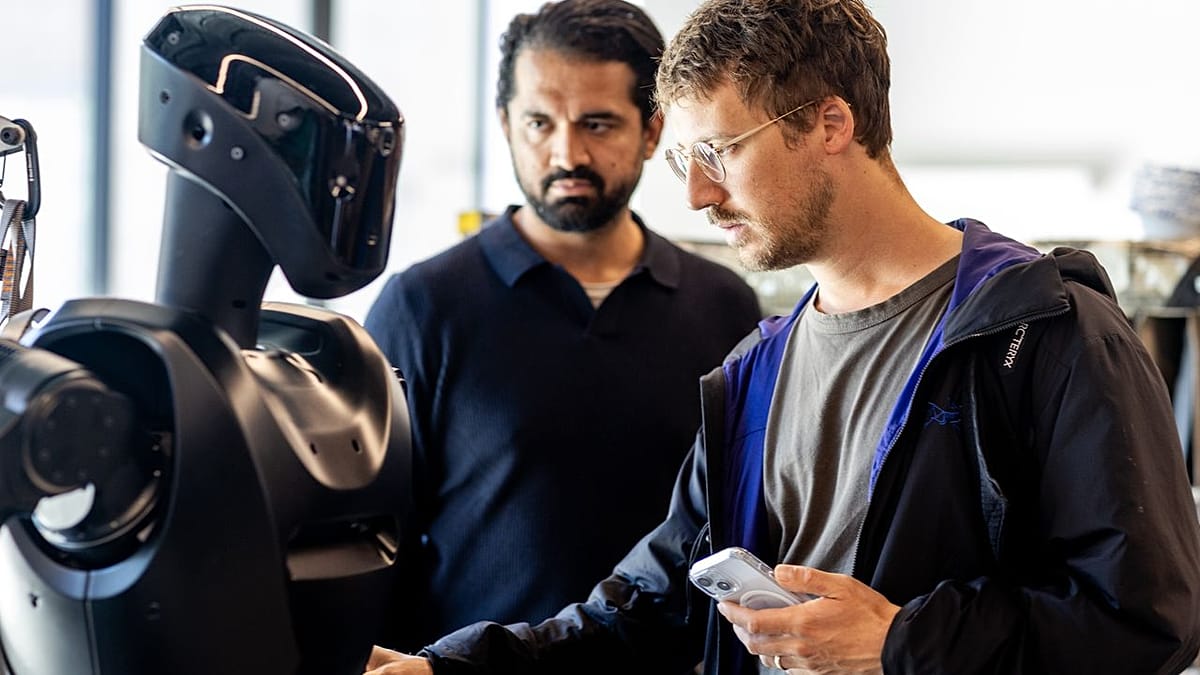
Humanoid robots powered by artificial intelligence could be deployed as weapons on the battlefield as early as 2027, according to the CEO of Foundation Future Industries, a US-based company that has already tested its Phantom robots in Ukraine. The claim arrives as European capitals and Brussels grapple with the implications of autonomous systems in conflict zones, from the Donbas to the Baltic states.
Sankaet Pathak, the company's founder and CEO, told Euronews Next that he expects to begin testing weaponisation use cases for the humanoids "as early as next year," following pilot programs in Ukraine. The robots, designed for both commercial and military applications, have been evaluated in real-world conditions in a country that has become a testing ground for next-generation warfare.
Pathak acknowledged the public's "Terminator"-style fears but insisted the reality is more mundane. "It's essentially like why would you send a bunch of humanoids if your goal is to be able to wreak havoc?" he said, arguing that a bomb can achieve mass destruction more cheaply. Instead, he sees humanoids filling a niche for precision missions where avoiding civilian casualties and infrastructure damage is paramount.
Precision over destruction
Pathak does not envision humanoids replacing drones but rather complementing them as ground combat grows increasingly dangerous for human soldiers. "Humanoids only make sense when your mission objective is more precision, essentially trying to make sure you don't destroy infrastructure, hurt civilians, do the best of your ability as you can accomplish a very complex mission," he explained. He added that the technology could reduce risks for troops on the ground, a concern that resonates across European defence ministries as they modernise their forces.
The European Union has already deepened its defence ties with Ukraine through initiatives such as the joint drone production deal signed earlier this year, and the prospect of humanoid robots entering the fray adds a new dimension to the debate over autonomous weapons. Currently, no specific treaty governs humanoid or autonomous robots on the battlefield; they fall under existing international humanitarian law, which requires weapons to distinguish between combatants and civilians.
United Nations Secretary-General António Guterres has been vocal in his opposition to "lethal autonomous weapon systems," which he calls "killer robots"—machines that select and engage targets without human control. Since 2023, the UN has been negotiating a dedicated treaty through the Convention on Certain Conventional Weapons, with Guterres pushing for a binding ban by 2026. Pathak, however, sees no reason to treat humanoids differently from existing precision weapons like armed drones or unmanned ground vehicles.
AI and the risk of misuse
The Phantom robots rely on proprietary AI built on "world models" that learn from video and simulation data to predict physical environments, rather than the next word like large language models. Pathak said his company is "heavily focused on world models that can predict the future," which he believes is key to building intuitive and robust AI. But the broader risk, he argued, lies not in humanoids but in other AI-enabled systems. "If an AI's mission objective is to destroy humanity, I guarantee you they're not sending 100,000 humanoids. I think they're just using drones or nuclear arsenals," he said.
Pathak identified "AI terrorism"—the misuse of widely available AI models for cyberattacks, disinformation, or arming consumer drones—as a more immediate danger. He blamed open-source models for this vulnerability, noting that after Meta released its Llama 2 model in 2023, uncensored versions quickly appeared that could answer questions about building nuclear bombs. Proponents of open-source AI argue it democratises access, but critics warn it undermines safety safeguards.
For now, Pathak believes the scenario where AI systems rewrite their own directives and self-replicate remains "three, four, maybe five hops away." But even before weaponisation, humanoids could serve on battlefields in support roles such as material handling, reconnaissance, and mapping—tasks that European militaries, from Berlin to Warsaw, are already exploring with drones and unmanned vehicles.
The timeline of 2027 may seem distant, but in the fast-evolving world of defence technology, it is closer than many policymakers in Brussels and national capitals might assume. As the EU and Ukraine continue to strengthen their defence cooperation, the question of where to draw the line on autonomous weapons will only grow more urgent.