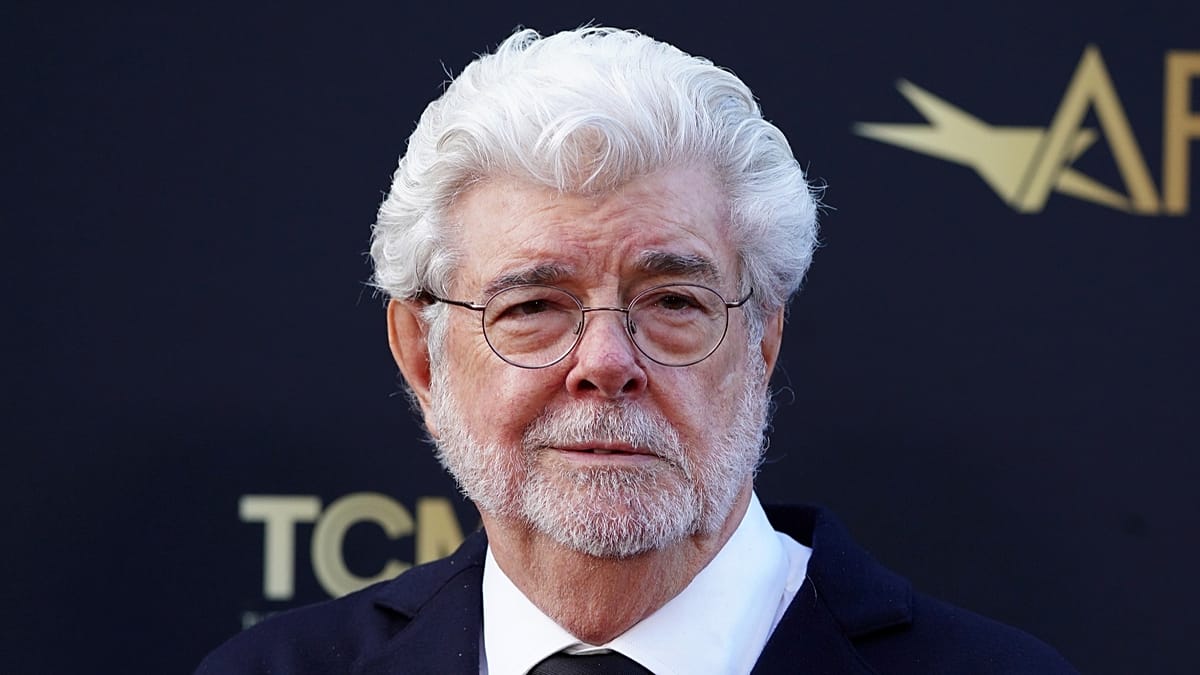
In a recent interview, Star Wars creator George Lucas declared that artificial intelligence is the unavoidable future of filmmaking, comparing those who resist the technology to people who preferred horse-drawn carriages over automobiles. Speaking to A Rabbit’s Foot, Lucas dismissed concerns that AI threatens the art of cinema, arguing that progress cannot be stopped.
“Artificial intelligence means it’s much easier for us to make movies,” Lucas said. “It’s very much like sitting here saying, ‘Well, I believe the horse and the buggy is really where it’s at. These cars, they break down, they need gas, there’s all kinds of problems with them and pretty soon they’ll be making them into tanks, and then they’ll be killing people. It’s terrible.’ There’s nothing you can do about it. That’s progress, it’s the future.”
Lucas also argued that AI can help identify fake content, something humans cannot reliably do. “If you want AI that tells you when something is fake and where it came from, AI can do that. Humans can’t, we’re not that smart,” he said. He added that creators remain responsible for their work: “You’re a human being, you’re responsible for what you say and what you do, and if you’re doing something that’s illegal you should be punished for that.”
A European Perspective on the AI Divide
The debate over AI in filmmaking resonates strongly across Europe, where the film industry is a significant cultural and economic force. From the Cinémathèque Française in Paris to the Berlinale in Berlin, European filmmakers have been vocal about protecting human creativity. The European Union has also taken a regulatory lead with the AI Act, which aims to balance innovation with ethical safeguards.
Lucas’s comments come amid a backlash against the use of AI in filmmaking. Earlier this year, Martin Scorsese faced criticism for endorsing an AI firm for storyboarding. Actors and directors have protested that AI models are trained on human-made art without consent, raising questions about intellectual property and fair compensation.
Oscar-winning director Christopher Nolan, known for his practical effects in films like Dunkirk and Oppenheimer, has taken a starkly different stance. In a recent interview, Nolan said he is confident that younger generations will continue to reject what he calls “AI slop.” He noted that his four children have an “immediate and harsh” reaction to AI-generated content. “Their judgment of AI slop has been immediate and harsh. They see it for what it is very quickly – and it’s much easier for them to identify it, because it grew out of an online world they know really well,” Nolan said. He argued that after years of heavily virtual environments, there is a renewed interest in “more tactile, more real forms of storytelling.”
Nolan’s views align with a growing movement in European cinema that emphasizes practical effects and authentic storytelling. At the Cannes Film Festival, for instance, several directors have championed traditional techniques. The Cannes Lions also featured debates on AI, with EY’s Julie Linn Teigland arguing that the technology’s future depends on human creativity.
The divide between Lucas and Nolan reflects a broader tension in the film industry. While Lucas sees AI as a tool for democratizing filmmaking, Nolan warns that it threatens the craft. European filmmakers, from Paris to Prague, are watching closely as the EU considers further regulations on AI in creative sectors.
Lucas’s comments also touch on accountability. He emphasized that AI can help trace the origin of content, making it easier to hold creators responsible for illegal or harmful material. “Whatever you do, you should be recognised. It’s just like real life,” he said.
As the debate continues, European audiences and policymakers face a critical question: how to harness AI’s potential without undermining the human artistry that defines cinema. The answer may shape the future of filmmaking on both sides of the Atlantic.