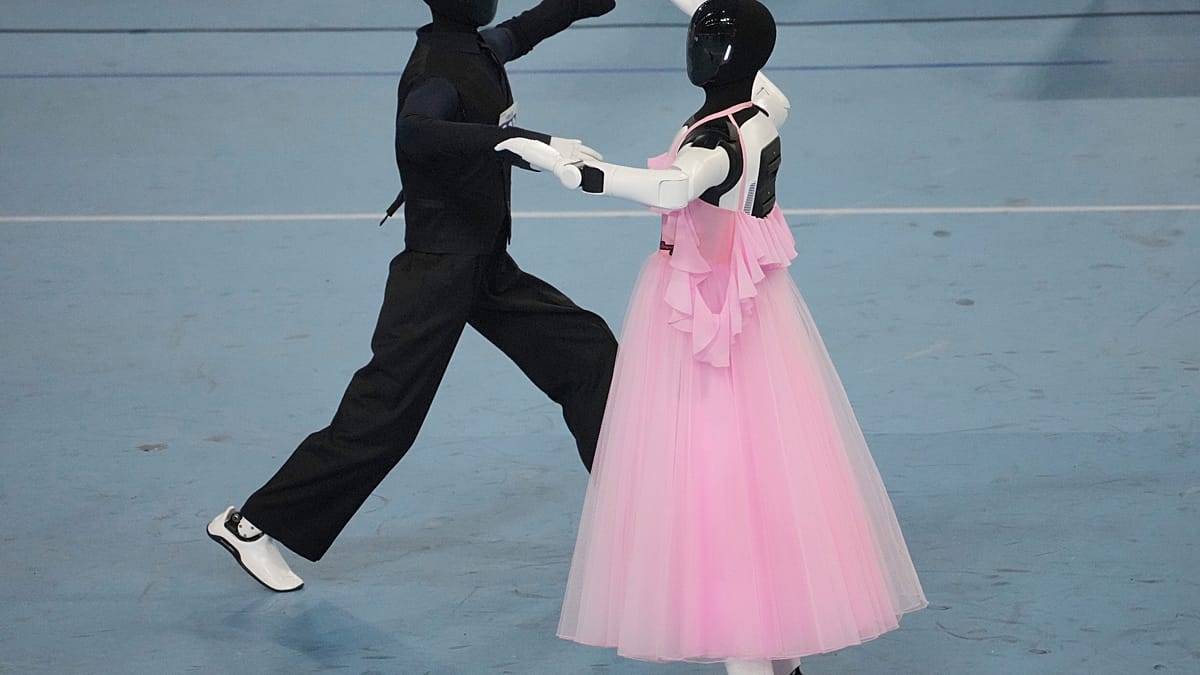
The opening ceremony of WorldSkills 2026 in Shanghai delivered a spectacle that blurred the line between human talent and machine precision. As thousands of young competitors from more than 80 countries marched into the arena, the stage was shared by professional dancers and a squad of humanoid robots, moving in synchrony to a score that mixed traditional Chinese instruments with electronic beats.
The robots, developed by Chinese robotics firms, executed choreographed routines with fluid arm movements and coordinated steps, at times mirroring the human performers almost exactly. For the audience in the Shanghai venue and the millions watching online, the message was unmistakable: the skills of the future will not be exclusively human.
A showcase of automation's reach
WorldSkills, often described as the Olympics of vocational excellence, has long celebrated craftsmanship in fields from carpentry to culinary arts. This year's opening, however, deliberately placed robotics at the centre, a nod to the growing role of automation in industries that were once considered safe from mechanisation. The humanoid dancers were not just props; they were programmed to respond to the music in real time, using sensors and AI to adapt their movements to the rhythm.
For European delegations, the performance carried particular resonance. Countries such as Germany, France, and Italy have been wrestling with how to integrate robotics into their manufacturing and service sectors without displacing workers. The sight of robots performing alongside humans on a global stage underscored the urgency of that debate.
"What we saw tonight is not science fiction," said Margarete Schmidt, a vocational training expert from Berlin who attended the ceremony. "It is a preview of the workplace that today's apprentices will inhabit. The question is not whether robots will be part of it, but how we prepare people to work with them."
Europe's robotics landscape
Europe is already a major player in robotics research and deployment. The EU's Horizon programme has funded numerous projects on collaborative robots, or cobots, designed to work alongside humans in factories and warehouses. In countries like Sweden and the Netherlands, robots are increasingly used in logistics and healthcare, while French trials are testing robots and AI as companions in Alzheimer's care, a sign of the technology's expanding social role.
Yet the humanoid form remains a challenge. Unlike industrial arms fixed to a factory floor, humanoids must navigate stairs, doors, and unpredictable environments. The Shanghai robots, with their articulated hands and bipedal locomotion, represent a significant step forward, but they are still far from matching human dexterity and adaptability.
"Humanoids are the ultimate test for AI and mechanical engineering," said Dr. Elena Rossi, a robotics researcher at the Polytechnic University of Milan, who watched the ceremony remotely. "They force us to solve problems of balance, perception, and manipulation all at once. Europe has strong fundamentals in these areas, but we risk falling behind if we do not invest more in applied research and commercialisation."
Implications for skilled trades
The WorldSkills competition itself is a testament to the enduring value of human skill. Over the coming days, young welders, pastry chefs, and graphic designers will compete for medals in disciplines that require years of practice and a human touch. But the opening ceremony was a reminder that even these crafts are being reshaped by automation.
In the construction sector, for example, robots are already being used for bricklaying and 3D printing of building components. In healthcare, robotic exoskeletons are helping rehabilitation patients walk again. And in the arts, AI robots are carving Carrara marble, redefining what it means to be a sculptor.
The European response to these changes has been mixed. Some policymakers advocate for a "robot tax" to slow job displacement, while others push for aggressive upskilling programmes. The European Commission's recent proposal for a "Digital Skills and Jobs Coalition" aims to train 20 million Europeans in basic digital skills by 2030, but critics argue that more needs to be done to address the specific challenges of humanoid robotics.
"We cannot simply hope that the market will solve this," said Schmidt. "We need a coordinated European strategy that supports both innovation and worker protection. The Shanghai ceremony should be a wake-up call."
A global stage for a global debate
WorldSkills has always been about more than medals. It is a platform for sharing best practices and fostering international cooperation. This year's opening ceremony, with its fusion of human and robotic performance, served as a powerful metaphor for the challenges and opportunities that lie ahead.
As the competition gets underway, the human competitors will no doubt inspire awe with their skill and dedication. But the robots that shared the stage with them will linger in the memory, a reminder that the future of work is not a zero-sum game between humans and machines, but a partnership that requires careful design and deliberate policy.
For Europe, the lesson from Shanghai is clear: the continent must embrace the potential of robotics while ensuring that no worker is left behind. The next few years will be critical in shaping that balance, and events like WorldSkills provide a valuable opportunity to reflect on the path forward.