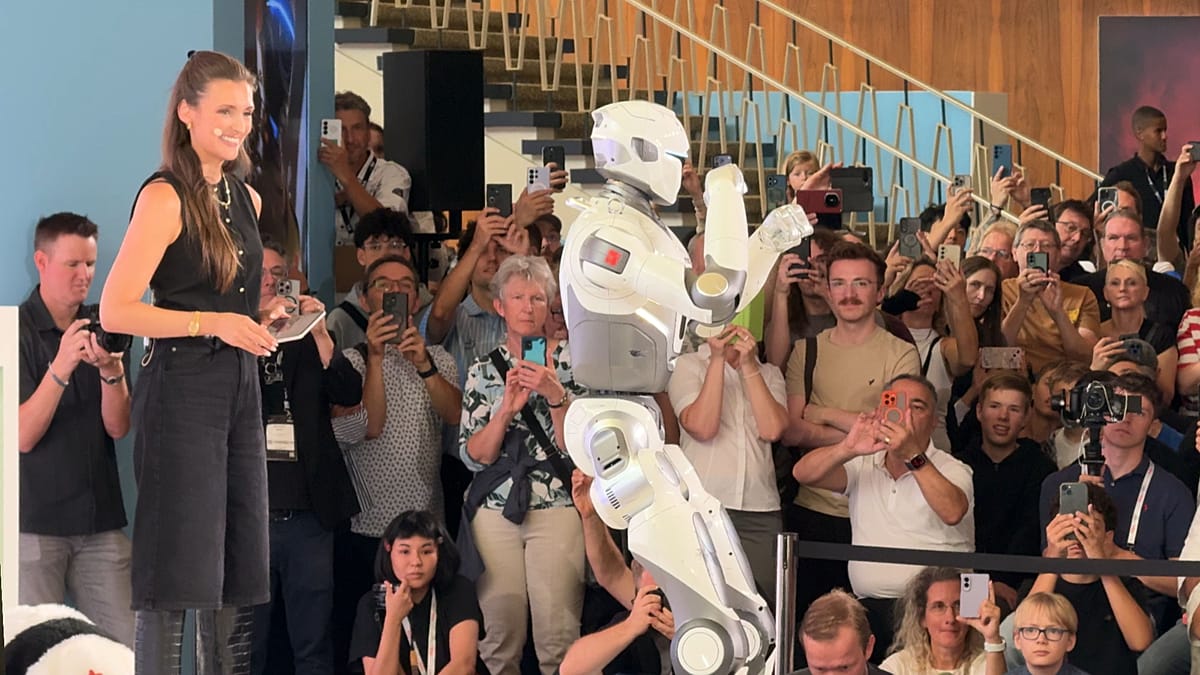
Berlin's IFA 2026, one of Europe's largest technology trade fairs, has become a showcase for the next wave of robotics. This year, humanoid robots were everywhere—walking, waving, and interacting with visitors, with many making their European debut. The message from manufacturers was clear: robots are moving beyond the lab and into homes, workplaces, and even entertainment.
Leif Lindner, CEO of IFA Management GmbH, emphasized the significance of robotics at this year's event. "Alongside artificial intelligence, robotics is one of the key future topics at IFA 2026," he said, pointing to humanoids, physical AI, and home robotic systems as examples of the rapid pace of development.
From laundry to zero-labor homes
South Korean electronics giant LG presented its vision of a "Zero Labor Home," centered around its CLOiD home robot. In a symbolic gesture, CLOiD acted as the conductor of an "AI Orchestra," coordinating appliances, entertainment systems, and other devices throughout the household. LG's long-term goal is to reduce the burden of household chores, with robots and connected appliances taking over more everyday tasks.
Chinese appliance maker Haier also focused on domestic robotics, showcasing humanoid robots designed to interact with people and appliances, alongside cleaning and companion robots. Meanwhile, US-based SwitchBot demonstrated a robot that could load clothes into a washing machine—a practical, if slow, application. The robot picked up garments, placed them inside the drum, and closed the door, but the process was noticeably deliberate. As one observer noted, you would need plenty of patience while the robot takes the laundry off your hands.
Chinese firm Pudu Robotics is targeting commercial settings. Known for its service and cleaning robots used in hospitality, retail, healthcare, and logistics, the company presented its PUDU D7 humanoid. At its booth, the robot performed simple interactions: picking up objects on request, posing for photos, taking selfies, and forming a heart shape with its hands. These demonstrations remain a far cry from robots independently handling complex tasks, but they offer a glimpse of where manufacturers see potential beyond the exhibition floor.
Companions, not just workers
Not every company is trying to make robots look or behave like humans. Some are deliberately moving away from the humanoid form, developing smaller, animal-inspired robots designed as companions rather than helpers. TCL presented AiMe, an AI companion robot that responds to voices, expressions, and emotional cues. With its rounded, teddy-bear-like design, AiMe can engage in conversations, play games, tell stories, and remember previous interactions over time.
Similarly, OlloBot introduced the OlloNi SS1, described as a "Cyber Pet." This small robot learns from a user's voice, habits, and interactions, adapting its responses accordingly. Its design—rounded body, pet-like movements—is intended to feel more like a companion than a piece of technology.
Other manufacturers drew inspiration from the animal kingdom. MagicLab Robotics brought several humanoids dressed in panda costumes to Berlin, though their skills were far from typical of real pandas: they repeatedly performed backflips. The spectacle was a hit with crowds, but it also underscored the entertainment value that often accompanies robotics demonstrations.
Robots on stage
Nowhere was the blend of practicality and performance more evident than at IFA's Robot Show. Humanoid robots and robotic pets took to the runway to dance, perform Tai Chi, do backflips, and even execute the splits. The area was packed with visitors, with cheers and applause accompanying each routine. It was one of the most popular attractions at the fair.
Yet the show also served as a reminder of how far the technology still has to go. Some robots appeared noticeably unsteady, and the gap between choreographed performances and real-world utility remains wide. As trials in San Francisco have shown, humanoid cleaners are being tested in homes at €26 an hour, but they still struggle with speed and reliability. Similarly, demonstrations at the EU Parliament have highlighted both the potential and the limitations of robots in delivery, factory, and household tasks.
For now, the robots at IFA 2026 are as much about spectacle as they are about substance. But the direction is clear: humanoid robots are edging closer to everyday life, even if they still need a few more years—and a few more backflips—before they truly take over.