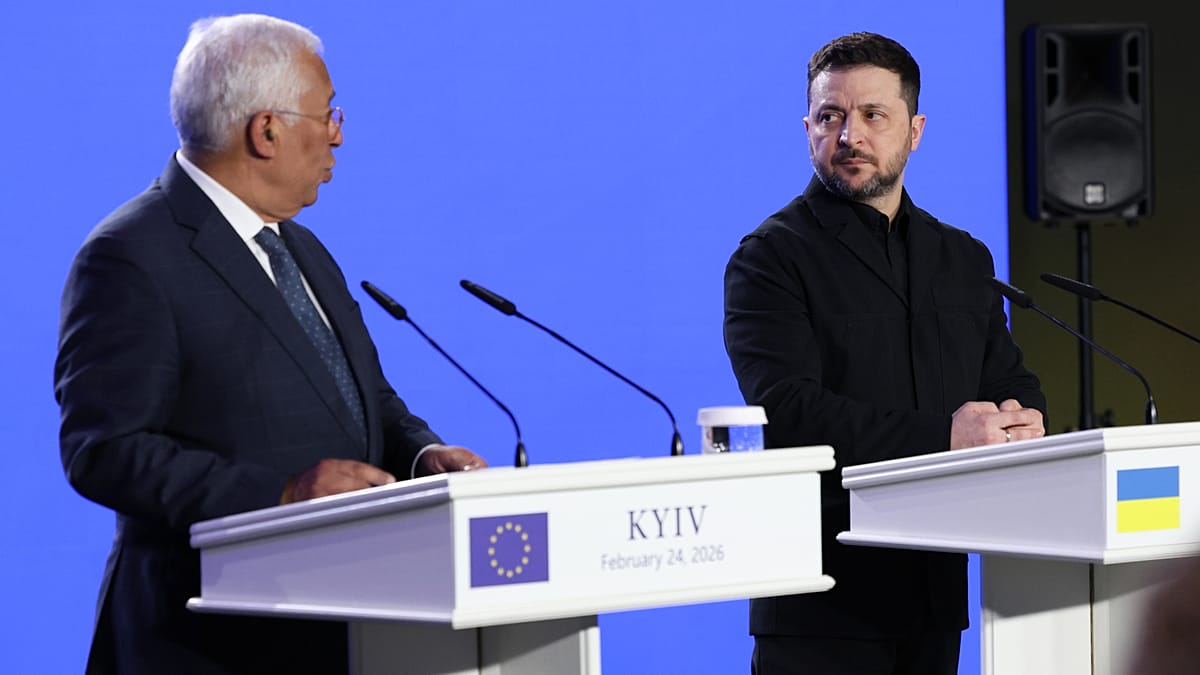
In a significant shift for European Union enlargement, Hungary has ended its two-year blockade on Ukraine's accession talks, following an agreement on the rights of the Hungarian-speaking minority in Ukraine's Transcarpathia region. The move, announced late Wednesday by Hungarian Prime Minister Péter Magyar, removes a key obstacle that had stalled Kyiv's path toward membership.
"We have reached a comprehensive agreement with Ukraine on the expansion of the linguistic, educational, cultural and political rights of the 100,000-strong Hungarian minority," Magyar said in a Facebook video. His government had been in regular talks with Ukrainian counterparts to resolve the issue, which had been a central point of contention under the previous Orbán-led administration.
Ukraine's deputy prime minister for European integration, Taras Kachka, thanked Hungary for its "constructive engagement" but did not immediately confirm the deal's specifics. "We are opening a new chapter in Ukraine-Hungary relations – one built on mutual respect, trust, and our shared European future. Ukraine is moving forward," Kachka said.
The change in position came during a meeting of EU ambassadors in Brussels, when the Hungarian envoy signaled the lifting of reservations, prompting a last-minute agenda adjustment. The end of the veto allows Ukraine and Moldova, which have been informally paired on their accession paths, to formally open the first cluster of negotiations. Both countries have already received letters confirming they meet the necessary criteria for talks. The Council of the EU is now expected to define its common position to guide the negotiations.
EU enlargement chief Marta Kos welcomed the news, urging Ukraine and Moldova to "accelerate on their road to EU membership." She added, "This is the best way to ensure minority rights are respected."
Western Balkans in Focus
The breakthrough comes as EU leaders prepare to meet with six Western Balkan counterparts in Tivat, Montenegro, for a summit aimed at reinforcing the region's EU aspirations. European Council President António Costa is on the penultimate stop of his Western Balkan tour in Belgrade, Serbia, before heading to Tivat for a dinner tonight ahead of the summit.
Serbia, the largest Western Balkan economy, remains one of the most challenging candidates due to persistent rule-of-law concerns and its foreign policy misalignment with the EU. While other Western Balkan candidates fully align with EU foreign policy, Serbia's alignment stands at 63%, notably as it has not imposed sanctions on Russia. EU enlargement chief Marta Kos has withheld funds from an economic stimulation package for Serbia, citing backsliding on the rule of law.
Montenegro, the summit's host, is widely seen as the frontrunner for EU membership, potentially joining within the next year. The gathering will include most of the EU's 27 leaders and all six Western Balkan heads of state and government. Our Europe Editor Maria Tadeo is on the ground; more details will follow in tomorrow's newsletter.
For more on the broader enlargement context, see our coverage of EU and Western Balkans Leaders Meet in Montenegro as Enlargement Talks Gain Momentum.
In other news, EU Trade Commissioner Maroš Šefčovič is set to meet Chinese trade envoy Li Chenggang on the sidelines of an OECD ministerial meeting in Paris on Thursday, amid escalating trade tensions between Brussels and Beijing. The meeting comes as the EU seeks to address trade vulnerabilities and strategic dependencies, a topic also being discussed at a two-day summit on economic security co-hosted by Euronews and the European Policy Centre in Brussels. For more, see EU Trade Chief to Meet Chinese Envoy Amid Escalating Trade Tensions.
Meanwhile, a controversial event on children's rights at the European Parliament has drawn criticism from around 60 MEPs, who signed a letter to President Roberta Metsola questioning the appropriateness of a roundtable focused on young LGBTQI+ individuals and sexual autodetermination for children. The event, organized by Renew Europe's Lukas Sieper, has been labeled by some as promoting "crazy ideologies," according to European Conservatives and Reformists MEP Paolo Inselvini.