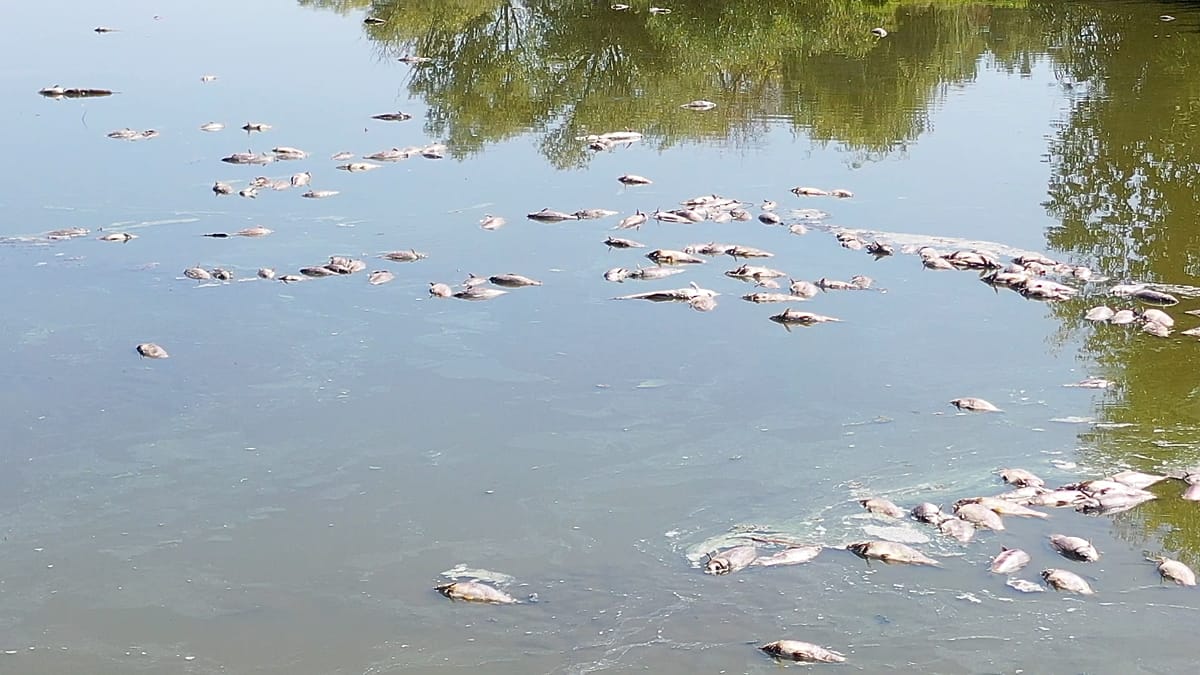
In August, one of Hungary's largest fish farm complexes at Rétimajor, south of Budapest, suffered a catastrophic die-off, with several hundred tonnes of fish lost. The 800-hectare pond system, a remnant of the historic Sárrét marshlands, is now at the centre of a bitter dispute over water management in a region increasingly affected by climate change.
Ferenc Lévai, who privatised the estate in 1994 and runs it as an integrated agri-tourism business, says the primary cause was the failure of water authorities to release sufficient supplies. He argues that the Middle Danube Water Directorate prioritised upstream irrigation over the ecological needs of the ponds, which are among the most strictly protected wetlands in Europe.
“In our view, because of a very poor water distribution regime, very little water reached us here; we could not even reach the water level that Hungary's most protected area would be entitled to, the ecological water level, which stipulates at least 50% water across the whole water surface,” Lévai told Euronews. “We were unable even to maintain that 50% level: the extent of evaporation and the inadequate water supply led to a catastrophe.”
The consequences were severe. Around 150 hectares of the pond system have dried out completely, while on another 400 hectares the fish are surviving in just 30 to 40 centimetres of water. Only on about 200 to 250 hectares is the depth sufficient for normal fish farming. Despite emergency measures, 300 to 350 tonnes of fish died, representing a financial loss of roughly €1.1 to €1.4 million.
The low water levels also caused the remaining water to warm rapidly, accelerating the release of toxic gases from the sludge, which poisoned the fish. Lévai warns that the drying out is not just an economic disaster but an ecological one, as the ponds provide critical habitat for rare amphibians and birds, including species protected under the EU's Natura 2000 network and the Ramsar Convention.
Authorities defend their actions
The Central Transdanubian Water Directorate, which manages the region's water, rejects the accusation that it withheld water. It says it had prepared for drought but could not have foreseen the extreme heat dome that gripped the country in late July. From 26 July, regional water restrictions were imposed, limiting irrigation use by 60% and fishpond use by 20%. The directorate insists it complied with these rules.
In August, it released 1.18 million cubic metres of water from the Fehérvárcsurgó reservoir over two weeks to replenish the fishponds. That reservoir, which largely stores treated sewage from Székesfehérvár, now holds barely more than that amount – just 1.4 million cubic metres. The authority estimates that evaporation from the 800-hectare water surface may have reached 100,000 cubic metres per day during the peak heat, making upstream irrigation a negligible factor.
“In our view, meeting (restricted) irrigation demands does not materially affect the very substantial volume of water requested to compensate for evaporation losses from fish-farming water use,” the directorate told Euronews. “The emergency situation may not have been caused by the abstraction of irrigation water, but by the oxygen-depleted state of water heated up by the heat.”
The dispute reflects a broader challenge across Europe, where record-low river levels and shrinking reservoirs are forcing difficult choices between agricultural, ecological and economic needs. In Hungary, the government has been working to unlock EU funds for water infrastructure, but the immediate crisis has exposed the fragility of the system.
Lévai, who says he is not looking for someone to blame but for solutions, believes the answer lies in crop growers building their own reservoirs to store water during wetter periods, so that during droughts they do not have to compete for scarce supplies. He argues that livestock farming and wildlife should come first.
The water authority has also announced it is conducting a hydrological study of the water system, focusing on the water reserves committed to users with operating licences. Whether that study will lead to changes in allocation remains to be seen, but for the fish farms of Rétimajor, the next dry season could bring another crisis.