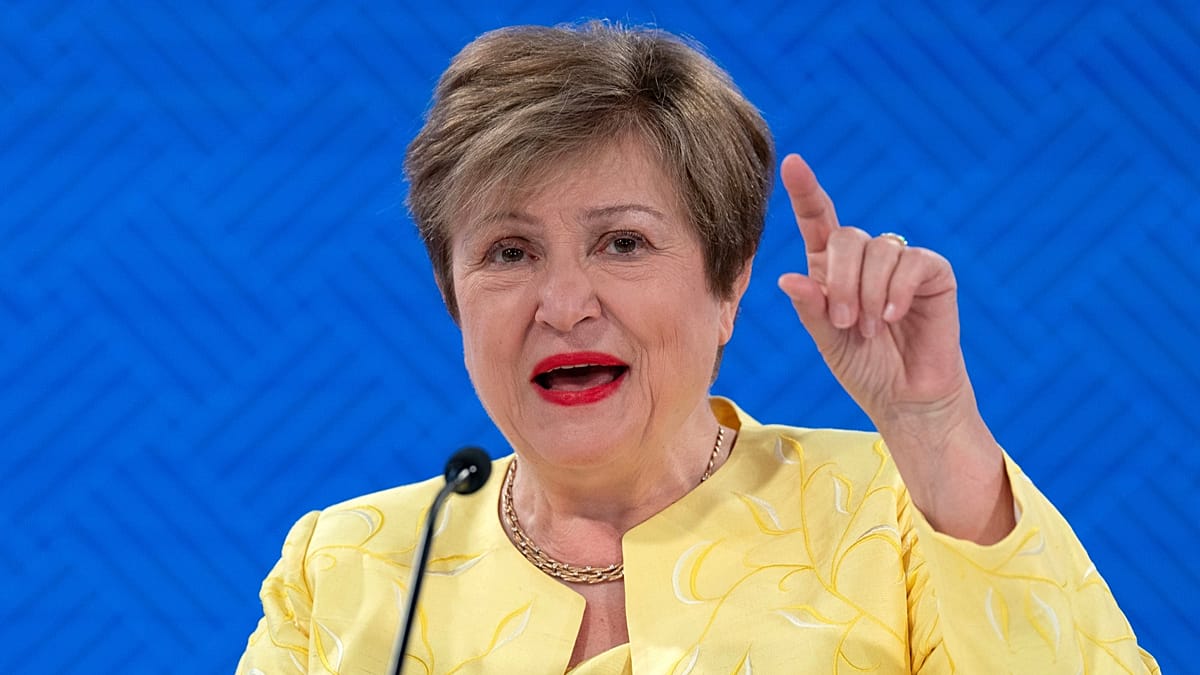
Russia's economy is showing clear signs of strain, even as higher oil prices offer a temporary reprieve, according to Kristalina Georgieva, managing director of the International Monetary Fund. In an interview with Euronews, Georgieva outlined how the country's shift to a war economy has masked deeper structural problems that are now becoming more apparent.
The IMF recently raised its 2026 growth forecast for Russia from 0.8% to 1.1%, but Georgieva cautioned that this figure does not capture the full extent of the weakening. “The higher oil prices do give a breather to Russia,” she said, “but they cannot offset the bigger hit to the economy.”
Depleted buffers and slowing growth
Russia has drawn down its financial reserves significantly since the full-scale invasion of Ukraine began in February 2022. Georgieva noted that the windfall from elevated oil prices appears to be used “to rebuild buffers rather than to inject more investment into the economy.” This suggests a defensive posture rather than a foundation for sustainable growth.
Growth has decelerated markedly. “Before the war, their potential growth was 1.6%,” Georgieva pointed out. “Now we are projecting 1%.” Inflation remains elevated, forcing the central bank to keep interest rates near 15%, a level that further constrains economic activity.
The IMF does not anticipate a “material impact on growth in Russia” in the near term, but Georgieva stressed that the country's medium- and long-term prospects have “worsened significantly.” She identified three key factors behind this deterioration.
Demographic decline and technological isolation
The first factor is human capital. “A country that was in a demographic decline to begin with now lost so many young people for a terrible reason,” Georgieva said. The war has accelerated an already troubling population trend, with tens of thousands of working-age Russians killed or displaced.
Second, international sanctions are biting deeply, especially in technology. “What we see in the oil and gas sector in Russia, there is a tremendous problem with lack of technological renewal that is restricting the ability of the sector to expand,” she explained. Without access to Western equipment and expertise, Russia's energy industry—its economic backbone—faces mounting difficulties in maintaining and modernising production.
Third, Russia has lost standing on the global stage. “That translates into many tangible and non-tangible losses,” Georgieva said. “Just think of the young Russians that could have built relations with Europeans and others and did not because of the war.” This erosion of influence affects trade, investment, and diplomatic leverage.
The broader European context is significant. The EU and its member states have imposed multiple sanctions packages targeting Russian energy exports, finance, and technology. These measures, coordinated with the United Kingdom, Switzerland, and Norway, have contributed to Russia's economic isolation. Meanwhile, the EU has accelerated its own energy transition, with projects like Poland and Germany planning Baltic offshore wind farms to reduce dependence on Russian supplies.
Georgieva's assessment aligns with recent data showing that Russia's economy, while resilient in the short term, is structurally impaired. The war in Ukraine continues to drain resources, and the loss of European markets for gas and oil—once Russia's primary customers—has forced Moscow to seek alternative buyers at discounted prices.
The IMF chief's remarks come as the EU rolls out new sanctions on Russia, including measures targeting its energy sector and military-industrial complex. The bloc is also streamlining defence procurement to counter Russian threats, as reported in EU Streamlines Defence Procurement to Counter Russian Threats and US Disengagement.
For European policymakers, the message is clear: while Russia may have gained a temporary financial cushion from higher oil prices, its long-term economic trajectory is downward. The combination of demographic loss, technological stagnation, and diminished global standing means that the country's capacity to project power or sustain its war effort will continue to erode.