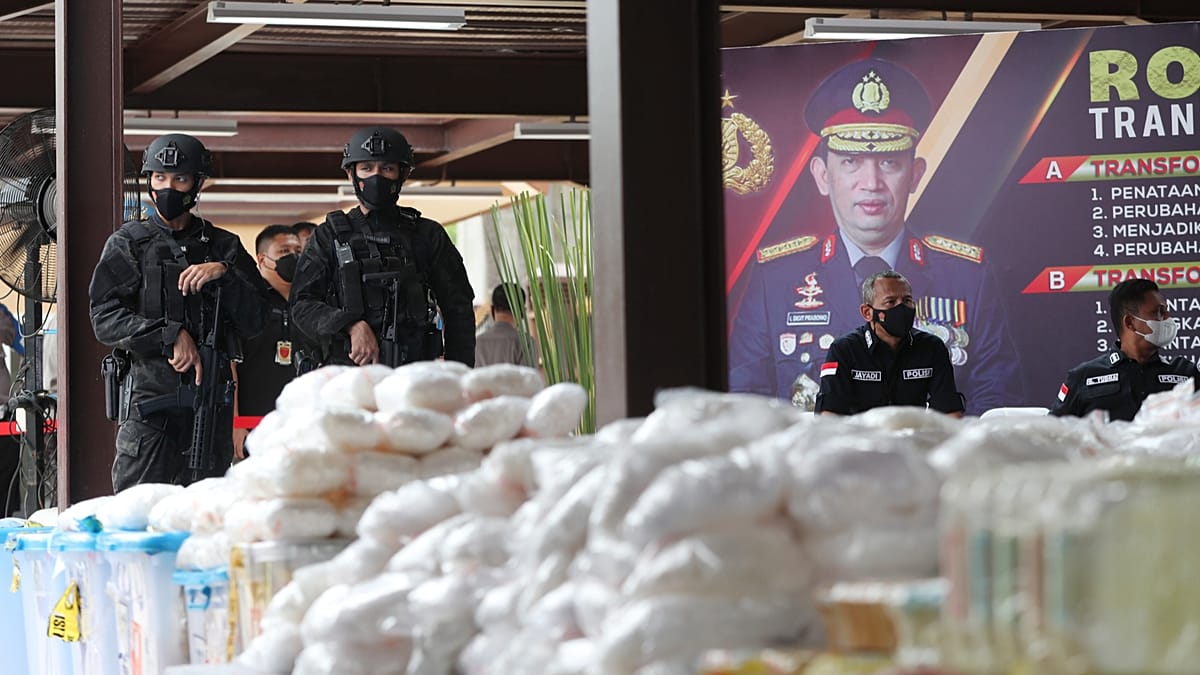
Indonesian authorities have intercepted a vessel carrying 2.6 tonnes of liquid methamphetamine in one of the country's largest drug seizures, arresting ten crew members, a senior narcotics official said on Wednesday.
The National Narcotics Agency (BNN) said it had acted on intelligence that a ship travelling from Sarawak in Malaysia through the Andaman Sea might be transporting narcotics into Indonesian waters. In a joint operation with customs officials, the vessel, identified as the MV Rain Maker and sailing under a false name, was stopped late on Monday near Bengkalis in Riau province, on the east coast of Sumatra.
“The inspection of the vessel found 2.6 tonnes of methamphetamine, or liquid meth, stored in eight water barrels and a water tank,” said Roy Hardi Siahaan, a BNN official. Sniffer dogs also discovered more than 1.5 million illegal cigarettes on board, the agency said.
All ten arrested crew members are Myanmar nationals. The operation follows a series of high-profile maritime drug busts in the region, highlighting the persistent flow of narcotics through Southeast Asian sea routes.
Second Tanzanian-flagged vessel this month
Monday's seizure was the second involving a Tanzanian-flagged ship in the same area within weeks. On 8 August, Indonesian authorities confiscated 1.3 tonnes of ketamine from a vessel in waters around the Riau Islands, near Singapore. Eight crew members—seven from Myanmar and one from Taiwan—were arrested in that operation.
Last year, the BNN announced its biggest-ever drug bust, seizing two tonnes of crystal meth hidden on a fishing boat sailing from the Andaman Sea to Batam Island. The latest haul surpasses that record in volume, though the liquid form of methamphetamine complicates direct comparisons.
The Andaman Sea and the Strait of Malacca have become key transit corridors for drug smugglers moving product from the Golden Triangle and other production hubs toward Indonesian and regional markets. The proximity of the Riau Islands to Singapore and Malaysia makes the area a favoured drop-off point.
Indonesia has some of the world's toughest anti-drug laws, including the death penalty for traffickers, but has maintained a moratorium on executions for several years. The government has repeatedly emphasised its commitment to disrupting trafficking networks, even as critics question the effectiveness of punitive approaches.
The latest seizure underscores the scale of the challenge facing Indonesian law enforcement. Liquid methamphetamine, often transported in containers or barrels, can be converted to crystal form with relatively simple chemical processes, making it an attractive option for traffickers seeking to evade detection.
Regional cooperation remains uneven, with intelligence-sharing often ad hoc. The BNN has called for stronger international partnerships to track vessels across the Andaman Sea, a vast and lightly patrolled expanse that borders Myanmar, Thailand, and Malaysia.
For now, the ten crew members face charges that could carry severe penalties, though the long-standing moratorium on executions means they are unlikely to face the death penalty in practice. The case also highlights the broader issue of maritime drug trafficking in Southeast Asia, a problem that European and other international agencies have monitored closely, given the global reach of synthetic drug networks.