In the heart of Tuscany, within the ancient walls of Volterra prison, a remarkable experiment has been unfolding for nearly four decades. The Compagnia della Fortezza, founded by director Armando Punzo, brings professional theatre-makers together with inmates to create performances that defy the usual boundaries of prison life. What began as a personal challenge has grown into one of Italy's most enduring cultural projects, one that raises profound questions about the purpose of incarceration and the transformative power of art.
A theatre born from curiosity
Punzo first entered the prison in the late 1980s, not with a fixed plan, but with a desire to test theatre in an environment where art and culture seemed utterly out of place. "I wanted to put theatre to the test in a situation where, even if naively, I thought, and I believe it was the case, that art and culture had absolutely nothing to do with it," he recalls. "And I found that extremely interesting and challenging."
Instead of trained actors, he encountered a multicultural group of men with little or no prior connection to the stage. Yet Punzo saw beyond their circumstances. "I encountered people who had never once reflected on themselves differently. They were deeply immersed, just as we all are, in their ordinary lives," he says. "Their lives were vastly different from ours, yet driven by the exact same mechanism."
For Punzo, the project's success lies in its universality. "Art and culture can truly reach everyone; if they fail to do so, it is simply because the necessary work to make that happen has not been done," he adds.
Creating together, year after year
Each year, the company produces a new work, while also revisiting and restaging earlier performances. This continuous cycle of research and artistic development means that prisoners are not merely performers; they are collaborators, working alongside professional directors, designers, and actors in every aspect of the production.
For many inmates, this involvement becomes a lifeline. Giacomo, who transferred to Volterra from another prison in 2024 specifically because of the theatre programme, describes the experience in striking terms. "Life on the outside leads you to lose yourself, and to lose all those aspects that, however silly it may sound to say, I am actually rediscovering in here," he says. "The metaphor, which I find incredibly important, is that by losing my freedom in here, within a state of total confinement, I am finding total openness."
That openness extends to the creative process itself. Viola Ferro, a young actress who chose to join the company, explains how theatre can reshape any space. "Theatre can transform any space. Doing so is inherent to the language of theatre, and therefore, this is theatre. When we do this, the prison steps aside, much like an actor who sets aside a part of himself when stepping onto the stage," she says.
Rehabilitation beyond punishment
For Valentina Bruno, the prison's director, the theatre project is part of a broader philosophy of rehabilitation that treats inmates as individuals, not just numbers. "They feel that the staff cares for them in the best possible way," she says. "They feel valued as individuals, not merely as numbers or files. They feel that they matter, and that their family context matters too, given the frequent contact we maintain with their relatives."
Above all, Bruno emphasises the role of hope. "What they strongly feel is hope: the hope of returning to society, whether upon completing their sentence or even sooner, as changed individuals capable of giving something back to the community," she adds.
Opening the fortress to the outside world
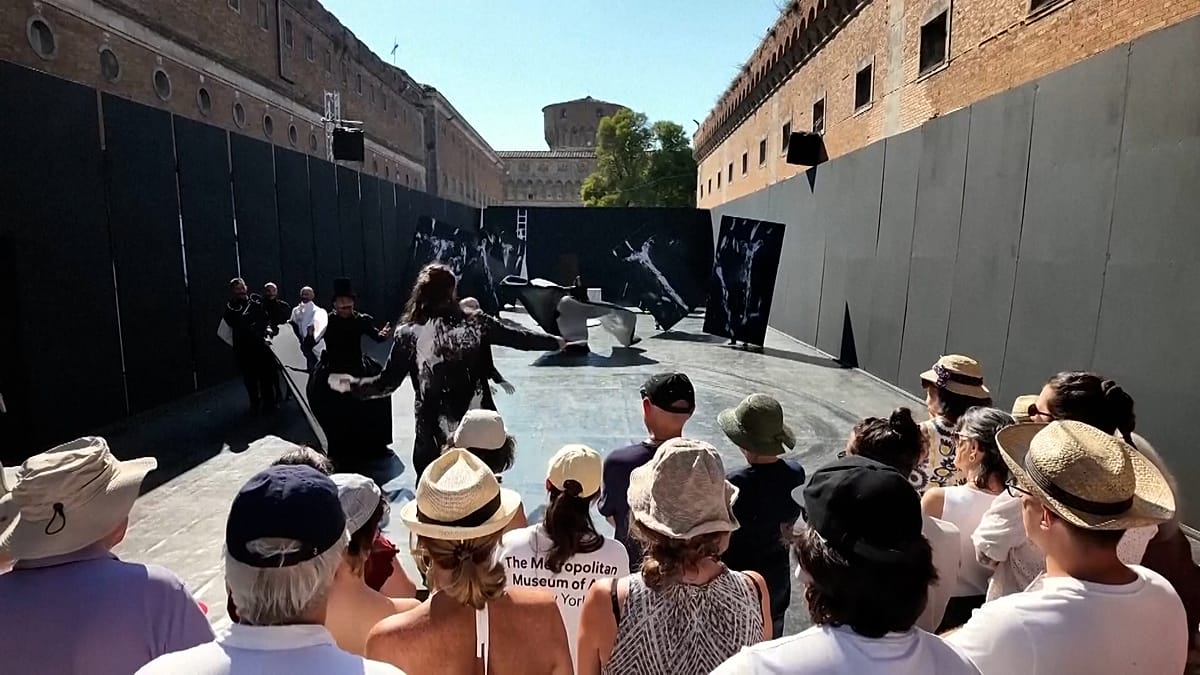
The most striking moments come when the prison opens its gates to the public. The courtyard becomes a stage, with the fortress walls as a dramatic backdrop, and spectators from outside enter the prison to watch the performances. This annual ritual blurs the line between confinement and freedom, inviting the community to witness the humanity of those behind bars.
Writer Maria Nadotti, a regular attendee, praises the company for something increasingly rare in contemporary theatre. "I have absolute admiration for the work of the Compagnia della Fortezza and for something that, in my view, is increasingly rare in theatre, and not just in Italy," she says. "A combination of imagination, joy, energy, and an absolute passion for wonder. Wonder is the soul of the world, and it is all present here."
The project has also drawn attention beyond Italy's borders, as European debates about prison reform and rehabilitation continue. While Italy faces its own challenges, from border disputes with Spain to broader questions about social cohesion, Volterra offers a model of what can be achieved when art is given a genuine role in the justice system.
As the Compagnia della Fortezza enters its fifth decade, its legacy is clear: even within the most restrictive of spaces, creativity can flourish, and freedom can be found in the most unexpected ways.