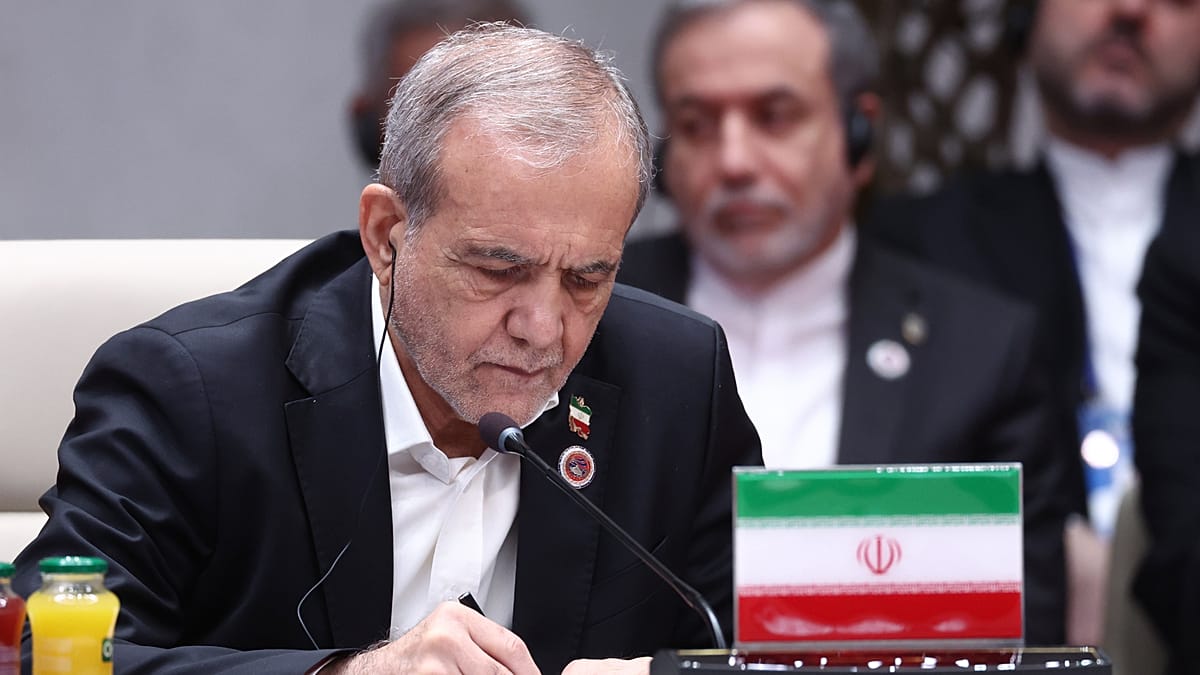
Iran's President Masoud Pezeshkian said on Tuesday that Tehran is ready to return to the ceasefire framework agreed with Washington in June, provided the United States also honors its side of the deal. The offer came during the Shanghai Cooperation Organisation (SCO) summit in Bishkek, Kyrgyzstan, just days after the two countries exchanged fire for the first time in a month.
According to Iranian state media, Pezeshkian told the summit: “If the US returns to its commitments in the memorandum of understanding, the Islamic Republic of Iran will immediately reciprocate.” His remarks were conciliatory in tone, yet they arrive against a backdrop of renewed hostilities.
A fragile framework
The June memorandum called for an immediate ceasefire and opened a 60-day window for negotiations aimed at a broader peace settlement. Under its terms, Tehran agreed to clear mines from the Strait of Hormuz and guarantee safe passage for shipping, while Washington pledged to lift its naval blockade, ease sanctions, grant waivers for Iranian oil exports, and begin work on a reconstruction package for Iran.
That agreement quickly unravelled. Although a lull in fighting followed, the weekend saw fresh exchanges of fire, underscoring how brittle the truce has become. On Monday, US forces struck two Iranian missile launchers on Larak Island, near the strategic strait. Hours later, Pezeshkian insisted that Iran does not seek war but would “never sit quietly” in the face of aggression and would “deliver a firm response to the aggressors.”
Iran’s foreign minister, Abbas Araghchi, echoed the president’s stance while attending the same summit. “The US must honour its commitments and the framework deal,” he told state television. “Then we can get out of this situation.”
Pezeshkian also used his speech to stress that Tehran is not looking for conflict and pointed to Iran’s record of fulfilling international treaties. Yet the influence of the Islamic Revolutionary Guard Corps (IRGC) remains a significant obstacle. The elite paramilitary force is pressing for far greater concessions from Washington, including Iranian control over Hormuz and financial compensation for war damages—conditions that are almost certainly unacceptable to the US administration.
The SCO summit in Bishkek has drawn leaders from across Eurasia, with discussions focused on regional security and economic cooperation. The gathering also saw UN Secretary-General António Guterres appeal for an end to hostilities, urging leaders to “stop this madness” and pursue peace. Meanwhile, the reshaping of regional alliances was a key theme, as Central Asian states seek to balance their ties with Moscow, Beijing, and the West.
For European observers, the Iran-US standoff carries direct implications. The Strait of Hormuz is a critical chokepoint for global energy supplies, and any disruption would reverberate through European economies already grappling with inflation and energy security concerns. European diplomats have repeatedly called for de-escalation, but their leverage remains limited as Washington and Tehran remain locked in a cycle of mistrust.
Pezeshkian’s offer, while conditional, may represent a window for renewed diplomacy. However, the IRGC’s maximalist demands and the recent exchange of fire suggest that the path back to the June framework is strewn with obstacles. Whether Washington will respond positively to Tehran’s overture remains to be seen, but the coming days will be critical in determining whether the ceasefire can be resurrected or whether the region slides back into open conflict.