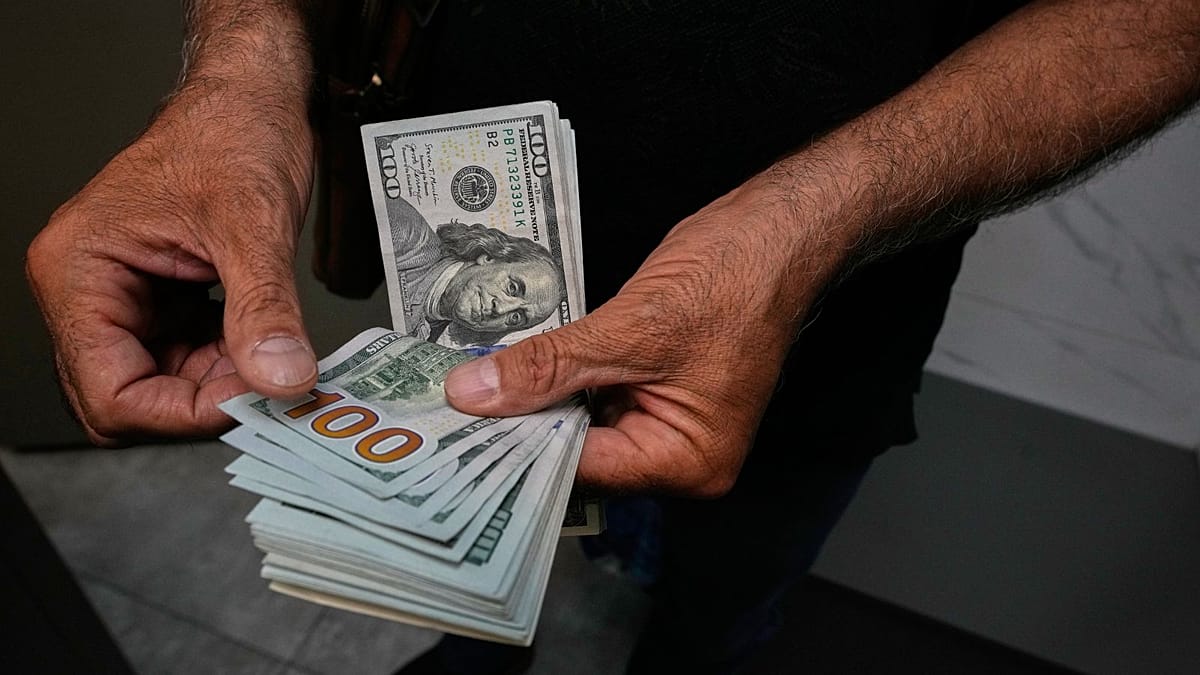
The Iranian rial has hit a new record low on Tehran's free market, with the US dollar trading above 22 million tomans (2.2 million rials) on Wednesday. The currency has now lost roughly 60% of its value since the start of the Iranian calendar year in March, when the dollar was worth about 1.35 million rials.
The slide has accelerated since the United States reimposed a naval blockade on Iranian ports in July, following the collapse of a short-lived ceasefire. The euro reached an unprecedented 2.55 million rials, while the British pound climbed to 2.976 million rials. The UAE dirham, a key benchmark for regional currency markets, crossed 600,000 rials for the first time.
Gold prices have also soared: one gram of 18-carat gold rose above 225.7 million rials, and the Imami gold coin—a standard unit of value in Iran—changed hands at 2.26 billion rials.
Dual exchange rate system under strain
Iran operates a dual exchange rate system. The official rate, set by the Central Bank and used for state transactions and subsidised imports of essential goods, remains significantly stronger than the free-market rate available to ordinary Iranians and businesses. The gap between the two has widened sharply since the war began, with the free-market rate now more than double the official rate.
The rial has been in freefall since US-Israeli strikes on Iran on 28 February launched the ongoing conflict, now in its seventh month. Washington's economic pressure campaign has intensified, with the US Treasury cutting off Iran's access to regional banks, severing a key channel for foreign currency and import payments. The naval blockade has compounded the pressure by restricting trade routes and reducing Iran's oil export revenues.
Central Bank Governor Abdolnaser Hemmati said the bank was ready to inject $2 billion into the foreign exchange market to stabilise the rial. He attributed the latest slide primarily to psychological factors rather than fundamental economic ones.
"The dust created in the foreign exchange market will settle, and the recent increase in exchange rates is driven more by psychological factors than by real economic factors," Hemmati said.
Hemmati acknowledged that inflation had placed heavy pressure on households. "Although inflation and rising prices have placed heavy pressure on people's livelihoods and daily lives, and these difficulties are tangible, the Central Bank has been able to control the accelerating pace of inflation by using monetary, supervisory and prudential tools," he said.
He rejected US claims that Tehran lacked access to financial reserves. "These claims are completely baseless. The reserves have not been frozen, and the Central Bank has access to stable resources as well as multiple oil and non-oil revenues," he said, claiming that more than $18 billion in foreign currency had been provided for imports of essential goods, medicines, animal feed and raw materials since March. He provided no further details to support the figure.
The rial's collapse is feeding directly into consumer prices. Iran was already experiencing high inflation before the war, and the currency's further depreciation has raised the cost of all imported goods, raw materials and energy inputs. Iranians who hold savings in rials have seen their purchasing power roughly halved in less than six months. Gold and hard currency have become the primary store of value for those who can access them.
Iran's official currency is the rial, although most Iranians conduct everyday transactions in tomans—a colloquial unit equal to 10 rials that is so deeply embedded in daily use that shops, restaurants and property listings quote prices almost exclusively in tomans. At Wednesday's free-market rate, the US dollar traded at about 220,000 tomans. The government announced plans in 2020 to formally replace the rial with the toman and remove four zeros from the currency, a redenomination that has not yet been fully implemented.
The economic turmoil in Iran comes as European nations remain alert to broader regional instability. The ongoing conflict and sanctions have ripple effects on global energy markets and migration flows, which are of direct concern to EU policymakers. Meanwhile, Europe's own security challenges continue to demand attention, as the continent grapples with hybrid threats and economic pressures.