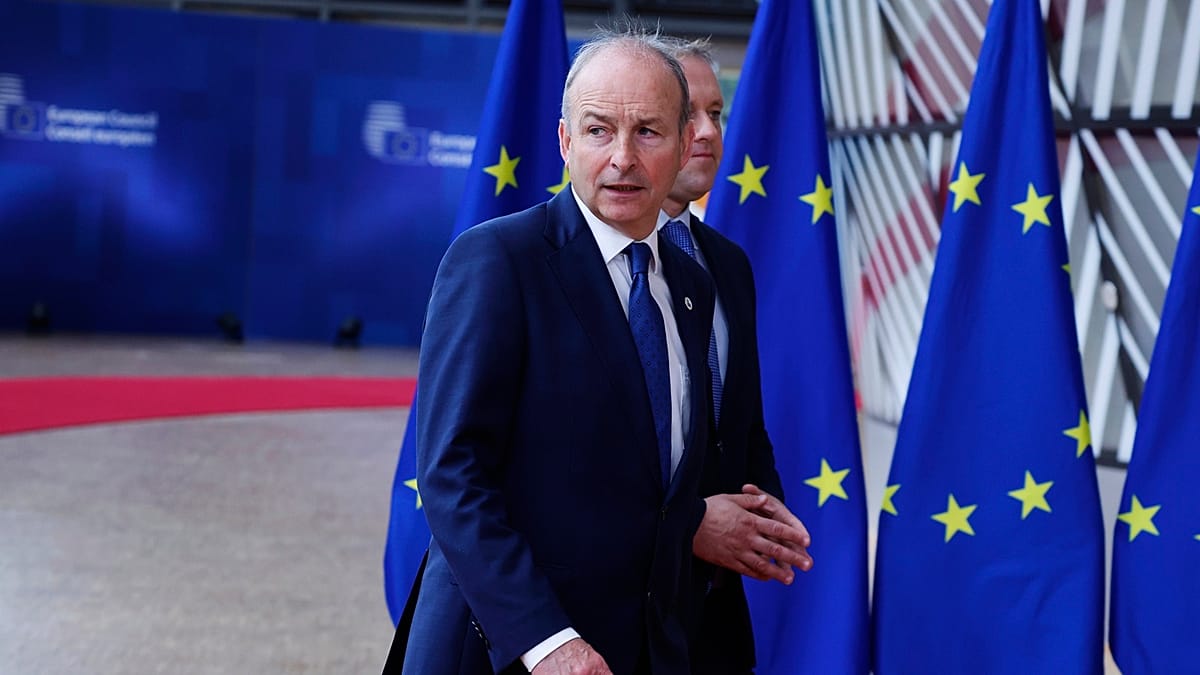
Ireland assumed the rotating presidency of the Council of the European Union for the eighth time this week, an occasion that was meant to highlight the benefits of EU membership and the diplomatic acumen Dublin has cultivated over decades. Taoiseach Micheál Martin, speaking at the opening ceremony at Dublin Castle, called it "an honour and a responsibility" and pledged to give it his all. Yet the festivities have been overshadowed by a deepening scandal over Ireland's continued alumina exports to Russia—a trade that directly supports Moscow's military-industrial complex as it wages war on Ukraine.
The controversy erupted in late March when investigative reports revealed that Aughinish Alumina, a sprawling refinery in County Limerick, sells roughly half of its alumina output to Russia. Alumina is a white powder used to produce aluminium, a lightweight metal essential for manufacturing weapons, including those used on the battlefield in Ukraine. The revelation has placed Ireland in an uncomfortable spotlight, given that Dublin has placed support for Kyiv at the top of its EU presidency priorities and has long styled itself as an "honest broker" among the 27 member states.
Ukrainian President Volodymyr Zelenskyy, the guest of honour at the opening ceremony, did not mince words. "Every tonne of raw materials that ends up in Russia is used against us in this war," he said, directly addressing Martin. "This is what we understand. This is how we see it." The Taoiseach, visibly stone-faced, attempted to defuse the tension, stating he had a "good conversation" with Zelenskyy and promising to share the findings of an ongoing investigation with the European Commission. "We do not want to be in a position where material emanating from a plant in Ireland goes to support the Russian war machine," Martin said.
A Thundering Headache for Dublin
Ireland is far from alone in facing accusations of propping up Russia's war economy. Hungary and Slovakia continue to rely on Russian crude oil and pipeline gas; Spain and France import large volumes of Russian LNG; Greece and Malta have blocked a full ban on maritime services for Russian tankers; and Austria's Raiffeisen Bank International still operates inside Russia. These are the unseemly remnants of the EU's largest-ever sanctions regime against a nation that, until February 2022, was one of the bloc's main trading partners. Millions—sometimes billions—of euros are at stake when cutting business ties overnight.
Yet for Ireland, a country whose controversies typically revolve around Big Tech and low corporate taxation, the perception of being an indirect enabler of the deadliest conflict in Europe since World War II has proven particularly damaging. The scandal has raised uncomfortable questions that Dublin has yet to answer, and it threatens to undermine the credibility of its EU presidency. As Ireland faces growing calls to halt alumina exports to Russia, the government finds itself caught between moral imperatives and economic realities.
Neither Martin nor his deputies have offered an unequivocal commitment to supporting sanctions on alumina—if such sanctions are ever proposed. Ironically, one of the most pressing tasks of the Irish presidency is to reach a deal on the 21st package of sanctions against Russia. Deputy Prime Minister Simon Harris insisted, "Ireland will never cherry-pick when it comes to sanctions. It will never cherry-pick the criteria. The criteria are clear. The criteria must be applied. That's important. But it's important that we establish the facts."
The facts, however, are complicated. Aughinish Alumina is Europe's largest alumina refinery, and a ban on exports to Russia would have devastating consequences for the company and its workforce. The Irish government has repeatedly voiced concerns about the impact on direct and indirect jobs, the environment, and Europe's strategic supply chain. Aughinish has lobbied Dublin to deter sanctions and has even raised the prospect of nationalisation if an export ban is introduced—a threat that Martin and Harris have rejected but which underscores the high stakes involved.
In yet another awkward twist, Swedish authorities recently concluded that Rusal, Aughinish's parent company, remains under the effective control of Oleg Deripaska, a Russian oligarch with close ties to the Kremlin who is under EU sanctions. Zelenskyy seized on this fact to accentuate his displeasure, noting that "there are companies in Europe that are owned or effectively controlled by sanctioned individuals."
European Commission President Ursula von der Leyen, who visited Cork on Friday, was succinct on her take: "It is for Ireland to lead this investigation and to set the time frame." The message was clear: Dublin must resolve this itself, without expecting Brussels to intervene. As EU enlargement takes centre stage during Ireland's presidency, the alumina scandal threatens to distract from the bloc's broader agenda, including advancing Ukraine's accession process.
For now, the Irish government is walking a tightrope. It must balance its commitment to Ukraine with the economic realities of a major employer in a region already vulnerable to industrial decline. The investigation is nearing completion, Martin said, but the clock is ticking. Zelenskyy urged him to avoid procrastination: "We very much hope for a positive result for us in this investigation, and we hope that we won't have to wait for it for months." The outcome will test whether Ireland can truly act as an honest broker—or whether its own economic interests will ultimately prevail.