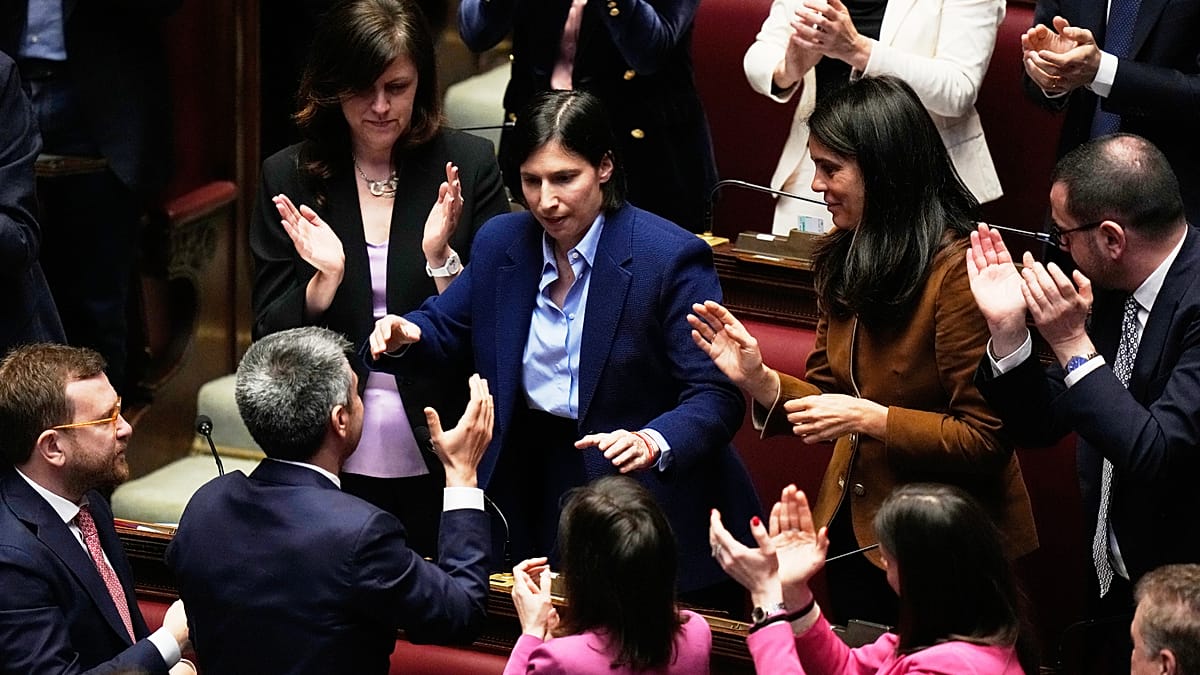
Italy's Chamber of Deputies gave final approval on Tuesday to a bill aimed at combating antisemitism, a measure that has reopened a fierce debate over where legitimate criticism of Israel's government ends and antisemitism begins. The vote, which saw 147 in favour, 93 against, and 5 abstentions, exposed deep divisions within the opposition, with the Democratic Party (PD) splitting ranks.
The bill, already passed by the Senate in March, enshrines the definition of antisemitism adopted by the International Holocaust Remembrance Alliance (IHRA) in 2016. That definition, along with its accompanying examples, has become a flashpoint across Europe, with critics arguing that it conflates anti-Zionism and criticism of Israeli policy with antisemitism.
A divisive definition
The IHRA definition, which the bill incorporates, lists several illustrative examples of antisemitism, including "claiming that the existence of a State of Israel is a racist endeavor" and "applying double standards" to Israel. Opponents say these examples effectively criminalize dissent against Israeli government actions, while supporters insist they provide a necessary framework for identifying hate speech.
During the debate, opposition lawmakers urged the majority to replace the IHRA text with alternative formulations, such as the 2022 Council of Europe definition or the Jerusalem Declaration on Antisemitism, which explicitly distinguishes between antisemitism and criticism of Israel. The Jerusalem Declaration, endorsed by over 200 scholars, states that "opposition to Zionism as a political ideology" and "criticism of the Israeli government" are not inherently antisemitic.
Angelo Bonelli, co-founder of the Green-Left Alliance (AVS), was blunt in his condemnation: "This is a gag law to cover up the crimes of the Netanyahu government and the ethnic cleansing of the Palestinians. The Meloni government chooses not to disturb those who illegally occupy Palestinian land and at the same time wants to muzzle those who denounce it. It is a disgrace."
Laura Boldrini, a PD deputy and former speaker of the Chamber, echoed that sentiment: "The majority does not really want to fight antisemitism, it wants to censor criticism of the Israeli government, which is committing genocide. If it had really wanted to fight antisemitism, it would have approved our amendments, which replace the IHRA declaration, which is controversial, with the Jerusalem Declaration."
Supporters of the bill, including the Osservatorio Israele, countered that the legislation "does not limit freedom to criticise the Israeli government, but distinguishes legitimate political dissent from antisemitism." They point to the bill's first article, which explicitly safeguards "freedom of political criticism and freedom of expression" in line with constitutional principles.
Opposition fractures
The vote laid bare the opposition's internal fault lines. The PD, the Five Star Movement, and AVS voted against the bill, but a notable group of PD lawmakers, including Piero Fassino, broke with the party line to support it. Italia Viva and Azione, both centrist parties, voted in favour.
Fassino, a veteran PD figure, announced before the vote that he and several colleagues would not follow the party whip, arguing that the bill's core aim—combating antisemitism—should not be undermined by disagreements over the definition. His defection highlighted the growing tension within the PD between its reformist wing and its more left-leaning base.
The bill also introduces a national coordinator for the antisemitism strategy and mandates educational and training initiatives. However, all amendments proposed by the opposition were rejected, including one that would have banned naming streets and monuments after figures who supported antisemitism. That amendment sparked a heated exchange in the chamber, with lawmakers trading insults over Italy's fascist-era statues and street names.
The debate grew particularly charged when the death toll in Gaza since 2023 was raised, with opposition members accusing the government of using the bill to deflect attention from Israel's military campaign. The government, led by Prime Minister Giorgia Meloni, has maintained that the law is a necessary tool to protect Italy's Jewish community, which has faced a rise in antisemitic incidents across Europe.
Italy's move aligns it with several other EU member states that have adopted the IHRA definition, though the controversy surrounding it continues to simmer. As Italy's fiscal discipline draws praise on the international stage, this legislative choice may prove more divisive at home, where the line between protecting minorities and safeguarding free speech remains a delicate balance.
The law now heads to the President's desk for signature, after which it will take effect. Its implementation, particularly the role of the new coordinator, will be closely watched by both supporters and critics, who see it as a test case for how Europe navigates the fraught intersection of antisemitism, free expression, and the Israeli-Palestinian conflict.