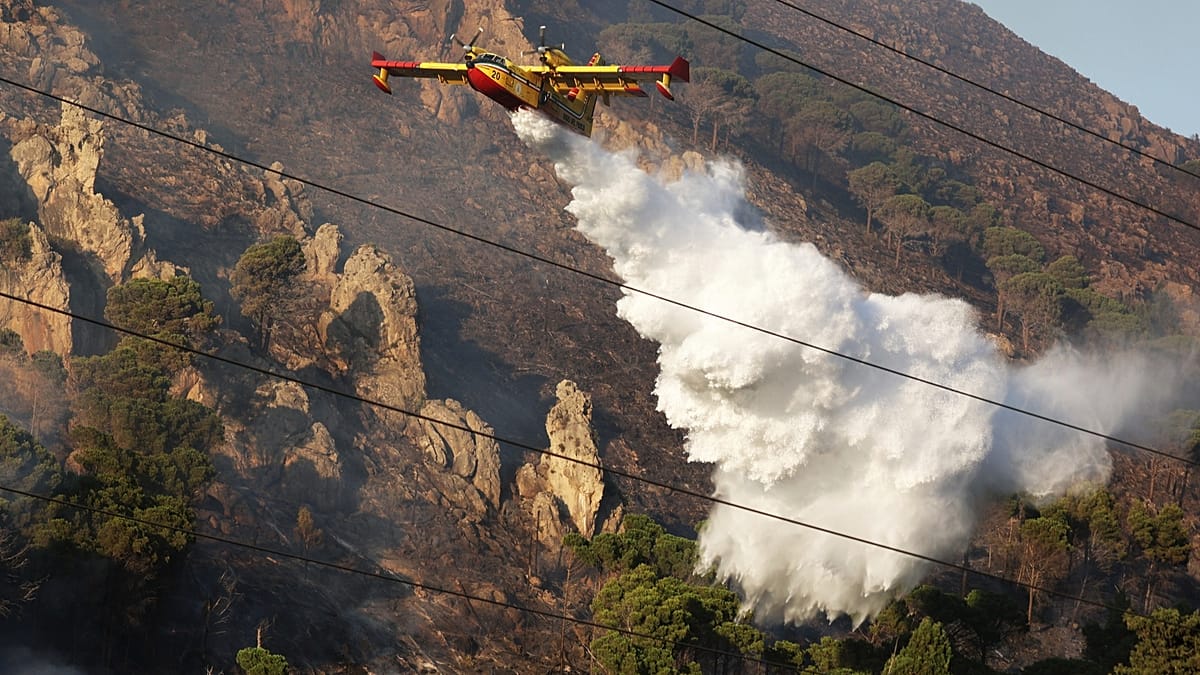
Italy's fleet of bright yellow and red Canadair water bombers has returned to a base outside Rome for several weeks of maintenance, closing out a summer in which the amphibious aircraft were deployed not only across Italy but also to Portugal and Spain under the European Union's shared firefighting arrangements.
The season was punishing by any measure. Western Europe recorded its hottest summer on record, and roughly 540,000 hectares burned across the EU between mid-June and early September, according to the European Forest Fire Information System (EFFIS). Italy alone lost 113,800 hectares across 645 fires — its fourth-largest fire season since 2006 — keeping the country's 18 water bombers in near-constant rotation.
Deployments abroad before fires at home
"At the start of the summer, we deployed to Portugal and Spain, where we faced two quite difficult situations," said Francesco Morgante, a pilot with Avincis, the company that operates the fleet on behalf of Italy's national fire service. Both countries saw blazes that threatened cities and tourist areas.
"After that, our own country required our full attention, particularly due to the emergency situation in northern Italy, which was quite unexpected and unusual this year," Morgante told AFP. Fires in Alpine and pre-Alpine areas are less common than in the Mediterranean south, making the northern outbreaks a particular strain on resources.
The Canadair CL-415, manufactured exclusively by Calgary-based De Havilland, is built for exactly this kind of rapid response. Two intakes beneath the fuselage allow it to scoop more than 6,000 litres of water in 12 seconds without landing, from a lake, reservoir or the sea, and to release the load in three seconds. Morgante described it as an ideal tool for medium-to-large fires, capable of containing a blaze even after it has fully developed.
A maintenance cycle that runs to March
In a vast, recently renovated hangar near Rome, engineers are now stripping down aircraft for deep inspections, including one with its twin turboprop engines exposed. Maurizio Tomassi, who heads maintenance operations at Avincis, said every aircraft in the fleet undergoes several weeks of checks, with the aim of completing the programme by March.
The closure of Italy's last operational base in Calabria on 31 October marked the formal end of the season. Like several other European countries, Italy is waiting for delivery of the next-generation DHC-515, which carries a price tag of around €100 million per aircraft.
No let-up in demand
For pilots, technicians and operations coordinators, the summer of 2026 will be remembered for its relentlessness. "We didn't get that moment when a summer storm rolls in, the temperature drops by three or four degrees, and you get a two-day break before things potentially pick up again," Morgante said. "That weather break simply didn't happen."
Alessandro Sette, who runs the operations room handling requests from Italy's Civil Protection agency, called it "an exceptional summer." Flights began at first light and typically continued until dusk. On a quiet late-September morning, however, the tracking screen showed almost no activity. "Practically all the planes are on the ground," he said.
The pressure on Europe's shared aerial firefighting capacity is unlikely to ease. Morgante noted a "slow, gradual increase in the need" for water bombers over the years, and argued that a fleet sized to meet demand at both national and EU level is now essential. With heatwaves intensifying and fire risk spreading northward — including into regions such as the Fontainebleau forest south of Paris — the question of how many aircraft Europe can call on is becoming a standing policy concern rather than a seasonal one.