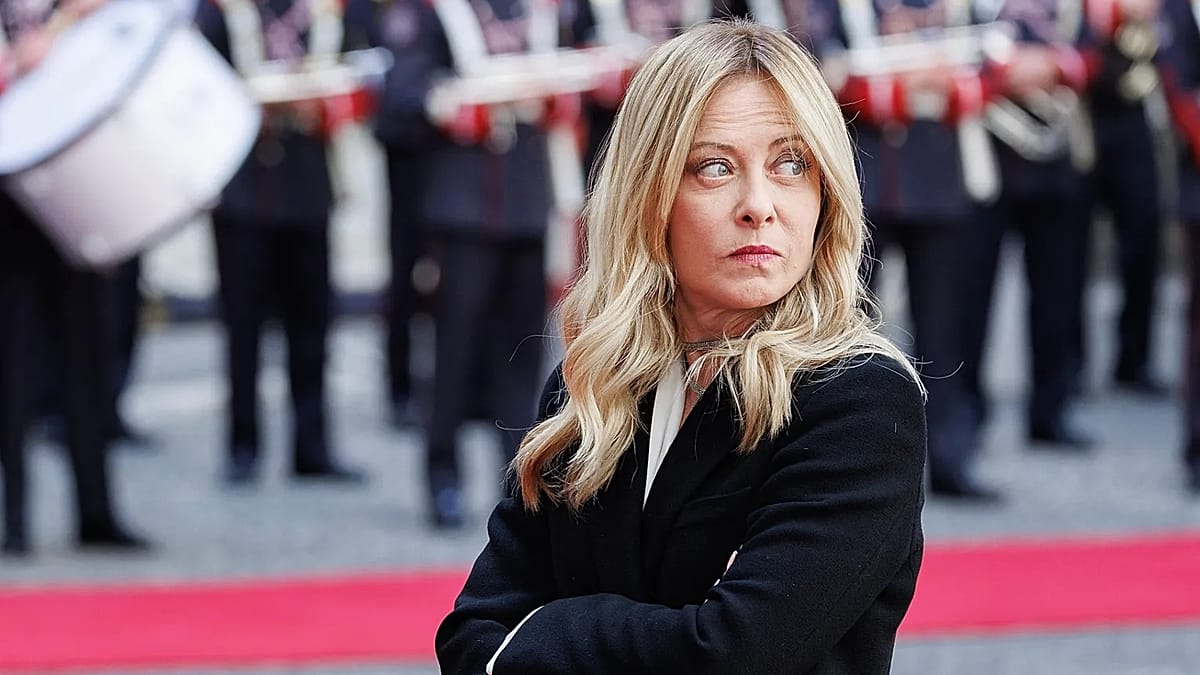
Italy has escalated its diplomatic response to Moscow after a Russian state television presenter launched a vitriolic personal attack on Prime Minister Giorgia Meloni. Foreign Minister Antonio Tajani confirmed on Tuesday that he had summoned the Russian ambassador, Alexey Paramonov, to the Ministry of Foreign Affairs in Rome to lodge a formal protest.
The remarks came from Vladimir Solovyov, a well-known host on Russian state television who often echoes Kremlin positions. According to Italian media reports, Solovyov first addressed Meloni in Italian, calling her a “disgrace to the human race,” a “wild beast,” a “certified idiot,” and a “nasty little woman.” Switching to Russian, he went further, labelling her a “fascist creature who betrayed her electors” and claiming she had “even betrayed (US President Donald) Trump.”
Tajani posted on X that the protest was over “the extremely serious and offensive remarks made by the TV host.” The move reflects a broader deterioration in bilateral relations, driven primarily by Meloni’s steadfast support for Ukraine in its defence against Russia’s full-scale invasion.
Cross-Party Condemnation in Rome
The insults drew swift and unified condemnation from across Italy’s political spectrum. Giuseppe Conte, leader of the opposition Five Star Movement, called the comments “unspeakable.” Mariastella Gelmini of the centrist Us Moderates (Noi Moderati) party described them as unacceptable. Elly Schlein, secretary of the centre-left Democratic Party, said: “A Russian TV presenter, a spokesman for the Kremlin position, made unacceptable sexist accusations against Giorgia Meloni. Once again, we would like to remind the Russian regime that those who insult the representatives of Italian institutions offend the entire country and we do not accept this.”
Barbara Floridia, president of the Rai supervisory commission, stressed that personal insults are not a legitimate instrument of political criticism and that Italy will not be intimidated by Russian propaganda. The unified front underscores how such attacks can rally domestic support even among political rivals.
The incident is the latest flashpoint in a relationship that has been tense since Meloni took office. Her government has been one of the most vocal European backers of Kyiv, supplying weapons and hosting Ukrainian President Volodymyr Zelenskyy in Rome. This stance has put Italy at odds with Moscow, which views Meloni as part of a hostile Western bloc. The broader context includes ongoing concerns about Russian disinformation campaigns across Europe, as highlighted by reports of AI-generated soldier deepfakes aimed at undermining Ukrainian morale.
Meanwhile, Meloni’s once-friendly relationship with US President Donald Trump has also soured. Last week, Trump launched a stinging criticism of Meloni in an interview with Italian daily Corriere della Sera, accusing her of lacking courage over her refusal to join the Iran war. “I’m shocked at her. I thought she had courage, but I was wrong,” Trump said. “She’s unacceptable because she doesn’t mind that Iran has a nuclear weapon and would blow up Italy in two minutes if they had the chance.”
The dual pressures from Moscow and Washington highlight the delicate balancing act facing Meloni as she navigates Italy’s foreign policy. The country remains one of the most exposed EU nations to fossil fuel shocks, a vulnerability that has prompted calls for a united European energy transition. At the same time, Rome must contend with the fallout from Russian propaganda efforts that target European leaders directly.
For now, the summoning of Ambassador Paramonov sends a clear signal: Italy will not tolerate personal attacks on its head of government, regardless of their source. Whether this diplomatic gesture will lead to any change in Moscow’s behaviour remains uncertain, but it underscores the growing friction between the Kremlin and one of Europe’s key NATO members.



