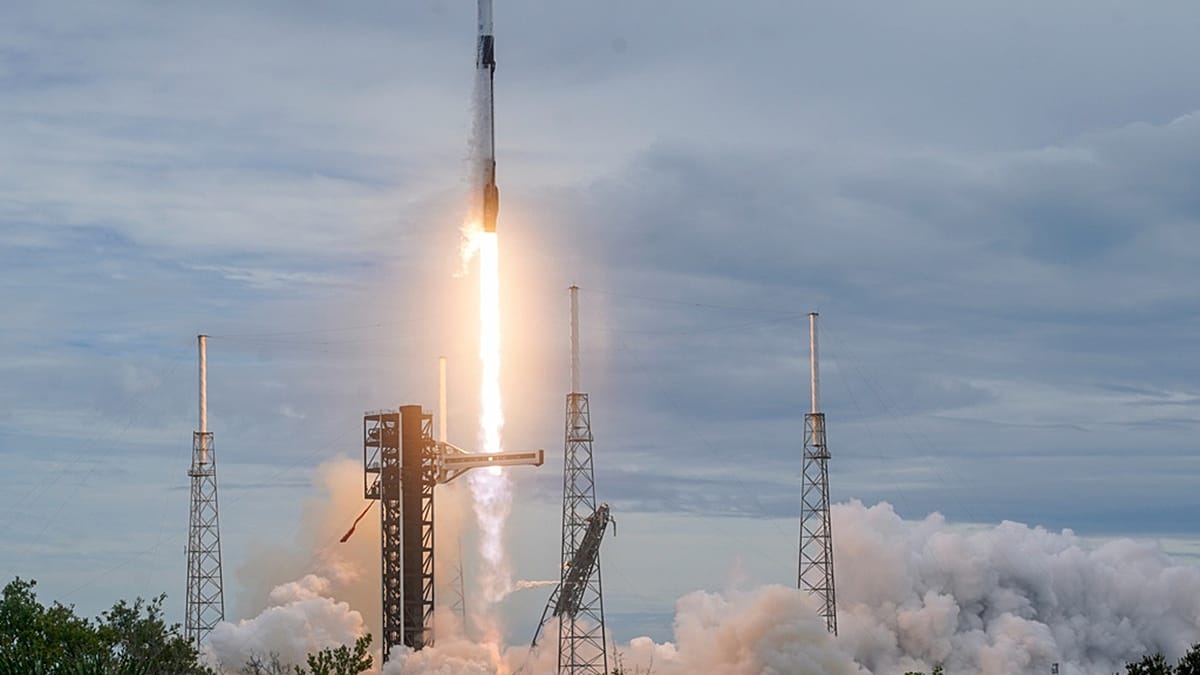
Japan's space agency JAXA has launched its flagship Martian Moons eXploration (MMX) mission, sending a spacecraft toward Phobos, the larger of Mars's two moons. The H3 rocket lifted off from the Tanegashima Space Center on Tuesday, marking a significant step in the country's deep-space ambitions and its growing partnership with European space institutions.
The probe is expected to reach the Martian system in 2026, where it will spend several months surveying Phobos and Deimos before attempting a daring touchdown on Phobos's surface. Using a pneumatic sampler, MMX aims to collect at least 10 grams of regolith — the loose dust and rock covering the moon — and return it to Earth by 2029. If successful, it would be the first sample return from a Martian moon.
Why Phobos matters
Phobos is a small, irregularly shaped body just 22 kilometres across, orbiting Mars at an unusually close distance. Scientists believe it may be a captured asteroid, or perhaps a fragment of Mars itself, blasted into orbit by an ancient impact. The samples could therefore reveal clues about the early Solar System, including the conditions that shaped the inner planets.
“Phobos is a time capsule,” said Dr. Hitoshi Kuninaka, a JAXA vice president, in a pre-launch briefing. “Its surface has been exposed to space for billions of years, and the material we bring back will help us understand not only the moon's history but also the processes that formed our planetary neighbourhood.”
The mission also carries a small rover developed jointly by JAXA, the German Aerospace Center (DLR), and the French space agency CNES. The rover will hop across Phobos's surface, taking close-up images and measuring the moon's thermal properties — a rare example of European-Japanese cooperation in planetary science.
European scientists are particularly interested in the mission's potential to shed light on the delivery of water and organic compounds to the early Earth. Some models suggest that moons like Phobos could have played a role in seeding our planet with the building blocks of life. The findings could also inform future crewed missions to Mars, as Phobos has been proposed as a staging post for human exploration.
The launch comes at a time when Europe is re-evaluating its own space strategy. The continent has faced setbacks with the Ariane 6 rocket and has relied on SpaceX for some launches, prompting calls for greater autonomy. Japan's success with the H3 — after a failed debut in 2023 — offers a counterpoint, showing how reliable access to space can be achieved through sustained investment and international collaboration.
“This mission is a reminder that space exploration is a global endeavour,” said Dr. Maria Zuber, a planetary scientist at MIT, who is not involved in the mission. “The data from Phobos will be shared across the international community, and that benefits everyone.”
The MMX probe is expected to arrive at Mars in 2026, and the sample return capsule is scheduled to land in Australia in 2029. Until then, scientists on both sides of the world will be watching closely, hoping that the little moon will yield big answers.