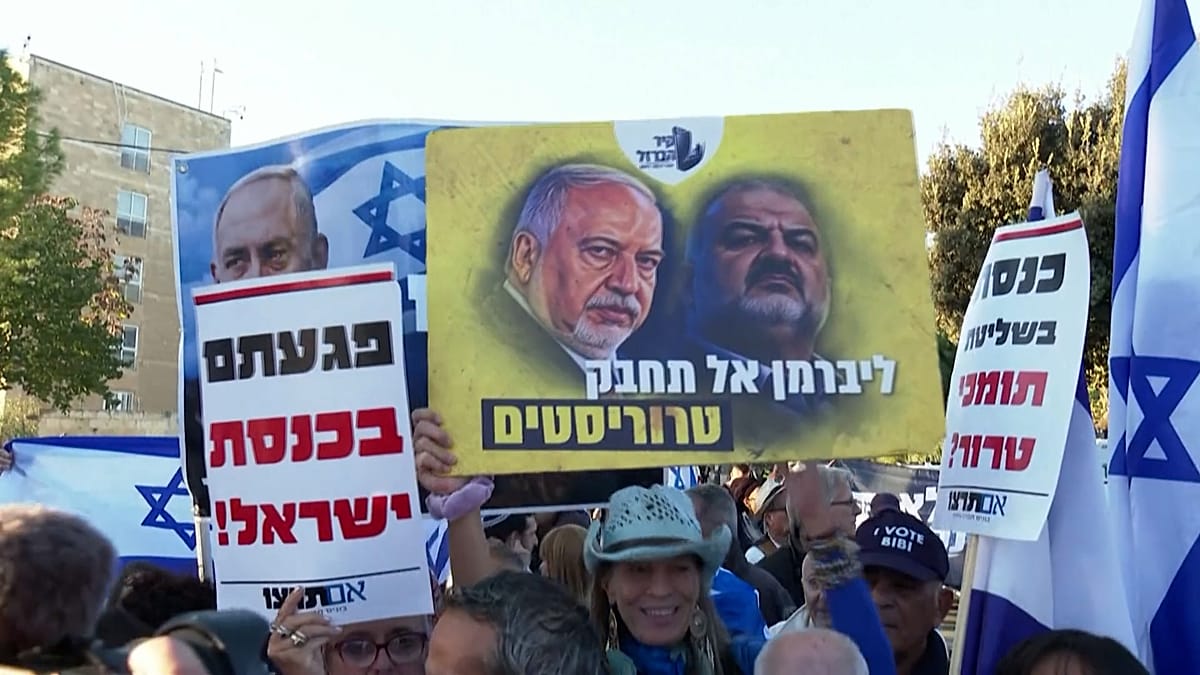
Thousands of demonstrators assembled outside the Knesset in Jerusalem on Tuesday, calling for fresh elections and expressing hostility toward the presence of Arab members of parliament. The rally, organized by right-wing groups, underscored the deepening polarization in Israeli politics as the country grapples with a prolonged governmental crisis.
Protesters waved Israeli flags and held signs reading "Elections Now" and "No to traitors in the Knesset," referring to the Joint List, an alliance of predominantly Arab parties. The demonstrators accused Arab lawmakers of undermining the state's Jewish character and of aligning with enemies of Israel.
The protest came amid a political stalemate that has seen four elections in two years, with no clear winner. The latest vote, held in March, left Prime Minister Benjamin Netanyahu's bloc short of a majority, while the opposition has struggled to form a coalition. Efforts to break the deadlock have so far failed, fueling public frustration.
Arab lawmakers under fire
Arab parties, which represent about 20% of Israel's population, have become a focal point of political debate. Their leaders have called for a two-state solution and have criticized government policies toward Palestinians. In recent weeks, they have also pushed for a no-confidence vote against Netanyahu, further inflaming tensions.
"They are not loyal citizens; they are a fifth column," said one protester, who identified himself as David from Tel Aviv. "We cannot allow them to dictate the future of this country."
Arab MKs, however, dismissed the protests as a distraction from the real issues. "The people are tired of corruption and failure," said Ayman Odeh, leader of the Joint List. "Instead of addressing the housing crisis and unemployment, the right is scapegoating us."
The rally also highlighted the growing influence of religious-nationalist groups, which have gained support in recent elections. Some demonstrators carried banners calling for the expulsion of Arab lawmakers, a demand that human rights groups have condemned as incitement.
European reactions
The events in Jerusalem have drawn attention across Europe, where governments are closely monitoring the stability of the region. The European Union has repeatedly called for a two-state solution and has expressed concern over the treatment of Arab citizens in Israel.
"We are watching the situation with concern," said a spokesperson for the EU's foreign policy arm. "The rights of all citizens, including minorities, must be respected."
In Brussels, some lawmakers have linked the Israeli crisis to broader regional dynamics. EU efforts to bolster its own strategic autonomy are partly motivated by the need to reduce dependence on volatile regions, including the Middle East.
The protests also come as tensions in the West Bank remain high, with Israeli military restrictions affecting Palestinian farmers. The olive harvest, a key economic activity, has been disrupted by settler violence and army checkpoints, drawing international criticism.
Political deadlock continues
Israel's political system remains in flux. Netanyahu, who is on trial for corruption charges, has failed to secure a majority in the Knesset. His main rival, Yair Lapid, has also struggled to form a coalition, despite winning the support of the Joint List from outside the government.
Analysts say the protests could further complicate coalition talks. "The right-wing base is energized, but that may not translate into a majority," said Dahlia Scheindlin, a political scientist. "The country is deeply divided, and the next election may not resolve anything."
Meanwhile, the demonstrators vowed to continue their campaign. "We will not rest until we have a government that represents the Jewish people," said another protester, holding a sign that read "The people demand a Jewish state."
The situation in Israel is being closely watched in European capitals, where there is concern that continued instability could have regional repercussions. Recent protests in Iran and other regional developments have added to the sense of uncertainty.
For now, the Knesset remains in session, but the path to a new government is unclear. The protests outside its walls are a stark reminder of the challenges facing Israeli democracy.