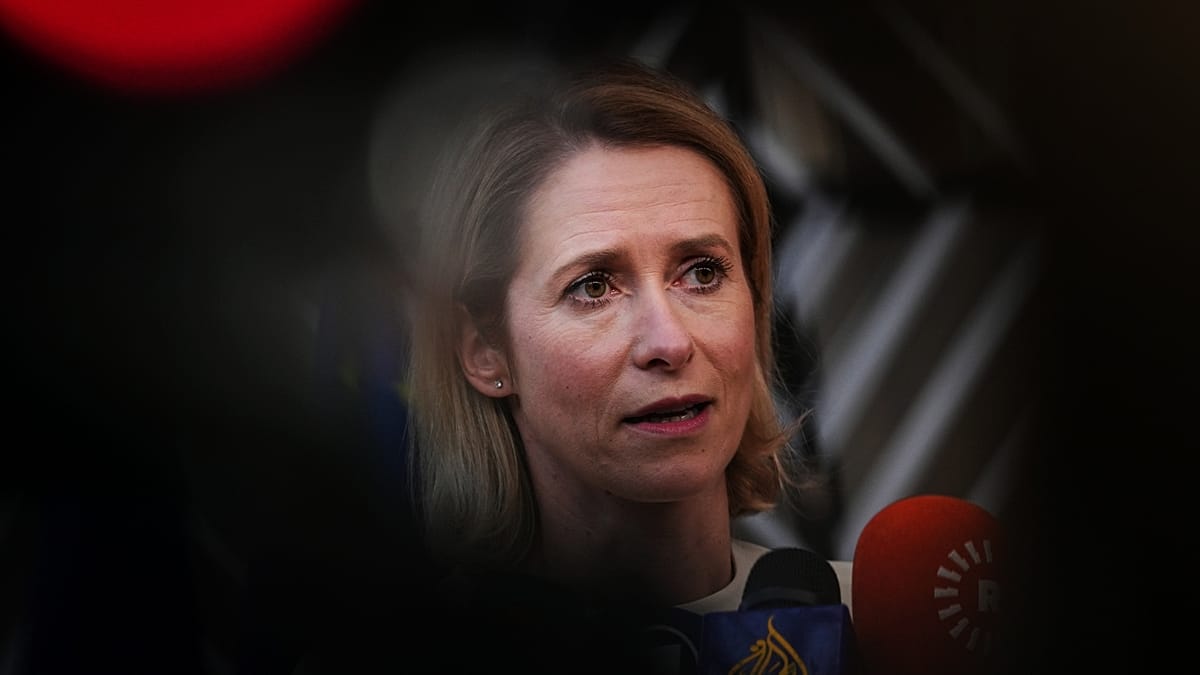
When Kaja Kallas took over as the European Union's foreign policy chief, she knew the job would come with setbacks. But the exclusion from last week's Dublin summit, where EU leaders assembled a seven-strong team to handle Ukraine peace negotiations, was a particularly sharp rebuke.
Kallas had flown to the Irish capital to argue that she should be the EU's special envoy for talks with Russia. Her pitch was simple: the EU's top jobs were divided in 2024 with the expectation that the foreign policy chief would lead on security matters. "In June 2024, there was a decision by the leaders on who is representing the EU when it comes to security and foreign policy," she said. "If the leaders want to change that agreement, of course, they may, but I think we should focus our energy on the substance."
Leaders were unmoved. According to people familiar with the closed-door discussions, Italian Prime Minister Giorgia Meloni argued that Kallas lacked the institutional weight for such a role and discouraged her candidacy. The final lineup included representatives from the European Council and the European Commission, but no one from the European External Action Service (EEAS), the institution Kallas oversees. Neither European Council President António Costa nor European Commission President Ursula von der Leyen spoke in her favour.
A role under threat
The snub has exposed a deeper contradiction. The EU's treaties task the High Representative with conducting the bloc's common foreign and security policy. Yet Kallas is now excluded from the most consequential diplomatic process Europe has faced since the Cold War. Some in Brussels see this as the natural consequence of her missteps—her off-script comments on China and Israel, and her habit of launching initiatives without consulting capitals. A defence expert group she proposed was cancelled at the last minute in September after pushback from Italy, France and others.
Germany has floated a reform that would place Kallas under von der Leyen's supervision, mirroring the hierarchy in national governments where a prime minister oversees a foreign minister. A senior diplomat noted that Kallas spent much of this year opposing direct talks with Russia, only to then pitch herself as the envoy to deal with Moscow. "If she actually talked to people and consulted with them, she would have known where the dynamics would lead to," the diplomat said. "Now, events have overtaken her."
Another diplomat was blunter, calling her intervention in Dublin "clumsy." Kallas had declared there that "Russians don't want me" as envoy. The diplomat argued that Kallas still operates like the Estonian prime minister she once was, forgetting that her current role is to coordinate the positions of foreign ministers. "Her job is to find the lowest common denominator among member states," the diplomat said.
Even her defenders admit the pitch was doomed. The war in Ukraine has become the defining issue of the European political agenda, touching defence, security, trade, energy, finance and enlargement. Leaders have taken personal ownership of the conflict, with French President Emmanuel Macron and UK Prime Minister Keir Starmer launching the Coalition of the Willing. This has inevitably eroded the influence of foreign ministers, who often find themselves haggling without making decisions.
The same pattern is visible in Washington, where US President Donald Trump has delegated Ukraine talks to his hand-picked envoys Steve Witkoff and Jared Kushner, rather than Secretary of State Marco Rubio. Kallas, whose title is equivalent to Rubio's, has suffered a similar fate.
Earlier this year, Kallas promoted a list of maximalist demands that Europeans should press Russia to fulfil as part of the negotiations. Although the document was confidential, she quoted it so often that its contents became widely known. That approach may have been principled, but it also made her a target for those who prefer a more pragmatic line.
The question now is what comes next. Some in Brussels believe Kallas can still recover if she recalibrates her style and builds alliances with national capitals. Others are less optimistic. As one diplomat put it: "On the merits she is not wrong. Nothing will come of these talks anyway. There's no way Russia will engage constructively." But the perception of her as isolated and out of step is hard to shake.
The broader debate about Europe's role in the peace process continues, with some arguing that substance matters more than titles. Yet for Kallas, the snub in Dublin has made her future in the role uncertain. Whether she can regain the trust of leaders who chose to sideline her remains to be seen.