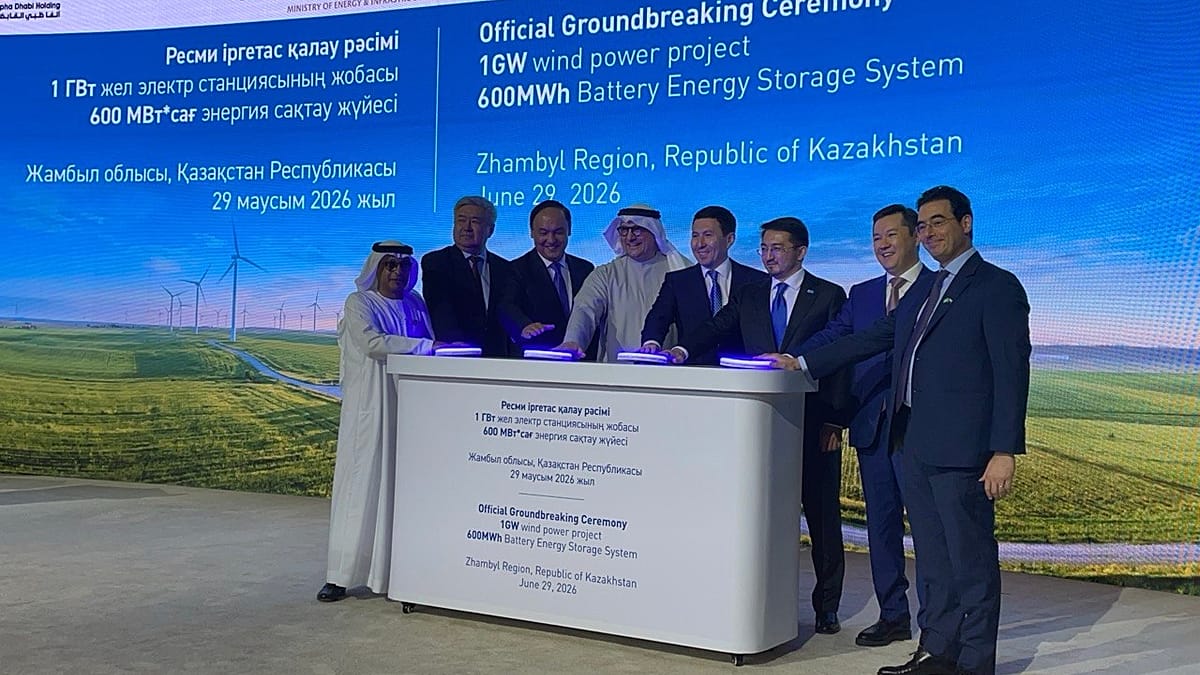
Kazakhstan and the United Arab Emirates have officially begun construction of a €1.2 billion wind farm in the Zhambyl region, one of the largest renewable energy projects in Central Asia. The 1 GW facility, led by Abu Dhabi-based Masdar, underscores Kazakhstan's accelerating push to diversify its energy mix and reduce carbon emissions.
The project integrates a battery energy storage system capable of delivering 300 MW of power and storing 600 MWh of electricity, making it one of the largest combined wind-and-storage installations in Eurasia. The initiative stems from intergovernmental agreements signed during the COP28 and COP29 climate conferences in 2023 and 2024, and aligns with Masdar's global target of building 100 GW of renewable capacity by 2030.
Strategic Investment in Kazakhstan's Energy Future
Kazakhstan's vast, wind-rich steppes, rising electricity demand, and supportive regulatory environment have made it an attractive destination for renewable energy investment, according to Abdulla Zayed, Executive Director of Business and Project Development at Masdar. "Kazakhstan has a lot of potential — abundant wind resources, the demand is there. This, coupled with the government's commitment to decarbonisation and a supportive regulatory environment, makes it an attractive market," he said.
Masdar expects the wind farm to operate for at least 30 years. The company is developing the project in partnership with W Solar, Qazaq Green Power (a subsidiary of the Samruk-Kazyna sovereign wealth fund), and the Kazakhstan Investment Development Fund.
Nurlan Zhakupov, Chairman of Samruk-Kazyna, highlighted the project's significance for Kazakhstan's investment climate. "The fact that companies like Masdar are investing in Kazakhstan reflects the country's mature investment climate and business environment. It also shows that Samruk-Kazyna is a trusted partner for international investors," he said.
Once operational, the wind farm is expected to supply electricity to nearly 300,000 households in Kazakhstan's energy-deficit southern regions, while avoiding approximately two million tonnes of CO₂ emissions annually. The electricity will be transmitted via more than 400 kilometres of new overhead transmission lines, helping to relieve pressure on the country's ageing north-south grid and improve supply reliability in the south.
Economic and Energy Security Benefits
Sultangali Kinzhakulov, Chairman of Kazakh Invest, emphasised the project's dual benefits. "Our priority is ensuring that every investment project delivers tangible results. The benefits of this project are clear: additional generating capacity for Kazakhstan's southern regions, clean energy for the country, investment in the economy, and a foundation for long-term sustainable development," he said.
The Zhambyl wind farm's 1 GW capacity is part of 6 GW of renewable energy projects currently being developed by Samruk-Kazyna. The sovereign wealth fund is also working to localise parts of the renewable energy supply chain, with plans to use equipment manufactured by a domestic producer through a joint venture with Sunny Renewables.
Kazakhstan's bet on wind power reflects a broader trend across Central Asia, where countries are seeking to reduce reliance on fossil fuels and attract foreign investment. The region's growing energy demands and abundant natural resources make it a key frontier for renewable energy development, with implications for European energy markets and climate goals. For more on Central Asia's investment landscape, see our coverage of the Tashkent Investment Forum, which closed with €37.6 billion in deals.
As Europe continues to grapple with energy security and decarbonisation, projects like the Zhambyl wind farm highlight the potential for cross-continental partnerships. The EU's own renewable energy targets and its engagement with Central Asia through initiatives such as the Global Gateway strategy underscore the interconnected nature of the global energy transition.