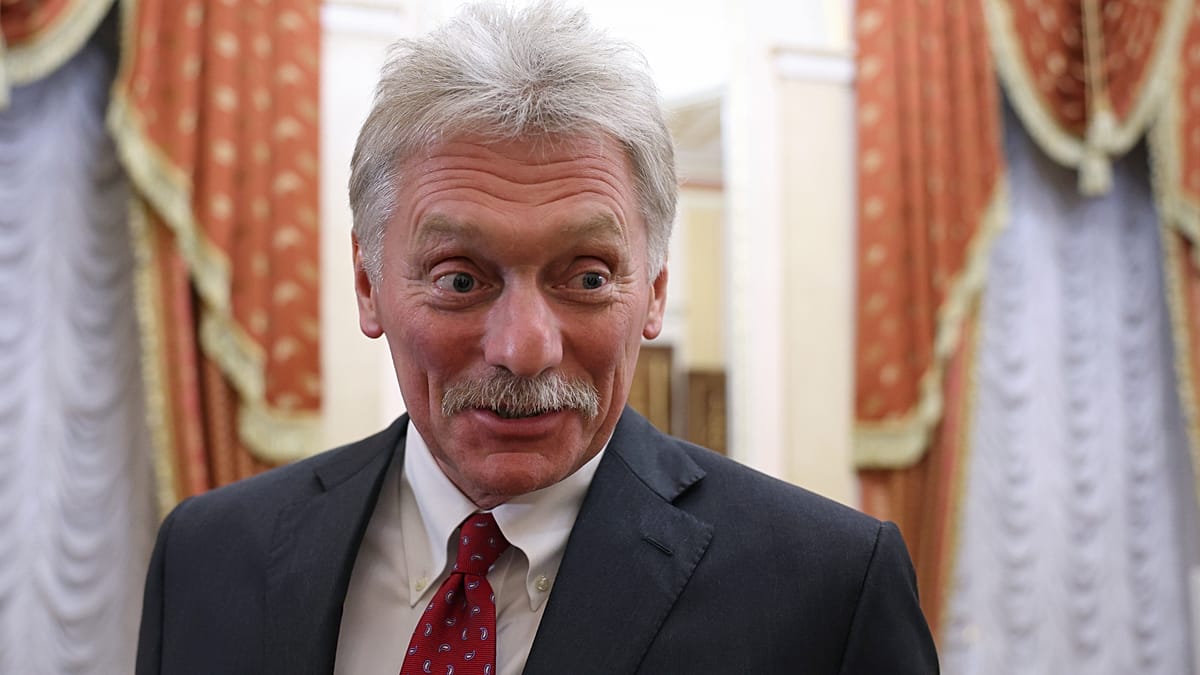
The Kremlin has brushed aside a rare public warning from France's far-right leaders Marine Le Pen and Jordan Bardella, insisting that Russia poses no threat to France or any other European country. Spokesperson Dmitry Peskov told reporters on Monday that Moscow had no disputes with European states and that President Vladimir Putin had repeatedly made this clear.
"Russia poses no threat. Russia does not threaten anyone, nor does it blackmail anyone," Peskov said, according to Russian media. His comments came after Le Pen and Bardella issued a joint statement on Saturday denouncing Moscow's actions as "an act hostile to the interests of France and Europe."
The statement followed a crisis meeting convened by French President Emmanuel Macron with party leaders, including Bardella, to discuss security threats posed by Russia. Macron later warned that Moscow's expanding shadow operations across Europe represented a growing danger and said he had ordered measures to protect France's critical infrastructure from hybrid attacks.
Le Pen and Bardella's warning
In their joint statement, Le Pen and Bardella declared: "We will never tolerate a foreign power, specifically Russia, attempting to dictate our country's policies through intimidation, threats, destabilisation, or psychological pressure, either directly or indirectly." They pointed to the recent drone attack at Leipzig/Halle Airport in Germany, which German authorities have blamed on Russia, and warned that France's economic interests and defence industry were also targeted.
The pair's condemnation marks a notable shift for the National Rally, which has historically maintained friendly ties with the Kremlin. Le Pen once expressed admiration for Putin, and the party took a €9.4 million loan from a Russian bank in 2014 after French banks refused financing. The party says it repaid the loan in full in September 2023.
Despite their tough rhetoric, Le Pen and Bardella stressed that questions around financial support for Ukraine remained "legitimate." Bardella recently sought to clarify comments by party vice-president Louis Aliot, who suggested "turning off the tap" on aid to Kyiv. Bardella argued that unconditional financial and military aid were not viable solutions, but insisted the party did not intend to abandon Ukraine.
Russia's election and European reactions
The Kremlin's dismissal came as Russian authorities announced that the pro-Putin United Russia party had secured a record supermajority in the State Duma, the lower house of parliament. Preliminary results gave the party 355 of 450 seats, following a tightly controlled election that excluded parties critical of the Kremlin and the war in Ukraine.
France's Ministry of Foreign Affairs acknowledged the expected outcome but regretted that the conditions for a free, pluralistic, and democratic election had not been met. The ministry also condemned Russia's recent seizure of assets belonging to French company Auchan and other foreign firms, calling it "unjustified placement under temporary administration of Russian subsidiaries."
The tensions come as European leaders grapple with Russia's increasingly assertive posture, from hybrid attacks to energy blackmail. The drone strikes on Moscow during the election period underscored the ongoing conflict, while EU discussions on new sanctions continue. Meanwhile, a UN report detailing systematic sexual violence by Russian forces has added to the urgency of European responses.
For now, the Kremlin's message remains unchanged: Russia is not a threat. But European leaders, including those who once courted Moscow, are increasingly wary of the Kremlin's intentions.