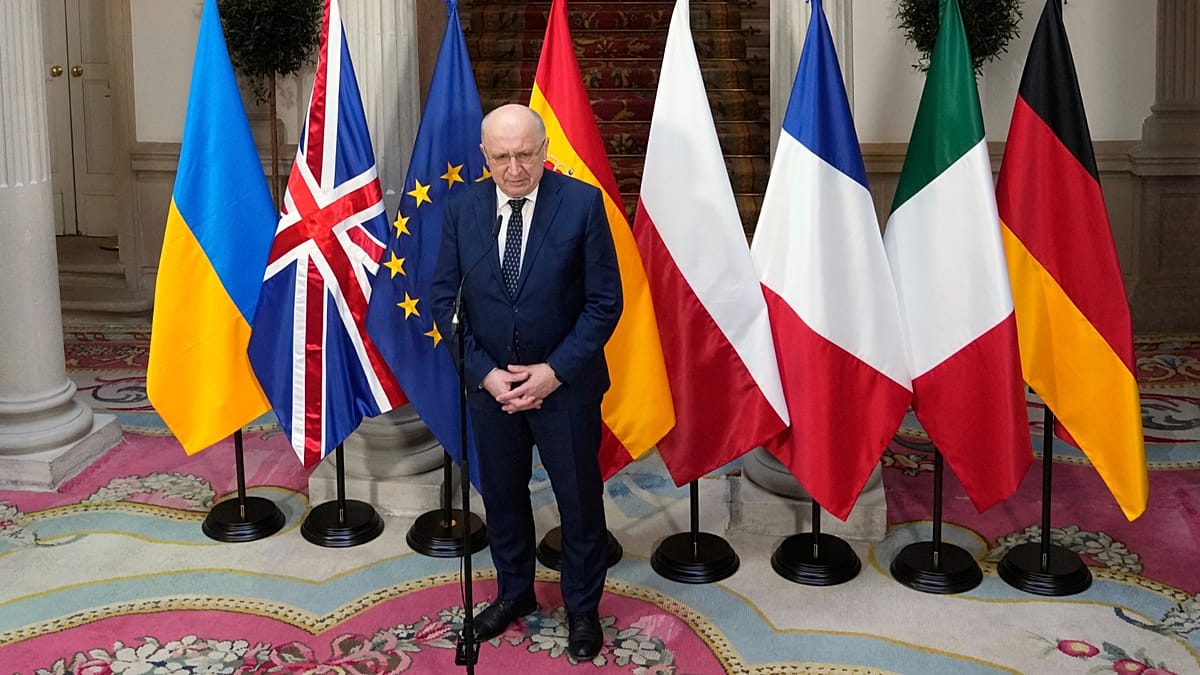
EU Defence Commissioner Andrius Kubilius is advancing a bold proposal for a treaty-backed European Defence Union that would extend beyond the bloc to include the United Kingdom, Norway, and Ukraine. Speaking in Poland on Wednesday, Kubilius argued that Europe must be prepared to defend itself independently of Washington, warning that “there is no time to waste.”
“It would be a big strategic mistake from our side not to seek such an integration,” Kubilius said. He noted that NATO membership for Ukraine remains out of reach for now, and full EU accession is a lengthy process that cannot guarantee rapid integration of defence capabilities. “Those are the reasons why the most effective instrument could be to look for some new instrument, which would concentrate specifically on the integration of all the European defence capabilities.”
The proposal comes as Commission President Ursula von der Leyen has pushed the EU to bolster its military posture, launching a €150 billion defence loan scheme and prioritising military mobility. These efforts are partly a response to US President Donald Trump’s repeated criticism of European defence spending and threats to withdraw from NATO. His Secretary of War Pete Hegseth last year accused Europe of “pathetic freeloading” on defence.
French President Emmanuel Macron, speaking in Greece last weekend, said Europe must recognise that Russia, Iran, and China are “dead against” the bloc, and that the US under Trump is also hostile. Trump’s “erratic” leadership style is one reason Europe should seriously consider Kubilius’ proposal, according to Guntram Wolff, a senior fellow at Bruegel, a Brussels-based think tank. Wolff told Euronews that a European Defence Union would allow allies to pool resources for expensive infrastructure projects like satellites without relying on the US. “Getting a coalition of the willing of these countries, I think, is quite realistic,” he said. “We are at a point where you have to really understand that the US is on its way out of Europe.”
Wolff noted that the concept has gained momentum among Brussels heavyweights since von der Leyen first suggested it in late 2024. Polling from Eurobarometer shows that more than two-thirds of Europeans (68%) believe their country is under threat, and one in five (20%) say more defence spending is needed. “European citizens think that we need to do more European defence and stop doing it just at the national level,” Wolff added.
Resistance and Reality Checks
Not everyone is convinced. EU foreign policy chief Kaja Kallas has previously resisted calls for a separate European army alongside national forces, arguing it would blur chains of command in a crisis. However, she acknowledged that some countries are too small to go it alone. “If we do it together, we can actually cover a bigger area,” she said, citing air defences and drones as examples.
Estonian MEP Riho Terras, a former commander of the Estonian Defence Forces, told Euronews the proposal is a “far-reaching philosophical discussion” that could create confusion in a conflict. “Who will give the orders? Who will be the chief of defence of Europe?” he asked. “This is not even close to reality.” Terras argued that what Europe needs is more money for its defence manufacturing sector, “not start to create something in addition to it.” He also questioned whether the idea has broad support among MEPs. “There are lots of dreamers here in this Parliament, but I cannot see a broad support to that idea,” he said.
Maria Martisiute, an analyst with the European Policy Centre, raised institutional questions. “If it is in the scope of the European Union... then it will probably be something of limited power, because I don't see how allies will delegate this political, military decision making to the institutions?” she told Euronews.
The debate over a European Defence Union comes amid broader discussions about Europe’s strategic autonomy. The EU has already activated its mutual defence clause, as noted in Kallas: EU Mutual Defence Clause Complements NATO Amid Trump Threats. Meanwhile, EU leaders recently gathered in Cyprus for crisis talks on energy, defence, and the Middle East, as reported in EU Leaders Gather in Cyprus for Crisis Talks on Energy, Defence, and Middle East. The economic fallout from global tensions is also being felt, with the Iran conflict pushing the eurozone into recession, as detailed in Iran Conflict Pushes Eurozone into Recession as PMI Data Signals Sharp Downturn.
As Kubilius pushes his vision, the question remains whether Europe can forge a unified defence identity without undermining existing structures like NATO or distracting from urgent needs. The coming months will test whether the political will matches the rhetorical ambition.