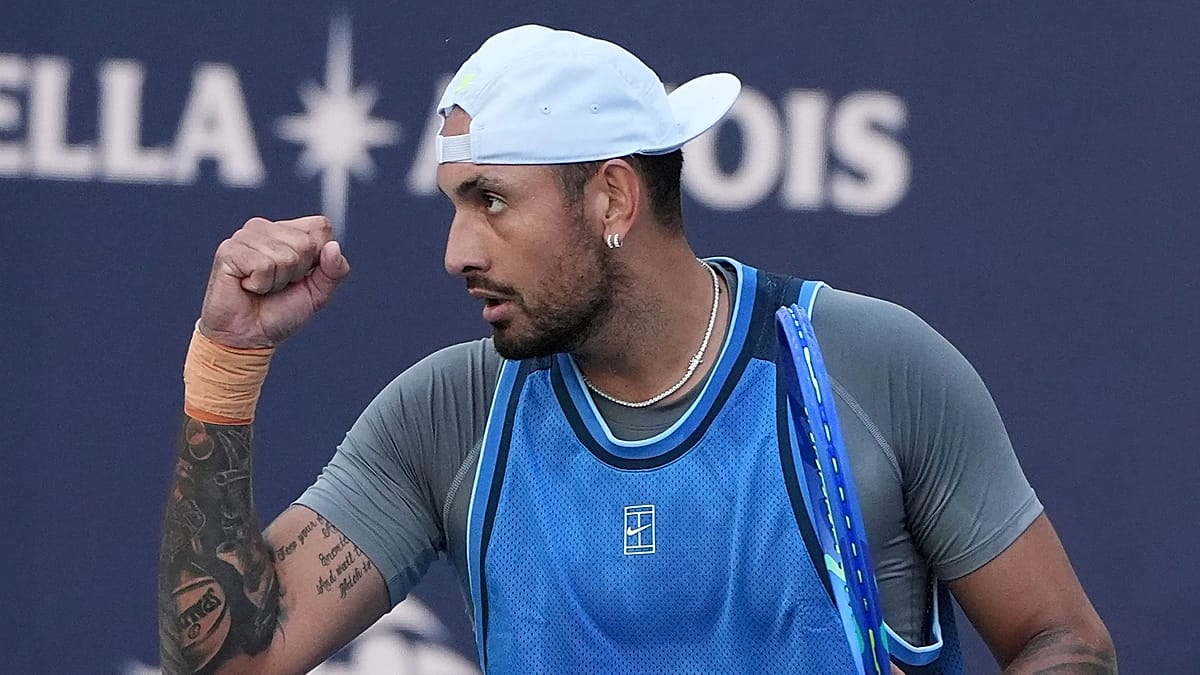
Australian tennis player Nick Kyrgios has accepted a one-month suspension and enrolled in a treatment programme after testing positive for cocaine at an ATP Tour event in Mallorca earlier this year. The 31-year-old, a former Wimbledon finalist, was provisionally suspended on 4 August, making him eligible to return to competition from Friday, provided he completes the programme.
The positive test occurred in June during the Mallorca Championships, where cocaine is classified as a stimulant on the World Anti-Doping Agency's prohibited list. Kyrgios later admitted to making a "huge mistake" and took "full responsibility" for his actions, citing the toll that recurring injuries have taken on his mental health in recent years.
"At times I've felt helpless and alone. None of that excuses what I did," he said in a statement.
In his account to investigators from the International Tennis Integrity Agency (ITIA), Kyrgios said he had used cocaine on a night out before a first-round match in Mallorca, which he lost in straight sets to fellow Australian Adam Walton. The ITIA consulted an independent scientific expert at a WADA-accredited laboratory, who concluded that the explanation was consistent with the level of cocaine found in his sample. As a result, the ITIA accepted that his use occurred outside of competition.
Reduced sanction for treatment
Under the rules, Kyrgios faced a default ban of three months, but that can be reduced to one month if the player commits to an ITIA-approved treatment programme. He will also forfeit his €6,570 prize money and the ranking points he earned from the Mallorca event.
The case highlights the ongoing challenges tennis authorities face in balancing strict anti-doping rules with support for players' mental health. Kyrgios has been open about his struggles with depression and anxiety, and his case has sparked debate about how the sport handles substance use linked to psychological distress.
Kyrgios, who reached a career-high ranking of world number 13, has not competed since October 2023 due to wrist and knee injuries. His return to the tour is expected to draw significant attention, both for his on-court talent and his off-court controversies.
The ITIA's decision to accept his explanation and reduce the ban reflects a growing recognition within sport that punitive measures alone may not address the root causes of such incidents. Similar cases in other sports have led to calls for more comprehensive mental health support for athletes.
For now, Kyrgios's focus will be on completing his treatment programme and preparing for a comeback. His next tournament remains unclear, but his eligibility from Friday opens the door for a return to the ATP circuit in the coming weeks.
This incident is not the first time Kyrgios has been in the spotlight for off-court behaviour, but it marks a significant moment in his career as he seeks to rebuild both his game and his reputation. The tennis world will be watching closely to see how he navigates this latest chapter.