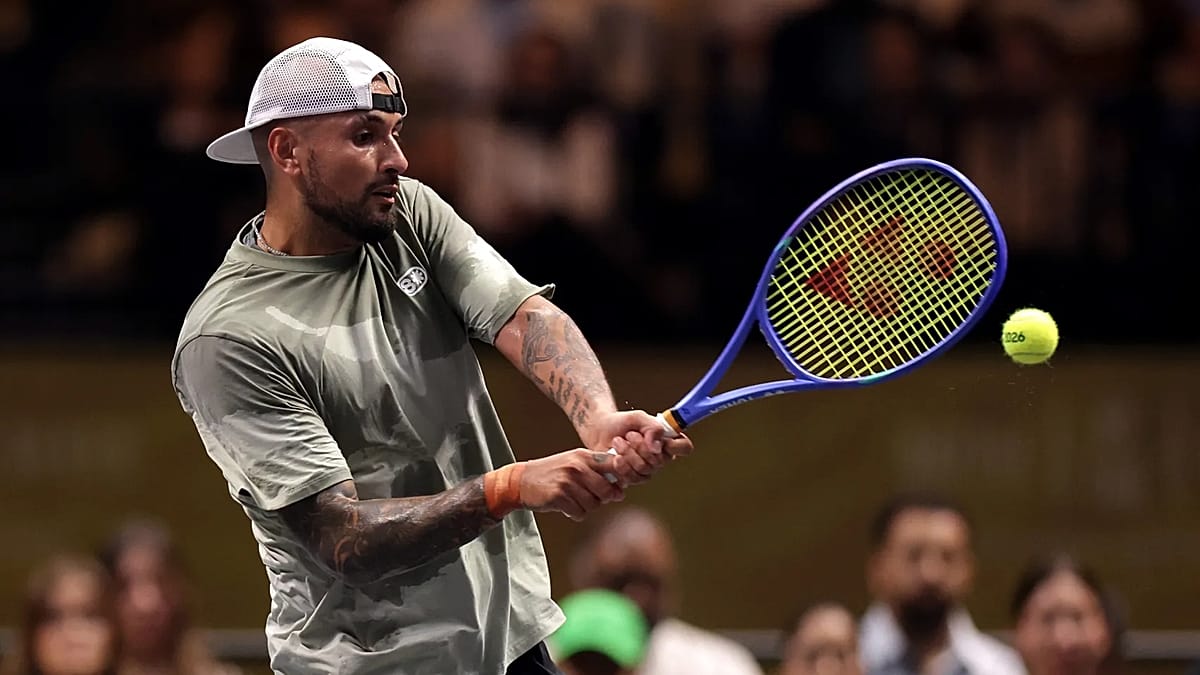
Nick Kyrgios, the Australian tennis player who reached the Wimbledon final in 2022, has revealed that he tested positive for cocaine and has been provisionally suspended from the sport. The 31-year-old made the announcement on social media on Wednesday, saying the sample was taken in Mallorca in June.
“I recently failed a drug test in Mallorca after testing positive for cocaine,” Kyrgios wrote, referring to a lower-tier tournament on the Spanish island. “I made a huge mistake and take full responsibility for it.”
Cocaine is prohibited as a doping substance during competition, though sanctions can be reduced if the substance was used outside of events. The International Tennis Integrity Agency (ITIA) confirmed that the sample was collected on 22 June and the positive result was confirmed on 17 July, after Kyrgios had competed at Wimbledon.
Kyrgios, who has been plagued by injuries over the past two years, said he struggled to accept that his career might be nearing its end. “At times I’ve felt helpless and alone. None of that excuses what I did,” he said.
The admission comes as a blow to a player who once electrified the sport with his raw talent and charisma. His run to the 2022 Wimbledon final, where he lost to Novak Djokovic, was a career highlight, but since then he has been sidelined by persistent physical problems. Currently ranked 919th in the world, he has played only a handful of matches in recent months.
At this year’s Wimbledon, Kyrgios received a wild card for the doubles draw, partnering Kazakhstan’s Alexander Bublik. The pair lost in the first round.
The case will be prosecuted by the ITIA, which oversees anti-doping in tennis. Under the World Anti-Doping Code, a positive test for cocaine during competition can lead to a ban of up to four years, though athletes who can prove the substance was taken out of competition and unrelated to performance enhancement may receive a reduced sanction.
Kyrgios’s situation echoes other high-profile cases in tennis, where players have faced suspensions for recreational drug use. The sport has strict rules, but the ITIA has shown flexibility in cases where the athlete demonstrates that the substance was not used to gain an advantage.
For European tennis fans, the news adds another layer of intrigue to a season already marked by controversy. The Mallorca tournament, a stop on the ATP Challenger Tour, is a regular fixture on the Spanish summer circuit, and the island has become a popular training base for players.
Kyrgios has not indicated whether he will appeal the provisional suspension. In his social media post, he expressed regret and a desire to move forward. “I know I have let people down, and I am sorry for that,” he wrote.
The ITIA has not yet set a date for a hearing. Meanwhile, the tennis world will watch closely to see how one of its most polarising figures navigates this latest setback.