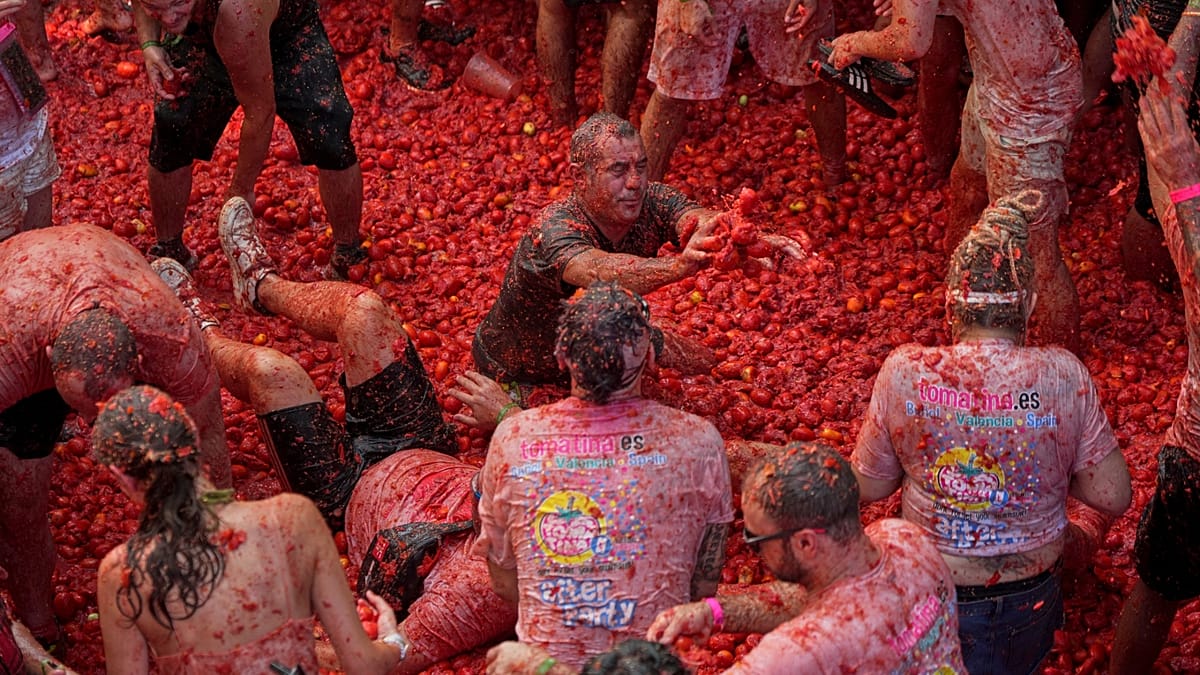
Thousands of participants turned the streets of Buñol, a small town near Valencia, into a sea of red on Wednesday as the annual La Tomatina festival reached its 2026 edition. Organisers said around 20,000 people took part in the hour-long battle, using more than 130 tonnes of ripe tomatoes supplied by local farms.
The event, which has been held on the last Wednesday of August since 1945, is one of Spain's most recognisable cultural spectacles. Participants from across Europe — including large contingents from Germany, France, Italy, and the United Kingdom — joined locals in the melee, which begins when a ham is hoisted atop a greased pole. Once someone manages to grab it, the trucks laden with tomatoes roll in and the fight begins.
A tradition with deep roots
La Tomatina's origins are often traced to a spontaneous brawl in 1945, when a group of young men started throwing tomatoes from a vegetable stall during a parade. The practice was initially banned by local authorities, but public demand led to its official recognition in 1959. Today, the festival is a major draw for international tourism, with many visitors planning their trips months in advance.
Buñol's mayor, María José García, told European Pulse that the event is vital for the town's economy. “La Tomatina is not just a party; it is a key driver for local businesses, hotels, and restaurants. We see visitors from all over the world, and many return year after year,” she said.
The festival also has a significant environmental impact. Organisers have implemented measures to reduce waste, including using only tomatoes that are too ripe for sale and collecting the pulp for use as compost. The town's streets are cleaned within hours, and the water used is recycled.
Safety and logistics
Participants are advised to follow strict rules: tomatoes must be squashed before throwing to avoid injury, and no other objects are allowed. Medical teams and volunteers are stationed throughout the route, and the event is fenced off to control the crowd. In recent years, organisers have limited the number of tickets to 20,000 to ensure safety and comfort.
The festival has also become a cultural export, with similar events in other countries, but Buñol remains the original and most authentic. For many Europeans, it is a chance to let loose in a uniquely Spanish way, as one German tourist put it: “It's chaotic, messy, and absolutely brilliant. You have to experience it at least once.”
As the sun dried the tomato-stained streets, participants headed to the river to wash off, and the town began its transformation back to normal. For Buñol, the 2026 edition was another resounding success, cementing its place on Europe's summer festival calendar.